

Is Your Nutrition Plan Adaptable? Why Rigid Diets Fail
Rigid diets are built for ideal conditions, and ideal conditions are rare in the life of a busy professional. If your nutrition strategy can't bend, it will break.

This image was created using AI to avoid copyright issues while conveying the context of this article.
You followed the plan perfectly for three weeks. Meal prep on Sunday, macros tracked, nothing off-script. Then a work trip hit. Or a dinner out with clients. Or you just had a week where everything went sideways. And instead of adjusting, the whole thing collapsed.
That's not a discipline problem. That's a design flaw.
Rigid diets are built for ideal conditions, and ideal conditions are rare in the life of a busy professional. What looks like a sustainable plan on paper becomes a liability the moment your schedule shifts, which it always does. If your nutrition strategy can't bend, it will break, and it will take your confidence with it when it goes.
Why Rigid Plans Feel Safe (But Aren't)
There's a reason people are drawn to strict protocols. Rules feel safe. When someone tells you to eat exactly this, in exactly this amount, at exactly these times, there's no guesswork. It feels like control.
But that sense of control is fragile. It only holds when your environment cooperates. The moment you're eating at an airport, attending a catered event, or dealing with a week of back-to-back meetings, the rules fall apart. And when the rules fall apart, most people don't adapt. They quit.
Research consistently shows that dietary flexibility is one of the strongest predictors of long-term adherence. It's not the strictest plans that produce lasting results; it's the ones people can actually stick to across the long, messy arc of real life.
The Real Problem with All-or-Nothing Thinking
Rigid plans breed an all-or-nothing mindset. If you ate the wrong thing, the day is blown. If you missed the window, the week is shot. You end up in a cycle of perfect weeks followed by total abandonment, and every restart feels harder than the last.
This pattern is especially common among high-performing professionals. You're used to executing at a high level. When a system breaks down, there's a strong pull to scrap it entirely and start over with something stricter. But nutrition doesn't work like a project plan. It's not something you execute once and move on from. It's a practice you return to every single day, under different circumstances, with different variables.
Flexibility isn't a compromise. It's a feature.
What an Adaptable Nutrition Plan Actually Looks Like
An adaptable plan isn't a loose plan. It's a plan built with decision rules, not rigid scripts.
Instead of "eat 40 grams of protein at 7am," an adaptable approach sounds like: "Prioritize protein at every meal, and if I'm eating out, I'll anchor my plate around a protein source and build from there." Instead of "no carbs after 6pm," it sounds like: "On high-activity days, I'll include more carbs. On lower-activity days, I'll pull back."
This kind of thinking keeps your core principles intact while giving you room to operate in the real world. You're not winging it. You're applying judgment within a framework you understand.
The building blocks of a flexible plan include: a solid grasp of your caloric range (not a single target number), a working knowledge of protein priorities, a few go-to meals you can execute anywhere, and a recovery strategy for days that go off-plan. That last piece matters more than most people realize. Knowing how to get back on track in 24 hours is more valuable than having a flawless week.
Travel, Restaurants, and the High-Variability Week
The true test of a nutrition plan isn't how it performs when you're home, rested, and in control of your kitchen. It's how it holds up during a three-day conference, a family visit, or a week where work pushes everything else to the margins.
Adaptable eaters have a few tools that rigid dieters don't. They know how to read a menu and make a reasonable call without spiraling. They understand that one or two less-than-perfect meals don't move the needle on their overall progress. They've built the habit of returning to their baseline quickly, without guilt and without a long recovery ramp.
The goal isn't perfection. The goal is consistency over time, and consistency requires flexibility.
Building the Habit of Adjusting, Not Abandoning
Adaptability is a skill. It gets better with practice. The more you make in-the-moment adjustments and see that the plan survives, the more confident you become in your ability to navigate real-world situations without losing progress.
Start by identifying your highest-variability scenarios: travel, social events, high-stress weeks. Then build a decision framework for each one. It doesn't need to be complicated. A few simple rules that keep your priorities in place are far more powerful than a detailed plan that falls apart under pressure.
Ask yourself: what does "good enough" look like in this situation? Because good enough, consistently applied, will outperform perfect, intermittently achieved, every time.
At Legacy Fitness, we help our clients build nutrition strategies that actually fit their lives, not the other way around. If your current plan only works when everything goes right, it's time to build something better.
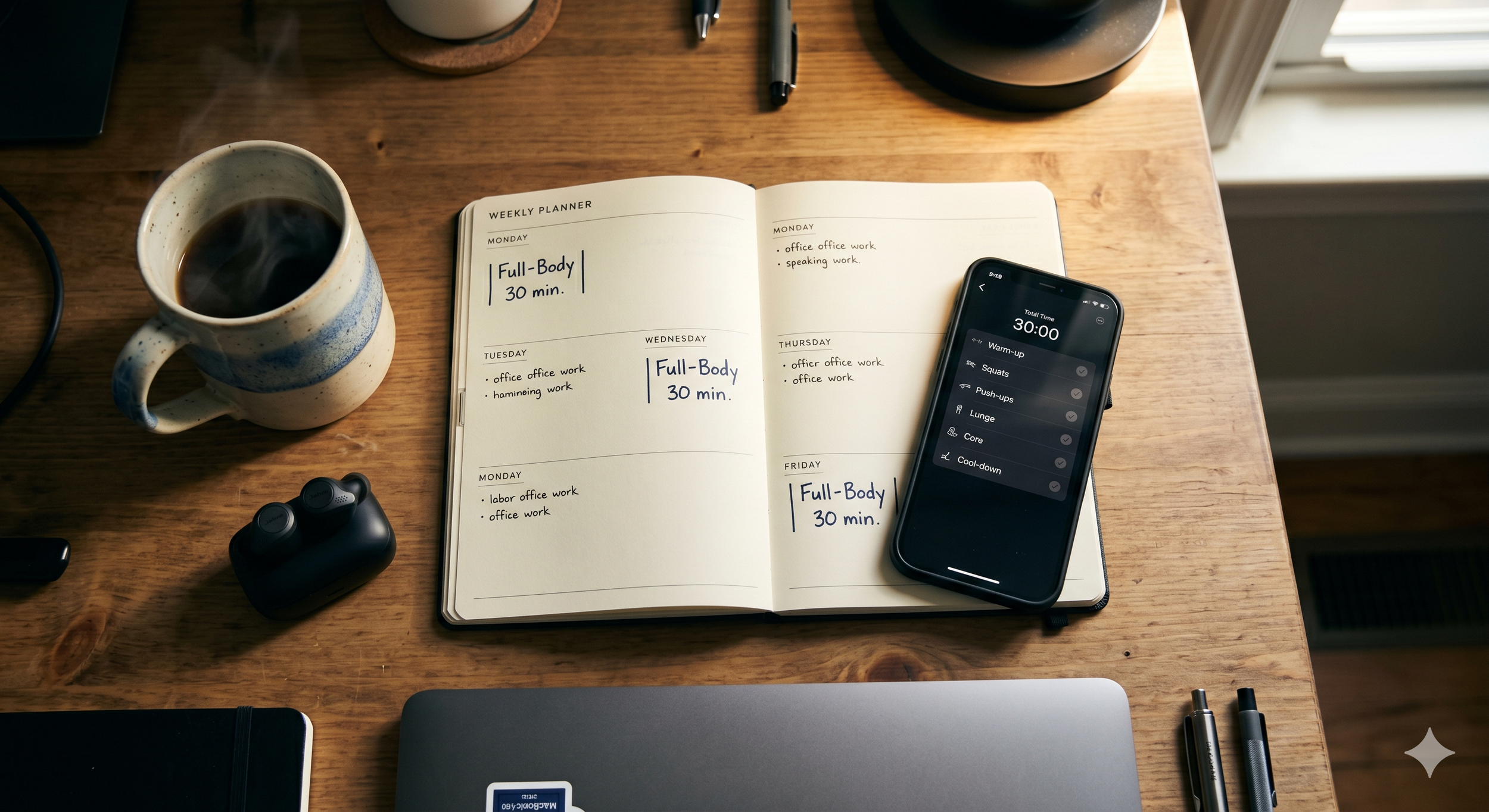
How to Build a 3-Day Personalized Fitness Plan in 2026
Three focused days. Five foundational movements.
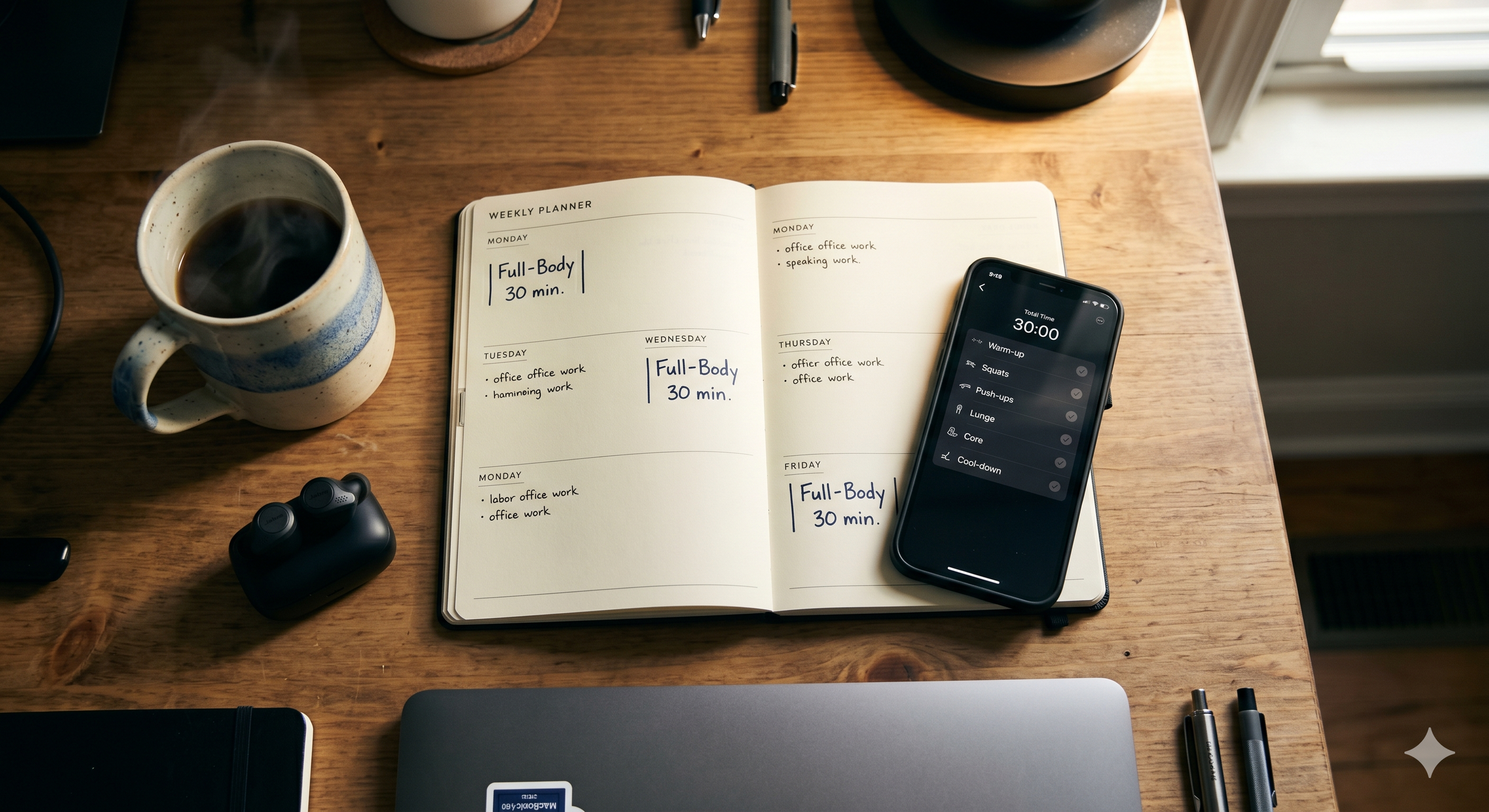
This image was created using AI to avoid copyright issues while conveying the context of this article.
Most busy professionals don't have a fitness problem. They have a scheduling problem.
When the calendar fills up with back-to-back meetings, last-minute travel, and the general unpredictability of running a business or leading a team, a five or six-day training schedule becomes the first casualty. You miss one session, then two, and before long the whole routine gets quietly shelved until "things calm down," which, as you know, they never really do.
Here's the reality: you don't need five days in the gym to build a lean, strong, capable body. You need three. A well-designed three-day training plan, built around your schedule and your movement patterns, will consistently outperform a five-day plan you can only follow half the time. Consistency wins every time — not the most ambitious schedule on paper.
Here is how to build one that actually works.
Start With Full-Body Sessions, Every Time
The old "body part split," chest on Monday, back on Tuesday, legs on Wednesday, was designed for people training five or six days a week. At three days, that model breaks down fast. Miss your Monday session and your chest doesn't get trained again for two weeks.
The fix is straightforward: every session should train your entire body. By hitting all your major muscle groups on Monday, Wednesday, and Friday, you create a consistent training signal across the whole week. If life pushes Friday's workout to Saturday, your progress stays intact. Nothing falls through the cracks because no single session carries the weight of the whole week.
Build Around the Five Foundational Movements
A common mistake when shortening a training plan is filling the time with isolated machine exercises, a bicep curl here, a leg extension there. These have their place, but they are not the foundation of an efficient plan. Your three-day structure should be built around the five movement patterns that develop real-world strength and protect your body over time:
Squatting: Builds lower body strength and protects your knees and hips. Goblet squats, split squats, and barbell squats all qualify.
Hinging: Deadlifts, Romanian deadlifts, and hip extensions that strengthen your glutes and lower back, critical for anyone spending long hours at a desk.
Pushing: Chest presses, shoulder presses, or push-up variations.
Pulling: Rows, pull-downs, and pull-ups that counteract the forward-rolled posture that comes with desk work and long flights.
Carrying or Core Stability: Farmer carries, planks, or any movement that forces your midsection to stabilize under load while you move.
One exercise from each category per session gives you a complete, athletic workout in under 30 minutes. There is no fluff, and nothing important gets left out.
Use the Superset Structure to Maximize Your Time
30 minutes sounds short until you realize how much time the average person wastes between sets, checking a phone, refilling a water bottle, watching someone else's set. The superset structure eliminates that dead time entirely.
Instead of resting between a set of chest presses and your next set of chest presses, you immediately move to a set of rows. Your chest recovers while your back works. Then you return to the press. You are doing the same volume of work in roughly half the time, and your heart rate stays elevated throughout, which adds a conditioning benefit on top of the strength work.
Pair your push and pull movements together. Pair your squat and hinge together. Finish with your core work. That structure alone can take a 60-minute workout and compress it cleanly into 25 to 30 minutes without sacrificing results.
Give Every Session an Alternate Version
This is the step most plans skip, and it is the reason most plans eventually fail.
Your Monday session calls for a barbell squat at your home gym or local facility. But you are flying out Sunday night and won't be back until Tuesday. If your plan doesn't have a backup, that session becomes a coin flip, you either improvise something, or you skip it.
Before your plan goes live, every workout should have a pre-built alternate version designed for a hotel room or a minimal gym. The goal for each movement stays identical. The execution adapts to what is available. A barbell squat becomes a heavy dumbbell goblet squat or a slow, controlled split squat using the hotel bed. A cable row becomes a resistance band row or a suitcase row. The substitution list should be built in advance, not invented under pressure at 6am in a Marriott.
The Real ROI of Three Days
There is a temptation to feel like three days isn't enough, that you should be doing more. That feeling is worth examining. More sessions create more opportunities to miss sessions, and every missed session erodes the psychological momentum that keeps a routine alive long-term.
A three-day plan that you execute consistently for 12 months will produce far better results than a five-day plan you follow for three weeks, abandon, restart, and abandon again. The compounding value of showing up, week after week, is the most underrated variable in fitness.
Three focused days. Five foundational movements. A backup plan already loaded. That is a system built to hold up under the real demands of a professional schedule, not just the idealized version of one.
At Legacy Fitness, we build three-day personalized training tracks around your specific movement history, schedule, and goals with alternate travel versions built in from day one. If you want a plan designed around your life, not against it, reach out here.

Mindset & Muscle: Why Your "Why" is Your Greatest Strength
One of the biggest mindset shifts you can make in your health management is changing your language.

This image was created using AI to avoid copyright issues while conveying the context of this article.
We spend a significant amount of time talking about the technical side of fitness. We discuss the perfect amount of protein for your body weight, the best way to lift a dumbbell to protect your joints, and how to manage your daily calorie budget. These things are the "how" of your transformation. They are the tools in your toolbox. However, the "how" will only get you so far. To achieve results that actually last for decades, you have to understand your "why."
Building muscle and changing your health is difficult work. There will be days when you are physically tired, days when the scale does not move despite your best efforts, and days when you would rather do anything other than train. In those moments, your physical strength is not what gets you through the workout; it is your mental strength. Your mindset is the foundation upon which all your physical results are built. Without a strong "why," even the best fitness system will eventually gather dust.
The Problem with Superficial Goals
Many people start a fitness journey with a goal that lives on the surface. They say things like, "I want to lose 20 pounds," or "I want to look better in a swimsuit for my summer vacation." While these are fine starting points, they are often too shallow to sustain you for the long haul. These goals are about an external result rather than an internal identity shift. They have a "finish line," and once you cross it, or if the finish line feels too far away, the motivation vanishes.
When your goal is just a number on a scale, it is very easy to give up when progress slows down. If your "why" is superficial, your commitment will be superficial too. To build lasting muscle and permanent health, you need a reason that taps into your core values and the person you want to become. You need a reason that feels important even on your worst day at the office.
Finding Your "Deep Why"
A "Deep Why" is a reason that connects to the life you want to lead and the legacy you want to leave behind. It is not about how you look to others; it is about how you show up for yourself and your family. When you find this reason, exercise stops being a chore and starts being a requirement for your success as a human being.
For some, the "why" is about being a more active parent or grandparent. They want to be the person who can run around the backyard or pick up a child without worrying about their back "going out." For others, it is about having the physical stamina to lead their company with more energy and focus. Perhaps it is about maintaining your independence as you age so you never have to rely on others for basic daily tasks. When your "why" is about being a more capable human being, a missed workout feels like a missed opportunity to grow, not just a missed chance to burn calories.
Muscle as a Metaphor for Resilience
The process of building muscle is a perfect lesson in mindset. To make a muscle grow, you have to put it under stress. You have to push it to the point where it is uncomfortable. The muscle then adapts and grows back stronger so it can handle that same stress more easily in the future. This is a biological law: growth requires resistance.
Your mindset works exactly the same way. Every time you choose to follow your health system when you are tired or busy, you are strengthening your "mental muscle." You are teaching your brain that you are the kind of person who keeps promises to themselves. This resilience is your greatest business and personal asset. It is what allows you to handle the high-pressure stresses of work and life without breaking. When you strengthen your body, you are also training your mind to handle the "heavy lifting" of life.
The Shift from "Have To" to "Get To"
One of the biggest mindset shifts you can make in your health management is changing your language. Most people approach fitness with a sense of obligation. They say, "I have to go to the gym," or "I have to eat this much protein today." This language makes health feel like a second job or a punishment for what you ate over the weekend. It creates friction in your mind.
Successful high-performers shift that language to "I get to." You get to move your body while many others cannot. You get to fuel yourself with high-quality nutrients that keep your brain sharp. You get to build a physical frame that will support your ambitions for the next 30 or 40 years. When you view your health management as a privilege and a strategic investment, the friction of staying consistent disappears. You aren't "dieting"; you are building a legacy of health that allows you to do everything else in life better.
Managing the "Internal Conversation"
We all have an internal voice that tries to talk us out of doing the hard things. On a rainy Tuesday morning, that voice will tell you that you’re too busy for your Micro-Workout or that one meal won't matter. Mindset management is about learning how to respond to that voice.
Instead of relying on a sudden burst of "motivation," which is notoriously unreliable, you rely on your identity. You tell yourself, "I am a person who prioritizes my vitality." When you make that shift, the conversation ends. You don't negotiate with yourself about whether or not to brush your teeth; you just do it because of who you are. Your fitness should eventually reach that same level of "non-negotiable" status.
The Partnership of Mind and Body
At Legacy Fitness, we know that a strong body is limited if the mind leading it is full of doubt or lacks direction. We don't just coach you on your reps, your sets, and your protein grams. We help you clarify your vision and audit your mindset. We want to help you find the reason that makes your health an essential part of your identity.
When your "why" is strong enough, the "how" becomes much easier to execute. By focusing on your mindset as much as your muscle, you ensure that your transformation isn't just a temporary phase or a "12-week challenge." It becomes a permanent change in who you are and how you live. You are training for the body you want to keep, but you are also building the mind that will make it possible.

Spring Cleaning Your Pantry: Out with the Processed, in with the Fuel
You don't win your fitness journey in the gym; you win it in the kitchen.

This image was created using AI to avoid copyright issues while conveying the context of this article.
As the flowers begin to bloom and the days get longer, "Spring Cleaning" is likely on your mind. You might be scrubbing the baseboards or organizing the garage, but there is one area of your house that has a much bigger impact on your legacy than a dusty shelf: your pantry.
Your environment dictates your behavior. If your pantry is filled with "highly palatable" processed snacks that are easy to grab when you’re stressed, you are forcing yourself to rely on willpower every single evening. And as we know, willpower is a finite resource.
In the final week of March, it’s time to audit your kitchen. Here is how to spring clean your pantry to ensure your home environment supports the version of you that we are building.
1. The "Logic vs. Impulse" Audit
Go through your pantry and look at every item. Ask yourself: "Does this food help me reach my goal, or is it a trap for my future self?"
If it’s a food that you consistently "lose control" with, like a specific type of chip or sugary cereal, it doesn't belong in the house. You aren't "wasting money" by throwing it away; you are protecting your health. If you don't want to toss it, donate unopened items to a local food bank.
2. Check the "Hidden" Ingredients
Processed foods are masters of disguise. Take a moment to read the labels of your condiments, dressings, and "healthy" bars. Look specifically for:
Added Sugars: Often hidden as high fructose corn syrup, maltodextrin, or dextrose.
Seed Oils: Highly processed oils that can contribute to systemic inflammation.
Artificial Fillers: If the ingredient list looks like a chemistry textbook, your body probably doesn't know how to use it as fuel.
3. Restock with "First-Line" Fuel
Once you’ve cleared the clutter, restock your shelves with items that make hitting your goals easy. Your "new" pantry should include:
High-Quality Proteins: Canned tuna, wild-caught sardines, or high-quality jerky for quick snacks.
Complex Carbs: Quinoa, oats, and legumes.
Healthy Fats: Raw nuts, seeds, and high-quality olive oil.
4. The "Eye-Level" Strategy
The "out of sight, out of mind" rule is real. Put your most supportive foods, like your protein powder and healthy staples, at eye level. Hide the "treats" (the ones you decided to keep for the kids or spouse) in an opaque bin on the highest shelf. If you have to work to find it, you’re much less likely to eat it mindlessly.
The Kitchen is Your Training Ground
You don't win your fitness journey in the gym; you win it in the kitchen. By cleaning out the "junk" and restocking with fuel, you are making the right choice the easy choice.
This week, take 30 minutes to open your cabinets and be honest about what’s inside. Let’s finish March with an environment that reflects your commitment to your legacy.

The Bridge from February: How to Turn Last Month’s "Tries" into This Month’s "Musts"
We made it to March. For many people, this is the month where the "New Year" excitement finally starts to fade.

We made it to March. For many people, this is the month where the "New Year" excitement finally starts to fade. In January, everyone is motivated. In February, most people try their best to keep up. But March is often where the wheels fall off. The weather might still be cold, the initial "spark" is gone, and life starts to get in the way.
However, at Legacy Fitness, we look at March differently. March is not the end of a resolution; it is the "bridge" month. It is the time when we move from "trying" to "doing." It is the month where we take the habits we practiced in February and turn them into non-negotiable parts of who we are.
If you want to make sure your progress doesn’t stall, you need to change your mindset. You have to stop treating your fitness like a temporary project and start treating it like a professional commitment.
The Problem with "Trying"
Think about the language we use. When we say, "I’m trying to get to the gym," we are giving ourselves an out. We are saying that if something else comes up, it is okay to skip. "Trying" is based on how we feel in the moment.
"Musts," on the other hand, are based on your identity. You don’t "try" to brush your teeth in the morning; you just do it because that is who you are. You don't "try" to show up for your job; you go because it is a requirement. To see real, lasting change in your body and your energy levels, your fitness habits need to move into that "must" category.
Building the Bridge: Three Steps to Consistency
How do we actually make that jump? It comes down to three specific strategies to bridge the gap between February and the rest of your year.
Review Your February Wins (And Your Misses)
You cannot improve what you do not measure. Take a look back at your logs from last month. Which workouts did you enjoy the most? Which days were the hardest to stay on track?
Don't judge yourself for the days you missed. Instead, look at them like a scientist. If you missed every Tuesday workout, maybe Tuesday isn't the right day for the gym. If you ate great until 3:00 PM and then crashed, maybe your lunch wasn't big enough. Use that data to build a better plan for March.The "Non-Negotiable" List
In March, I want you to pick three things that are "musts." These should be simple enough that you can do them even on your worst day. For example:
► I will hit my protein goal every single day.
► I will walk for 20 minutes, no matter what.
► I will log every meal in my tracker.
When these become "musts," you stop debating with yourself. You don't ask, "Should I log this?" You just do it because it’s on the list.Focus on the "Next Best Decision"
A lot of people quit in March because they have one "bad" day and feel like they ruined everything. They think the bridge is broken.
The bridge isn't broken; you just took a step back. Your only job is to make the "next best decision." If you ate a doughnut at the office, the next best decision is a high-protein lunch, not giving up on the whole day. Discipline is simply the act of stacking good decisions on top of each other, one at a time.
Why March Matters for Your Future Self
The habits you solidify this month are the ones that will carry you into the summer and beyond. If you can stay disciplined when the "newness" has worn off, you are building a version of yourself that is resilient and strong.
You aren't just working for the body you want in April; you are building the health you need for the next twenty years. Let’s stop "trying" to be fit and start being the person who never misses a "must."

The Art of the Sunday Meal Prep (Without the Stress)
Stop trying to be a gourmet chef every night. Meal prep isn't about being perfect; it’s about being prepared.

We have all seen the photos on social media: thirty identical plastic containers filled with chicken, broccoli, and brown rice, perfectly lined up on a kitchen counter. For many people, this version of "meal prep" looks like a nightmare. It looks like a whole Sunday spent in a hot kitchen and a whole week of eating boring, repetitive food. If that is what you think meal prep has to be, it is no wonder you haven’t started yet.
The truth is that meal prep is the single most powerful tool for fitness success, but it doesn't have to be stressful. In 2026, the trend is moving away from "The Batch Cook" and toward "The Component Prep." This method allows you to save hours of time during the week while still enjoying fresh, varied meals every single day. To build a legacy of health, you need a system that works for your busy life, not a second job as a chef.
Why Decision Fatigue is Your Enemy
The reason most people fail their diet on a Wednesday evening is "Decision Fatigue." Throughout the day, you use your brain to make hundreds of choices at work and with your family. By the time you get home at 6:00 PM, your "decision muscle" is exhausted. If you have to ask yourself, "What should I make for dinner?" you are much more likely to choose the easy path: takeout or a bowl of cereal.
Meal prep solves this by making the decision for you when your brain is still fresh. When the food is already partially ready, the "friction" of eating healthy disappears. You aren't "cooking dinner"; you are just "assembling" it.
The Component Method: How it Works
Instead of making full meals, you spend 60 to 90 minutes on Sunday preparing the building blocks of your week. Think of it like a "Lego set" for your nutrition. You want to prepare four main categories:
Two Proteins: Roast a large tray of chicken thighs and brown two pounds of lean ground beef or turkey. These are your "anchors" for the week.
Two Carbs: Boil a large pot of quinoa or roast a few pans of sweet potatoes. Having these ready prevents you from reaching for bread or pasta when you’re in a rush.
The "Veggie Wash": Chop your peppers, wash your spinach, and roast some broccoli. If the vegetables are ready to eat, you will actually eat them.
The "Flavor Booster": This is the secret to not getting bored. Make one or two simple sauces, like a lemon-tahini dressing or a fresh salsa. Using different sauces makes the same chicken and rice feel like a completely different meal every night.
The "Power Hour" Workflow
You don't need all day. You just need one focused hour. Start by putting your longest-cooking items in the oven (like potatoes). While those roast, start your grains on the stove. While the stove is humming, chop your vegetables. By the time the timer goes off for the potatoes, your kitchen is cleaned, and your fridge is stocked.
Winning the Week
This January, stop trying to be a gourmet chef every night. Give yourself the gift of a stocked fridge. When you remove the stress of "What's for dinner?" you gain back your time and your health. Meal prep isn't about being perfect; it’s about being prepared. Your future self on a tired Wednesday night will thank you.

Mastering the 'Pantry Audit'
Your environment should reflect the person you are becoming, not the person you used to be. A clean pantry leads to a clean plate and a clear mind.

Photo by Annie Spratt on Unsplash
Willpower is a finite resource. It’s like a phone battery; it starts full in the morning, but as you make decisions throughout the day, it drains. By 8:00 PM, after a long day of work and stress, your "willpower battery" is at 5%. If you open your pantry and the first thing you see is a bag of cookies, you are probably going to eat them.
The secret to a successful fitness legacy isn't having more willpower than everyone else. It is about designing an environment where you don't need willpower. This is why we perform a Pantry Audit.
The "Visibility" Rule
Humans are visual creatures. We eat what we see. If your healthy foods, like nuts, seeds, and whole grains, are hidden in the back, and the processed snacks are at eye level, you are fighting a losing battle.
During your audit, move your "Legacy Foods" to the front. Put your fruit bowl on the counter. Hide the "indulgence" foods in a high cabinet or a drawer that is hard to reach. If you have to work for it, you are less likely to do it mindlessly.
Decoding the Label
A pantry audit is also about education. Take five minutes to look at the ingredients of your favorite snacks. Look for the "Big Three" disruptors:
Added Sugars: Often hidden under names like "high fructose corn syrup" or "maltodextrin."
Seed Oils: Highly processed oils (like soybean or canola) can increase inflammation.
Ultra-Processed Grains: Flour that has been stripped of all its fiber.
If a food has more than five ingredients and you can't pronounce half of them, it might be time to find a "Legacy Swap." For example, swap crackers for air-potted popcorn or swap sugary granola for raw walnuts.
Set Your Environment for Success
Don't think of this as "throwing away money" if you toss out junk food. Think of it as "investing in your health." If the food isn't in your house, you can't eat it at 9:00 PM when your battery is low.
This January, take 30 minutes to clean out the clutter. Your environment should reflect the person you are becoming, not the person you used to be. A clean pantry leads to a clean plate and a clear mind.

The Identity Shift: Why This Year is Different
This year, don't just set a resolution. When you trust yourself to show up, your identity changes. When your identity changes, your life changes.

Image courtesy of Alex Avalos via Unsplash
Every January, millions of people make the same mistake. They set a goal to "lose weight" or "go to the gym five times a week." These are good goals, but they are missing the most important piece of the puzzle. They focus on what you want to do, rather than who you want to be.
This is what experts call an "Identity Shift." If you want your fitness results to last longer than a few weeks, you have to change how you see yourself. Most people see themselves as someone who is "trying" to be healthy. When life gets busy or they have a bad day, they go back to their old self. This year, we are going to change the operating system of your life.
What is an Identity Shift?
Think about two people who are offered a cigarette. The first person says, "No thanks, I’m trying to quit." The second person says, "No thanks, I’m not a smoker."
Do you see the difference? The first person still believes they are a smoker who is trying to change. The second person has changed their identity. Being a non-smoker is now part of who they are. In 2026, we want you to stop being someone who is "trying to get fit" and start being someone who "values their health."
Why Habits Snap Back
Your brain loves patterns. It wants to keep you doing what you have always done because it is safe and easy. This is why you might start strong in January but find yourself back on the couch by February. Your habits are snapping back to match the identity you believe is true.
If you believe "I am just not a morning person," it won't matter how many alarms you set. You will eventually hit snooze. To make a change stick, you have to prove to yourself that your new identity is real. You do this with small wins.
How to Build Your New Identity
You don't change your identity by thinking about it. You change it through your actions. Every time you choose a healthy snack, you are casting a vote for the person you want to become. Every time you put on your walking shoes, you are reinforcing the idea that you are an active person.
Here is how to start your shift this January:
Pick a Word: Choose one word that describes who you want to be. It could be "Athlete," "Resilient," or "Consistent."
Lower the Stakes: Don't try to be perfect. If your goal is to be a "Runner," and you only have ten minutes, go run for ten minutes. A runner is someone who runs, even if it is just a little bit.
Audit Your Language: Stop saying "I'm lazy" or "I have no willpower." Start saying "I am learning to prioritize my energy" or "I am someone who follows through on my promises."
The Power of the Identity Bridge
An identity bridge is a small behavior that connects your old self to your new self. It should be so easy that you can't fail. If you want to be someone who eats well, your bridge might be "drinking one full glass of water before my morning coffee."
These small acts are not just about the water or the walk. They are about building trust with yourself. When you trust yourself to show up, your identity changes. When your identity changes, your life changes. This year, don't just set a resolution. Build a legacy by becoming the person who makes those results happen naturally.

Happy New Year! Start with a Single, Perfect Push-Up (The Power of 1)
Happy New Year! Today, you do not need to do two hours of exercise. You do not need to cut every single thing you love. You simply need to execute The Power of 1.

Image courtesy of Soumitra Sengupta via Unsplash
Happy New Year! The calendar flips to to January 1st tomorrow. The pressure is on, the gyms will be packed, and the enthusiasm for change is high.
Many people feel they must launch their new routine with a massive, punishing two-hour workout, an immediate, drastic diet overhaul, or an aggressive five-mile run. They believe the sheer size of the effort must match the size of the goal.
At Legacy Fitness & Nutrition, we encourage the opposite approach for the single most important day of the year: Start with a single, perfect action.
Today, you do not need to do two hours of exercise. You do not need to cut every single thing you love. You simply need to execute The Power of 1. That first small, perfect action is the signal that you are committed, in control, and ready for a consistent year.
The Power of 1: Momentum Beats Effort
The goal of January 1st is not to prove how strong you are; it is to prove how consistent you can be. Consistency is the true currency of a lasting health legacy.
The first action of the year should be so easy that you cannot logically skip it.
1. The Single, Perfect Push-Up
The push-up is a great, foundational functional movement. It is a full-body exercise that requires core stability, arm strength, and chest engagement.
The Action: Perform one perfect push-up. If you cannot do a floor push-up yet, do one perfect push-up against a wall or an elevated surface (like a kitchen counter).
The Goal: The goal is not exhaustion; the goal is perfection and completion. You are not trying to build muscle in that one rep; you are sending a powerful signal to your brain: "The year has started, and the workout is done." This creates immediate momentum.
2. The Single, Perfect Meal
Do not use January 1st for extreme fasting or cutting. Use it to establish a strong nutritional anchor for the day.
The Action: Eat one meal that is perfectly structured: high in protein, packed with fiber-rich vegetables, and clean. (See article, Protein Power for the New Year).
The Goal: You are demonstrating control and intention. That one clean meal proves that your system is back online and that the indulgence of the holidays is over. You are establishing the baseline for the rest of the week.
3. The Single, Perfect Habit Stack
As we discussed in The Micro-Habit Playbook, habits need an anchor. The first day of the year is when you set that anchor firmly in the ground.
The Action: Commit to starting one single micro-habit that you will attach to an existing routine.
Example: "Right after I finish my first cup of coffee, I will drink a full glass of water."
The Goal: This creates immediate structure. You are automating a positive action so it is not reliant on willpower. This small action will carry you through the rest of the year.
Forget the Overhaul, Focus on the Launch
The trap of the New Year is feeling overwhelmed by the size of the challenge ahead. A single, perfect action breaks that feeling of overwhelm into manageable chunks.
When you finish that one perfect push-up, you have already won the day. You have proven that you are in control. You have built immediate momentum that makes the second action easier, and the third even easier.
Today, forget the resolutions that require massive effort. Focus on The Power of 1. Start small, start perfect, and build your legacy of health one powerful, consistent action at a time. Happy New Year from Legacy Fitness & Nutrition!

The "Resolution Insurance" Policy: How to Protect Your Goals from Life's Obstacles
Life happens. Being successful on your fitness journey is not avoiding these obstacles; it is having a plan for them. You need to put a "Resolution Insurance" Policy in place right now.

You've done the work. You've created your detailed Fitness Roadmap (see article, Setting Your GPS), you've focused on essential habits (as discussed in The Micro-Habit Playbook), and you're launching into the New Year feeling energized.
But here is the simple truth: Life happens. You will get sick, a child will need attention, a work project will demand late nights, or you will simply have a terrible, low-motivation day. These obstacles are not a sign of failure; they are an inevitable part of the journey.
The difference between a successful, lasting fitness legacy and one that crashes in February is not avoiding these obstacles; it is having a plan for them. You need to put a "Resolution Insurance" Policy in place right now. This policy gives you clear, pre-planned actions to take when things go wrong, ensuring a detour never becomes a dead end.
The Three Policy Clauses (Pre-Planned Solutions)
Your insurance policy needs to cover the three main types of disruptions that derail most New Year's resolutions:
1. The Time and Energy Policy (When Life Is Chaotic)
This policy protects you when your schedule is shredded and you have zero mental energy for complex tasks.
The Problem: You have 15 minutes and you feel too mentally exhausted to figure out what to do.
The Policy Action: Implement the "Anchor 5." You commit to doing only the five easiest, most non-negotiable health habits.
Examples: 10 push-ups, 10 minutes of walking, preparing a protein shake, and drinking 2 glasses of water.
Why it Works: This action removes the friction of decision-making. You do not worry about the "perfect" workout or meal; you simply hit the Anchor 5. This maintains the streak of consistency, which is the most valuable thing you own. (This is a simplified version of the principles in The Power of the 15-Minute Home Workout).
2. The Nutritional Policy (When You're Forced to Eat Out)
This policy protects you from food environments that are designed to make you fail, like last-minute business dinners or unexpected travel.
The Problem: You are unexpectedly eating at a fast-food restaurant or a chain restaurant with a heavy menu.
The Policy Action: Apply the "Protein-Vegetable First" Rule.
Commitment: Always choose the leanest protein source on the menu (grilled chicken, fish, or sirloin), and order a double side of vegetables or salad to replace the fries or heavy starches.
Why it Works: By prioritizing protein and fiber, you ensure maximum satiety and nutrient density (as taught in Protein Power for the New Year). This simple rule gives you a clear win, regardless of the menu, and prevents the "well, I've already messed up" spiral.
3. The Mental Policy (When Motivation Disappears)
This is the most critical policy. It protects you when you feel emotionally low, physically sore, and have zero desire to continue.
The Problem: You've missed two workouts, the scale is up a pound, and you feel like quitting everything.
The Policy Action: Invoke the "Why Check." Immediately stop focusing on the missed workouts or the number on the scale. (See article, Your "Why" is Not a Number).
Commitment: Contact your accountability partner or coach (see article, The Power of Accountability). Spend 5 minutes reviewing your deeper "Why" (e.g., "I want to be strong enough to hike with my family when I'm 70").
Why it Works: This shifts your focus from the emotion of failure to the long-term purpose of the journey. A coach or partner can filter the setback as data (as outlined in The "Failure Filter"), not personal weakness, helping you adjust your roadmap and restart immediately.
Do not wait for January 1st to be perfect. Create your Resolution Insurance Policy now. By planning for the detours, you guarantee that you always have a simple, strategic path back to your legacy destination.
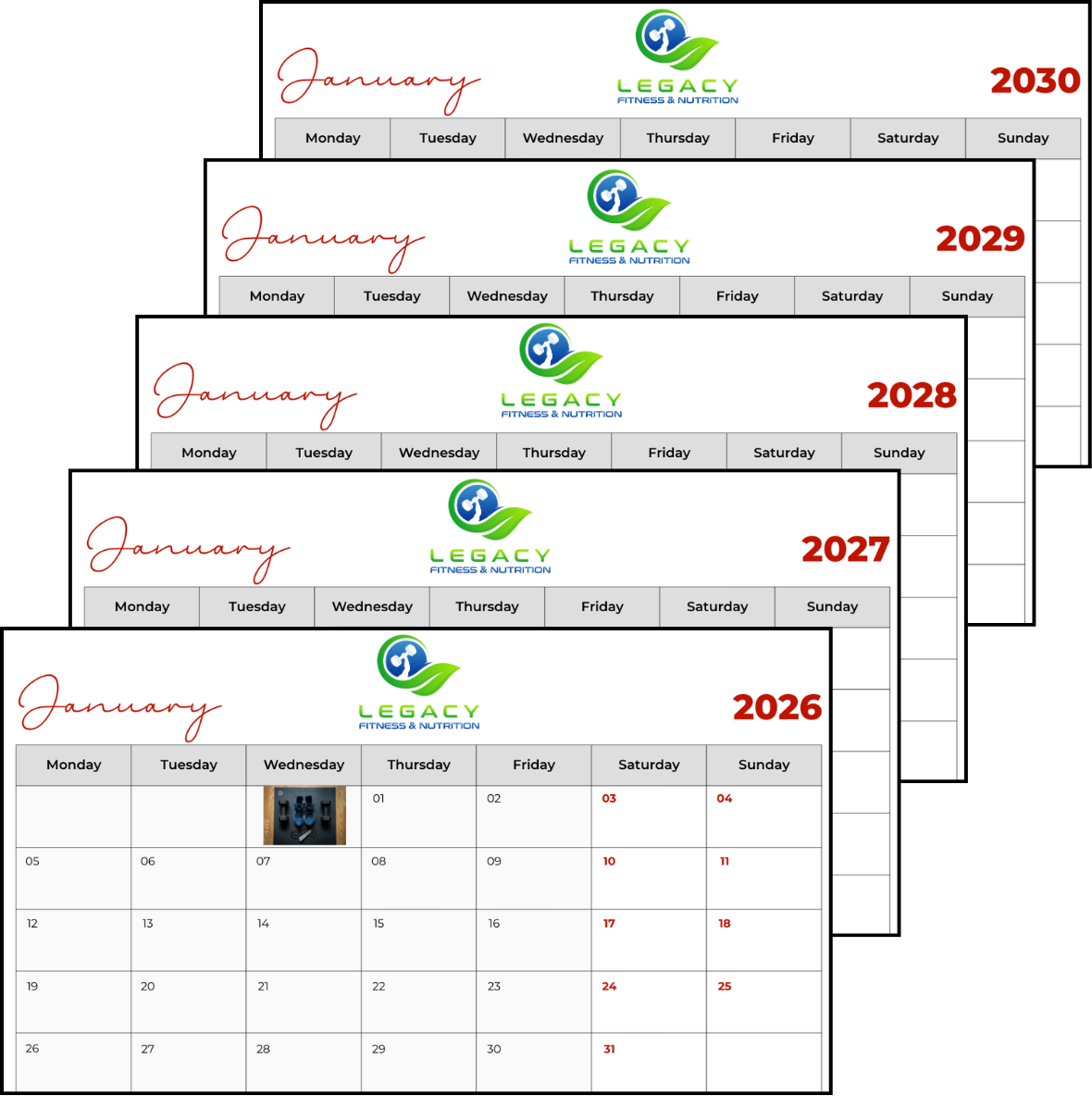
The 5-Year Fitness Plan: Building a True Legacy of Health
When most people set goals, they think in months; we encourage our clients to adopt a much longer vision: The 5-Year Fitness Plan.
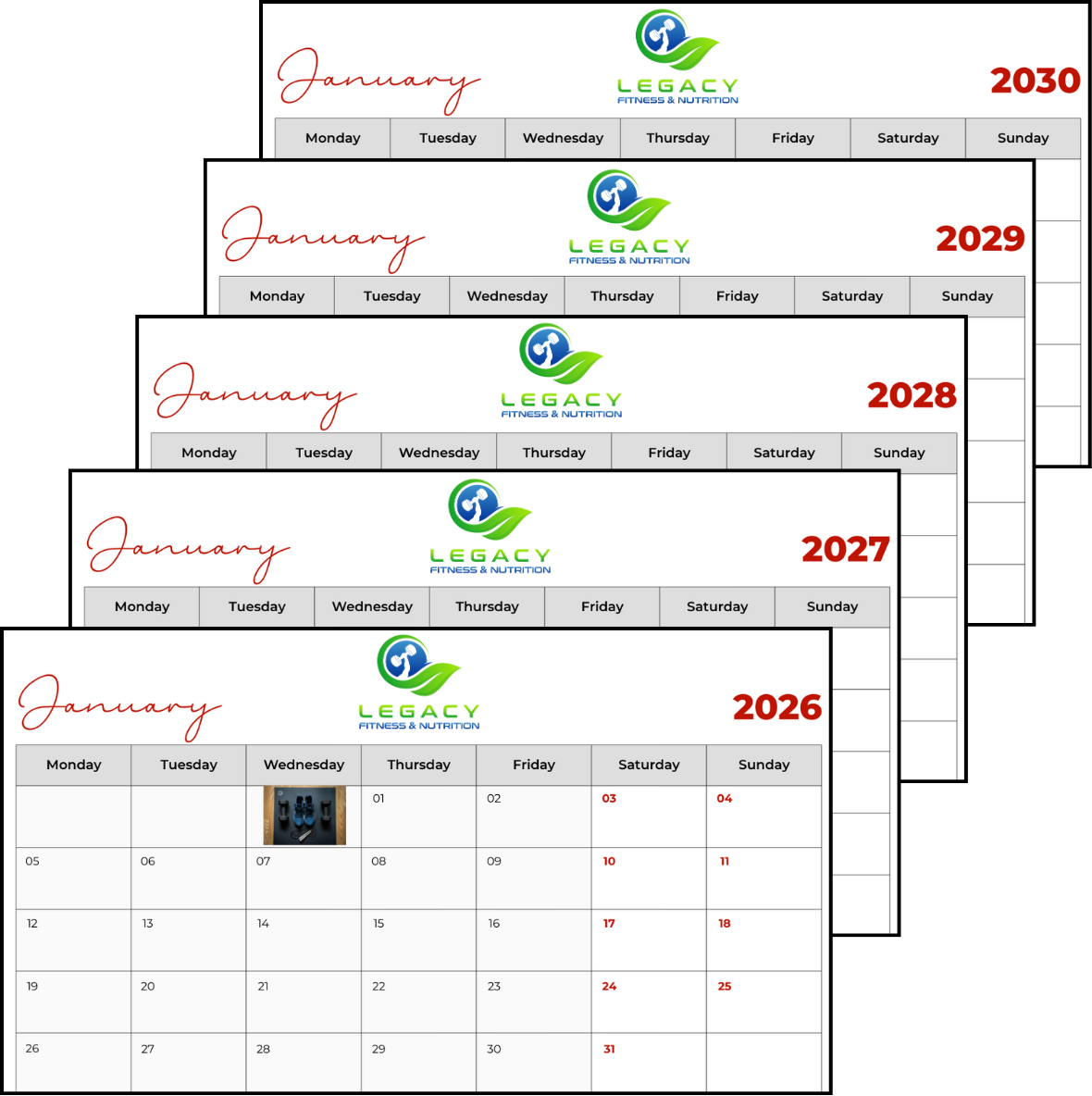
When most people set goals, they think in months. They focus on the next 12 weeks of training or the next 6 pounds they need to lose. This short-term thinking often leads to short-term results: rapid changes followed by an inevitable crash when life intervenes.
At Legacy Fitness & Nutrition, we encourage our clients to adopt a much longer vision: The 5-Year Fitness Plan.
This long view changes the way you approach exercise, nutrition, and stress. It transforms your goals from a series of exhausting sprints into a sustainable, consistent journey. You are no longer just trying to look good this summer; you are building a Legacy of Health that ensures you have the vitality, strength, and independence to enjoy your life decades from now.
Why 5 Years Changes Everything
Focusing on a 5-year plan shifts your decision-making from reaction to investment.
It Forces Sustainable Habits: If you know you have to run for 5 years, you won't sprint the first month. You will prioritize the foundational habits (see article, The Micro-Habit Playbook) that can be maintained regardless of your schedule. This eliminates crash diets and exhausting, injury-prone workouts.
It Prioritizes Longevity: You start viewing your training as an investment in your future self (as discussed in Strength Training for Longevity). You worry less about the aesthetic number on the scale and more about the functional health of your joints, bone density, and metabolic resilience.
It Plans for Detours: Over 5 years, you are guaranteed to face job changes, injuries, illnesses, and family crises. A long-term plan accepts these detours as inevitable and builds in the strategy for recovery (see article, The Failure Filter), instead of viewing them as reasons to quit entirely.
The 3 Pillars of Your 5-Year Fitness Legacy
1. The Functional Foundation (Years 1-2)
The first two years are dedicated to mastering your body and eliminating long-term health risks. This phase is about quality and movement literacy.
Focus: Perfect your form on foundational movements (squat, hinge, push, pull). Prioritize mobility and flexibility (as discussed in Beyond the Marathon). Consistently hit the daily process goals for sleep and protein intake.
Goal: Establish an unbreakable, sustainable routine that you can maintain during high-stress periods. You should feel strong, move pain-free, and sleep consistently.
2. The Resilience Build (Years 3-4)
Once the foundation is set, you build resilience and push performance safely.
Focus: Challenge your strength (increase weight safely) and expand your cardiovascular capacity. Introduce specific, measurable performance goals (e.g., hitting a consistent running pace, achieving specific strength numbers). Crucially, this is the time to optimize your stress management (as outlined in Your Secret Fitness Weapon).
Goal: Your health habits are now automatic. You have the mental and physical resilience to quickly recover from a week-long business trip or a major life event without losing momentum.
3. The Active Maintenance Legacy (Year 5+)
This phase is about fine-tuning and ensuring you maintain the strength and energy you have gained.
Focus: Continued strength training for bone density and muscle maintenance. Regular focus on new mobility challenges and maintaining a high level of functional fitness (the ability to perform daily tasks easily).
Goal: Your health is no longer a goal; it is simply a byproduct of your established lifestyle. You are fully capable of doing whatever you want—traveling, playing sports, running—without physical limitation, ensuring a high quality of life.
Stop looking at January 1st as a single, monumental day. View it as the start of a 5-year journey. When you commit to the long-term vision, the daily decisions become simple investments in the strong, independent, and vital person you are building.

The 1-Week Taper: Getting Your Mind and Body Primed for January 1st
The 1-Week Taper is your final strategic advantage. Use this time to rest, recover, and prime your body and mind.

With January 1st right around the corner, this final week is the most important for your success. Instead of ramping up your effort, we recommend a strategic period of intentional rest and preparation: The 1-Week Taper.
In running, a taper is a reduction in training volume before a race. This allows the body to fully repair, store energy, and peak for the event. The first week of January, when everyone else is running on holiday exhaustion and anxiety, is your "race day."
At Legacy Fitness & Nutrition, we encourage you to use this final week to prime your mind and body. This strategic rest ensures you launch into the new year feeling fresh, energized, and mentally sharp, not already battling burnout.
Taper Rule 1: Dial Down Physical Intensity
The goal of the Taper is to fully recover from the stress of December and maximize muscle repair. You want to store energy, not deplete it.
The Action: Cut your high-intensity training (heavy lifting, HIIT cardio) by 50 to 75%.
Example: If you usually do three lifting sessions a week, cut it to one or two very light sessions focused on perfect form. Replace intensity with mobility and light, low-stress movement (see article, Beyond the Marathon: Why Mobility Training is the New Foundation of Fitness).
Why it Works: This allows your muscles to fully rest and the small micro-tears to repair. You will not lose strength in one week; in fact, you will likely be stronger and have more energy when January 1st arrives.
Taper Rule 2: Maximize Sleep and Water Intake
Recovery is not just physical; it is hormonal (as discussed in Why You Can't "Out-Train" a Bad Sleep Schedule). You want to actively lower cortisol and maximize the hormones that aid fat loss and repair.
The Action: Commit to 7.5 to 9 hours of quality sleep every night this week. Maintain consistent, optimal hydration (water intake).
Why it Works: Sleep is when your body dumps cortisol and releases Human Growth Hormone (HGH), which helps repair muscles and burn fat. By maximizing sleep now, you actively lower the stress burden on your system, setting your metabolism up for a faster launch.
Taper Rule 3: Launch with a Simple Action
The mental pressure of the "New Year, New Me" is immense. You need a simple, pre-planned action that removes all friction and confirms your return to consistency.
The Action: Plan one simple, non-negotiable activity for January 1st that you cannot fail to do. (This builds on the principles in The Micro-Habit Playbook).
Examples: Lay out your workout clothes the night before; Mix up your protein smoothie before you go to sleep; Take a 10-minute walk before checking social media.
Why it Works: The power of the Taper is not the absence of effort; it is the intentionality of the return. By making the first action so easy and pre-planned, you jump-start your momentum and eliminate the mental resistance that kills most resolutions.
The 1-Week Taper is your final strategic advantage. Use this time to rest, recover, and prime your body and mind. Stop the urge to push harder and launch yourself into the New Year feeling energized, not depleted.

Don't Let New Year's Eve Derail You: Tips for a Balanced Celebration
Celebrate the year, cherish the memories, and ring in the New Year feeling balanced and in control.

This image was created using AI to avoid copyright issues while conveying the context of this article.
New Year's Eve is often the final hurdle before the grand launch of your January goals. It is a night of high energy, celebration, and often, high-calorie food and abundant alcohol.
The atmosphere is designed for maximum indulgence, which makes it incredibly easy to step off the track and wake up on January 1st feeling sluggish, dehydrated, and regretful. That feeling of regret is the worst way to start a new resolution.
At Legacy Fitness & Nutrition, we believe you can celebrate the end of a successful year without sacrificing your momentum for the next one. The key is applying the same strategic planning you used for your holiday parties (as discussed in the article, The "Pre-Game" Strategy) with a focus on intentional balance and hydration.
Here are four crucial tips to ensure your New Year's Eve celebration sets you up for success, not shame.
1. Prioritize a Protein-Rich Day
The common mistake is starving all day to "save" calories for the evening feast. This is a behavioral disaster waiting to happen. By the time you get to the party, your hunger hormones (Ghrelin) are spiking, and your willpower is nonexistent.
The Strategy: Eat two well-balanced, protein-rich meals during the day (reinforcing the principles in Protein Power for the New Year).
Example: A large, protein-packed breakfast and a lean lunch of chicken or fish.
Why it Works: This keeps your blood sugar stable and your satiety hormones (Leptin) high. You walk into the party feeling in control, allowing you to choose your indulgences thoughtfully rather than reacting to desperate hunger.
2. Implement the "Hydration Ladder"
New Year's Eve involves champagne, cocktails, and late hours, a perfect storm for dehydration and a massive hangover, which will kill your ability to start your new fitness plan on January 1st.
The Strategy: Use the Hydration Ladder:
Level 1 (Pre-Game): Drink 16 ounces of water before you leave the house.
Level 2 (In-Game): Commit to the "One-to-One" rule (one glass of water for every alcoholic drink).
Level 3 (Post-Game): Drink 16 ounces of water before you go to sleep, along with an electrolyte packet if you have one.
Why it Works: This constant, strategic hydration minimizes the impact of alcohol and ensures you wake up on January 1st feeling refreshed and ready to go, not recovering from a massive headache.
3. Be Selective: Choose Your Favorite Indulgence
The key to balance is realizing you do not have to eat or drink everything that is offered. You are celebrating a successful year; be intentional about what you choose to commemorate it.
The Strategy: Pick your One True Indulgence. Is it the special champagne toast? Is it the chocolate dessert? Is it the late-night pizza? Commit to truly enjoying that one thing and politely passing on the rest.
Why it Works: This removes the guilt of overconsumption. You savor your chosen treat fully, which enhances the emotional satisfaction, making it easier to refuse the endless stream of mindlessly consumed snacks.
4. Set the January 1st Anchor
The easiest way to prevent New Year's Eve from derailing you is to set a non-negotiable anchor for the next morning.
The Strategy: Pre-plan one small, simple action for January 1st that must happen, regardless of how you feel.
Examples: Go for a 15-minute gentle walk; Do 10 push-ups; Make a protein smoothie.
Why it Works: This small action (your resolution head start) proves that you are back on track. It prevents the psychological spiral where a night of indulgence turns into a week of quitting. Your legacy begins again the moment you perform that first planned action on January 1st.
Celebrate the year, cherish the memories, and ring in the New Year feeling balanced and in control.

The Power of Accountability: Why a Coach is a Long-Term Investment, Not a Short-Term Fix
A coach is not a short-term fix; a coach is a long-term investment in your human potential and the resilience of your health legacy.

This image was created using AI to avoid copyright issues while conveying the context of this article.
As people plan their New Year's resolutions, many will decide they need to hire a trainer or a coach. They often view this relationship as a short-term fix: "I need a coach for six weeks to lose 10 pounds," or "I'll hire one until I know all the exercises."
At Legacy Fitness & Nutrition, we encourage a different, more powerful perspective: A coach is not a short-term fix; a coach is a long-term investment in your human potential and the resilience of your health legacy.
The true power of a coaching relationship lies not in the exercise plan they write, but in the Accountability and Strategy they provide. This is the difference between achieving a temporary weight loss goal and establishing a health legacy that endures decades of change and challenge.
Why Willpower Fails, But Accountability Works
We have discussed why willpower is a finite resource (ref article, The "Failure Filter"). When life gets stressful, that willpower disappears, and you default back to old, comfortable habits. This is where accountability steps in as your most powerful tool.
A Coach Creates a System: A coach removes the burden of constant decision-making. You do not wake up wondering what to eat or how to train; you simply follow the system that has been proven to work for you.
A Coach Provides the "External Spine": When your internal motivation sags (and it will), your coach is the external spine that reminds you of your deeper "Why" (see our article, Your "Why" is Not a Number). Knowing that someone is checking in and expecting your results prevents that 5-minute skip from becoming a 5-week breakdown.
A Coach Filters Failure: A coach applies the Failure Filter to your setbacks objectively. When you see a plateau as personal failure, a coach sees it as data and immediately adjusts the roadmap (see our article, Setting Your GPS: Creating a Fitness Roadmap). This eliminates emotional quitting.
The 3 Ways Coaching Secures Your Legacy
The value of a coach extends far beyond the gym floor and impacts your overall healthspan:
1. The Expert Guide to Longevity
Longevity is built on precision: specific movement patterns, targeted metabolic conditioning, and tailored nutrition. A coach is an expert guide who can quickly identify the subtle errors in form, the hormonal imbalances (ref article, Why You Can't "Out-Train" a Bad Sleep Schedule) you are facing, or the nutritional gaps (see article, "Protein Power" for the New Year) that are stalling progress. You do not pay for their time; you pay for the tens of thousands of hours of expertise that prevents costly mistakes and accelerates results.
2. The Investor in Your Identity
The most profound shift in fitness is changing your identity from "someone who tries to work out" to "someone who is an athlete." A coach treats you like an athlete, and their consistent belief in your potential slowly forces you to internalize that identity. This identity shift is the ultimate guarantee of long-term consistency.
3. The Planner for Life Changes
Life is unpredictable. You will deal with injuries, job changes, family needs, and travel. A relationship with a coach means you never have to scrap your fitness plan. Instead, the coach is there to adapt the plan to your current circumstances, ensuring that your health legacy continues to be built during busy, stressful, or low-energy periods.
View hiring a coach not as a cost center, but as an investment in your long-term independence, resilience, and vitality. It is the most direct path to securing a lifelong legacy of health.

Setting Your GPS: Creating a Fitness Roadmap (Not Just a Wish List)
A wish list is a dream without instructions. A roadmap is a detailed plan that tells you exactly where to turn, what speed to maintain, and what obstacles to expect.

Image courtesy of Cathryn Lavery via Unsplash
Every January, people create a fitness "wish list." They write down vague goals like "I want to get healthy," "I want to lose weight," or "I want to feel better."
These statements are full of hope, but they are critically lacking one thing: A roadmap.
A wish list is a dream without instructions. A roadmap is a detailed plan that tells you exactly where to turn, what speed to maintain, and what obstacles to expect. Without a roadmap, you will quickly get lost, frustrated, and you will eventually pull over.
At Legacy Fitness & Nutrition, we teach you to set your Fitness GPS to ensure you not only reach your destination but know exactly how to get back on track when life throws a detour. A successful legacy is built on clear direction.
The Problem with Vague Goals
Why does "I want to lose 10 pounds" often fail? Because the goal is simply a destination, not a journey. It does not tell you the daily habits required to get there.
A successful fitness roadmap transforms the wish into a detailed, actionable plan using the SMART framework, but with a special focus on Actionable Habits.
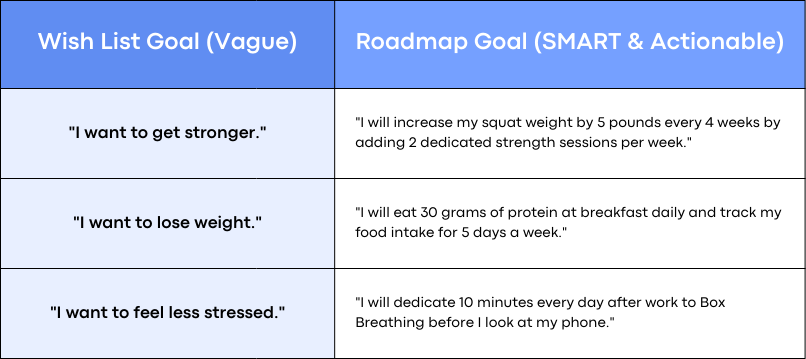
The difference is that the roadmap goal focuses on the consistent action you must take, not just the eventual outcome.
3 Essential Components of Your Fitness Roadmap
Your fitness plan needs three layers to be truly resilient and effective:
1. The Daily Checkpoint (Process Goals)
These are the small, daily actions you control 100%. These are the behaviors that, if done consistently, guarantee the bigger result.
Action: Identify 3 non-negotiable process goals for the first 30 days. These are habits, not outcomes.
Examples: Drink 60 ounces of water; Go to bed by 10 PM; Get a protein source in every meal.
Strategy: Focus 90% of your energy on winning the day by hitting these checkpoints. This builds confidence and momentum immediately.
2. The Quarterly Target (Performance Goals)
These are measurable steps that confirm you are moving in the right direction. They are big enough to be motivating but small enough to be reachable within a few months.
Action: Set a physical challenge for every three months.
Examples: Complete 10 perfect push-ups in a row by March 31st; Complete a 5K race by June 30th; Maintain a consistent sleeping average of 7.5 hours for 90 days.
Strategy: Quarterly targets keep you engaged and allow you to adjust your daily process goals based on real-time feedback.
3. The Fuel and Recovery Strategy (The Pit Stops)
The best roadmap also includes scheduled "pit stops" for fueling and maintenance. This recognizes that life isn't a straight line and that your body needs repair.
Action: Explicitly plan for rest, recovery, and nutrition management.
Examples: Schedule 2 non-negotiable rest days per week; Plan one healthy meal prep session every Sunday; Set a maximum cap on late nights (no more than one per week).
Strategy: By planning for recovery (see article, The 3 Rules of Recovery) and fueling (see article, “"Protein Power" for the New Year), you prevent the burnout and hormonal chaos (see article, Why You Can't "Out-Train" a Bad Sleep Schedule) that derail 90% of fitness journeys.
This January, don't just write a wish list. Sit down, create your detailed Fitness Roadmap, and set your GPS. Knowing the exact route gives you the power to overcome obstacles and guarantee that you arrive at your legacy destination.

Don't Wait for January 1st: The Power of the "Resolution Head Start"
January 1st is the worst day to start your resolution. Stop waiting for the perfect day. The perfect day to start building your legacy is right now.

This image was created using AI to avoid copyright issues while conveying the meaning of this article.
Every year, the calendar promises a magical reset button on January 1st. We load up our goals: eat better, exercise more, stress less and wait for the clock to strike midnight.
But here’s a crucial piece of advice from Legacy Fitness & Nutrition: January 1st is the worst day to start your resolution.
Think about it: January 1st is often a day of recovering, cleaning up, or easing back into work after a busy holiday period. It’s a day packed with pressure and distraction. If you start your biggest life change on a chaotic day, you set yourself up for failure.
The most successful people don't wait for the magic date. They start when they decide to start. And right now, in December, you have the biggest strategic advantage of the whole year: The Resolution Head Start.
Why December is Your Secret Weapon
December is usually when we throw up our hands and say, "I'll just enjoy the cookies now and fix everything later." This mindset is your enemy. Instead of viewing December as a write-off, see it as a low-pressure practice field.
When you start small now, you accomplish two major things:
You build momentum: Starting with a few small, consistent wins in December gives you energy and proof of success. You don't have to rely on sheer willpower on January 1st; you rely on habit.
You lower the pressure: When you start now, the stakes are lower. If you miss a day, it’s not the end of your resolution; it’s a practice stumble. This low-stress environment is where true, lasting habits are formed.
Think of it like training for a race. You don't start the marathon on race day. You start training weeks before, building your endurance slowly.
The 3-Step Head Start Plan
A head start doesn’t mean you launch into extreme dieting or 7-day-a-week training. It means choosing two or three small, non-negotiable actions that you practice consistently before the holiday rush.
Step 1: Choose Your Core 3
Identify the three simplest things you want to anchor your New Year to, and make them your December non-negotiables. They should be easy enough to do even on the busiest days.
Example 1 (Movement): 10 push-ups every morning before showering.
Example 2 (Nutrition): Eat one serving of green vegetables with dinner every night.
Example 3 (Mind/Rest): Get into bed 15 minutes earlier than usual.
That’s it. These are your Core 3. You are practicing the feeling of success and consistency without the pressure of a massive goal.
Step 2: Anchor the Habit
Connect your Core 3 habits to something you already do without fail. This is called habit stacking.
After I brew my coffee, I will do 10 push-ups.
After I sit down for dinner, I will immediately eat my serving of green vegetables.
When the 9 PM news starts, I will get ready for bed.
By linking a new, small habit to an old, established action, you take the decision-making out of the process. The coffee triggers the push-ups; the dinner table triggers the veggies. This is the mechanism that keeps momentum going through the chaos of holiday travel and parties.
Step 3: Accept Imperfection (The December Advantage)
December is messy. There will be nights when you eat an extra cookie or skip your walk because of snow. The December advantage is that these slips don't matter! They are part of the practice.
When you slip up in January, people often quit entirely. When you slip up in December, you simply say, "Oops, I missed it," and you start fresh tomorrow. You learn how to recover and restart without shame.
By January 1st, you won’t be starting a new resolution; you’ll be continuing a successful habit. You'll look back at December and realize you already built your momentum, confidence, and system.
Stop waiting for the perfect day. The perfect day to start building your legacy is right now.

The Micro-Habit Playbook: Why 5-Minute Changes Beat The 1-Day Overhaul
This December, forget the crushing weight of the "New Year, New Me" overhaul. Start small. Stay consistent. Build your legacy.

This image was created using AI to avoid copyright issues while conveying the meaning of this article.
The calendar is about to flip to a new year. You know what that means: time for the massive, life-changing, "new me" resolutions.
You promise yourself: “Starting January 1st, I will wake up at 5 AM, work out for 90 minutes, cook every meal from scratch, and never touch a soda again!”
It sounds great, doesn't it? It sounds like the key to a better you. But here's the truth most people ignore: The bigger the overhaul, the faster the fail.
If you’ve ever felt like your New Year's resolution was like trying to climb Mount Everest in a single jump, you're not alone. The problem isn't your motivation; it's your strategy. The biggest changes stick when they start small, so small in fact, that they feel almost silly.
Welcome to the Micro-Habit Playbook. This is the secret to building a fitness legacy that lasts.
The Problem with the "All or Nothing" Mentality
Why do most resolutions fail by February? Because we try to change our entire life at once. We go from 0 to 100 mph overnight.
Think of it like this: If you decide to save money, you don't instantly put $10,000 in your savings account. You start by saving $10 a week, then $20. It becomes a habit first.
Your brain and body hate sudden, painful changes. When you suddenly force yourself into a brutal, hour-and-a-half workout every day, your body screams: "Danger! Too much effort! Stop!" Your brain looks for an easy out. This is why you feel motivated on January 1st but completely burned out by January 15th.
The Micro-Habit Strategy: Too Small to Fail
A micro-habit is a behavior that is so easy and so quick that you cannot logically skip it. It usually takes five minutes or less and requires very little willpower.
The goal is not to get a workout in; the goal is to build consistency. You aren't building muscle; you are building the identity of a person who is consistent with their health.
Here’s how to apply the Micro-Habit Playbook to three common fitness goals:
Goal 1: Moving Your Body More
Instead of the big, scary goal ("I will exercise for 60 minutes every day"), try these micro-habits:
The "One Song" Rule: When you get home from work, play one song and walk, jog, or dance around the living room. (About 3–4 minutes).
The "Commercial Break" Challenge: Every time a commercial comes on while you're watching TV, do 10 squats or 10 standing push-ups against the wall. (About 2 minutes).
The "Alarm Clock Anchor": Place your shoes and socks right next to your bed. When the alarm goes off, the micro-habit is simply putting on the socks and shoes. That's it. Once the shoes are on, the full workout becomes much easier to start.
The key here is that you can always do more than the micro-habit, but the rule is you must at least do the minimum. Most days, once you have your shoes on, you’ll likely go for the walk. You’ve tricked your brain into overcoming the toughest part: starting.
Goal 2: Eating Healthier and Controlling Cravings
Nutrition goals often fail because we make the healthy choice too difficult and the unhealthy choice too easy.
The "Water First" Rule: Before you reach for any snack or start a meal, drink a full 8-ounce glass of water. (About 1 minute). This helps you check if you’re actually hungry or just thirsty, and it creates a feeling of fullness.
The "Veggies-First Bite": Before you touch anything else on your plate, take two bites of the vegetable part of the meal. (About 30 seconds). This small win prioritizes nutrient density and signals to your body that a healthy meal is coming.
The "Protein Prep": Every Sunday, cook three large chicken breasts or hard-boil six eggs. The micro-habit is just opening the fridge and slicing a piece off the pre-cooked protein anytime you feel a craving. (About 2 minutes). By having healthy protein ready, you make the healthy choice the path of least resistance.
Goal 3: Getting Better Sleep
Sleep is the engine of your fitness journey. If you skimp on sleep, you make losing weight and building muscle much harder because of hormones like cortisol.
The "Plug-In and Step Away": 1 hour before bed, plug your phone/tablet into a charger in a room other than your bedroom. The micro-habit is simply putting it on the charger. (1 minute). This separates your bedroom from your work/social life.
The "Journal Line": Before getting into bed, write one sentence, just one, about your day in a journal. (1 minute). This small act helps stop your brain from racing and prepares your mind for rest.
Building Your Legacy, Five Minutes at a Time
A small change done consistently is a mountain compared to a massive change done twice.
When you use the Micro-Habit Playbook, you aren't just achieving a goal; you are changing who you are. You are transforming into a person who consistently exercises, eats well, and prioritizes rest.
This December, forget the crushing weight of the "New Year, New Me" overhaul. Focus on the simple, repeatable actions that take five minutes or less. By the time January 1st rolls around, you won't need a resolution; you'll already have a legacy of healthy habits in place.
Start small. Stay consistent. Build your legacy.