
Setting Your GPS: Creating a Fitness Roadmap (Not Just a Wish List)

Image courtesy of Cathryn Lavery via Unsplash
Every January, people create a fitness "wish list." They write down vague goals like "I want to get healthy," "I want to lose weight," or "I want to feel better."
These statements are full of hope, but they are critically lacking one thing: A roadmap.
A wish list is a dream without instructions. A roadmap is a detailed plan that tells you exactly where to turn, what speed to maintain, and what obstacles to expect. Without a roadmap, you will quickly get lost, frustrated, and you will eventually pull over.
At Legacy Fitness & Nutrition, we teach you to set your Fitness GPS to ensure you not only reach your destination but know exactly how to get back on track when life throws a detour. A successful legacy is built on clear direction.
The Problem with Vague Goals
Why does "I want to lose 10 pounds" often fail? Because the goal is simply a destination, not a journey. It does not tell you the daily habits required to get there.
A successful fitness roadmap transforms the wish into a detailed, actionable plan using the SMART framework, but with a special focus on Actionable Habits.
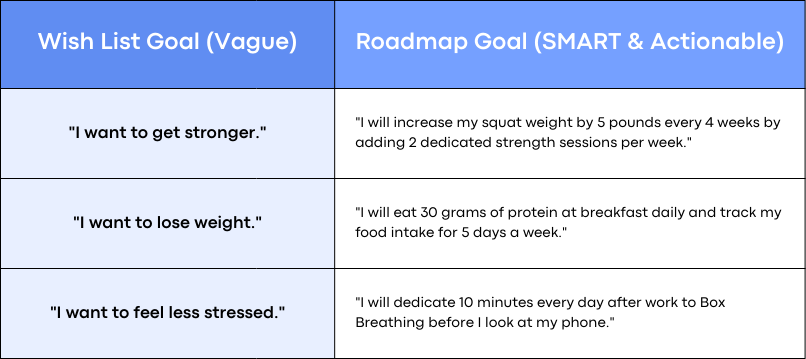
The difference is that the roadmap goal focuses on the consistent action you must take, not just the eventual outcome.
3 Essential Components of Your Fitness Roadmap
Your fitness plan needs three layers to be truly resilient and effective:
1. The Daily Checkpoint (Process Goals)
These are the small, daily actions you control 100%. These are the behaviors that, if done consistently, guarantee the bigger result.
Action: Identify 3 non-negotiable process goals for the first 30 days. These are habits, not outcomes.
Examples: Drink 60 ounces of water; Go to bed by 10 PM; Get a protein source in every meal.
Strategy: Focus 90% of your energy on winning the day by hitting these checkpoints. This builds confidence and momentum immediately.
2. The Quarterly Target (Performance Goals)
These are measurable steps that confirm you are moving in the right direction. They are big enough to be motivating but small enough to be reachable within a few months.
Action: Set a physical challenge for every three months.
Examples: Complete 10 perfect push-ups in a row by March 31st; Complete a 5K race by June 30th; Maintain a consistent sleeping average of 7.5 hours for 90 days.
Strategy: Quarterly targets keep you engaged and allow you to adjust your daily process goals based on real-time feedback.
3. The Fuel and Recovery Strategy (The Pit Stops)
The best roadmap also includes scheduled "pit stops" for fueling and maintenance. This recognizes that life isn't a straight line and that your body needs repair.
Action: Explicitly plan for rest, recovery, and nutrition management.
Examples: Schedule 2 non-negotiable rest days per week; Plan one healthy meal prep session every Sunday; Set a maximum cap on late nights (no more than one per week).
Strategy: By planning for recovery (see article, The 3 Rules of Recovery) and fueling (see article, “"Protein Power" for the New Year), you prevent the burnout and hormonal chaos (see article, Why You Can't "Out-Train" a Bad Sleep Schedule) that derail 90% of fitness journeys.
This January, don't just write a wish list. Sit down, create your detailed Fitness Roadmap, and set your GPS. Knowing the exact route gives you the power to overcome obstacles and guarantee that you arrive at your legacy destination.
