

Mentorship in Health: Why a Coach is an Investment, not an Expense
Your health deserves the same level of strategic investment as your business.

This image was created using AI to avoid copyright issues while conveying the context of this article.
In the world of business, we understand the value of a mentor. We seek out advisors, consultants, and executive coaches because we know that a single piece of expert advice can save us years of trial and error. We don't view these professional services as a "cost" that drains our bank account; we view them as an investment that multiplies our time and our results.
Yet, when it comes to the most important asset we own, our physical health, many people revert to a "DIY" (Do It Yourself) mindset. They try to piece together a fitness plan from random social media posts, or they jump from one fad diet to the next, hoping something finally sticks.
The reality is that your health deserves the same level of strategic investment as your business. A health coach or mentor isn't an "expense" like a luxury car or a high-end watch. A coach is a strategic partner who ensures your biological infrastructure can support your professional ambitions. Here is why mentorship is the missing link in your long-term health legacy.
The Problem with "Information Overload"
We live in an age where information is free and infinite. You can find ten different "perfect" workout plans and twenty "ideal" diets in a five-minute search. The problem isn't a lack of information; it is a lack of clarity.
When you try to go it alone, you spend your mental energy trying to decide which information is correct. Is coffee good for you today? Should you be doing keto or low-fat? Are you lifting too heavy or not heavy enough? This "decision fatigue" is the number one reason why high-performers quit their health routines. They are already making thousands of decisions a day at work; they don't have the "bandwidth" to manage the complexity of their own biology.
A coach removes the guesswork. A mentor provides a filtered, direct path to your goals based on your specific life, your specific stress levels, and your specific body. You aren't paying for "information"; you are paying for the curation of that information.
The Value of "Outside-In" Perspective
Even the best athletes in the world have coaches. It isn't because they don't know how to play the game; it’s because they cannot see their own "blind spots."
In business, you hire an auditor to find the holes in your finances. In fitness, a coach is the auditor for your lifestyle. You might think you are eating enough protein, but a coach looks at the data and sees that you are consistently falling short. You might think your squat form is perfect, but a coach sees the slight shift in your hips that is going to lead to a back injury in six months.
That "outside-in" perspective is what prevents plateaus and injuries. It ensures that every minute you spend in the gym is actually moving the needle. For a busy executive, wasting time on an ineffective workout is more than just frustrating, it is a poor use of a valuable resource.
Accountability: The Secret to Consistency
We have all had a "Monday Morning" where we were supposed to hit the gym, but a late-night email or a stressful meeting made it easy to hit the snooze button. When you are only accountable to yourself, it is easy to negotiate with yourself. You tell yourself you'll "make it up tomorrow."
But when you have a mentor, the dynamic changes. Accountability is the "force multiplier" of consistency. Knowing that someone is waiting for your check-in or looking at your data creates a level of psychological commitment that "willpower" alone cannot match.
A mentor doesn't just tell you what to do; they hold the standard for who you said you wanted to become. They are the guardian of your goals when your motivation is low.
Collapsing the Timeframe
The most valuable asset an executive has is time. You can always make more money, but you can never get back a year spent in "mediocre" health.
Mentorship "collapses" the timeframe. A journey that might take you three years of trial and error to figure out on your own can often be accomplished in six months with an expert guide. A coach has already seen the pitfalls, the common mistakes, and the metabolic "potholes" that stop most people. By following their lead, you are buying back your time. You are choosing the fast lane to a body that performs.
The ROI of Energy
Finally, we must look at the Return on Investment. If a coach helps you improve your sleep, optimize your nutrition, and build a stronger body, your "output" in every other area of life increases.
You are more patient with your family.
You are more focused during high-stakes meetings.
You have the energy to work a full day and still have "gas in the tank" for your personal life.
When you view it through this lens, the "cost" of a coach is actually one of the highest-yielding investments you can make. It is an investment in your career longevity and your personal happiness.
Building Your Team
No great legacy was ever built alone. Success is a team sport. Whether it is in the boardroom or the weight room, the right mentorship changes everything.
At Legacy Fitness, we aren't just trainers; we are strategic partners in your health. We provide the systems, the accountability, and the expertise so that you can focus on what you do best: leading.
Ready to Invest in Your Most Important Asset?
The DIY approach to health is the most expensive path you can take because it costs you time and energy. It’s time to move toward a strategic, expert-led plan.
For the Individual Leader: Ready to stop the guesswork and start the transformation? Let’s talk about your roadmap. Book My Discovery Call
For the Organization: Give your high-performers the support they need to stay at the top of their game. Explore Corporate Wellness Packages

Muscle: Your Metabolic Insurance Policy
You wouldn't leave your financial future to luck. Don't leave your physical future to luck either.

This image was created using AI to avoid copyright issues while conveying the context of this article.
In the world of finance, we buy insurance to protect ourselves against the unexpected. We pay into a policy so that if a crisis hits, we have a safety net. In the world of health, most people wait until the "crisis" happens, a bad blood test, a back injury, or a loss of energy, before they try to fix the problem.
But what if you could build a physical insurance policy that protected you from those things before they happened?
That policy is your muscle mass.
At Legacy Fitness, we don't just view muscle as something that looks good in the mirror. We view it as "Metabolic Insurance." It is the primary engine that keeps your blood sugar stable, your hormones balanced, and your body resilient as you age.
The "Sponge" for Blood Sugar
One of the most important jobs your muscle has is acting as a "glucose sink." When you eat carbohydrates, they are broken down into sugar (glucose) in your blood. Your body has to put that sugar somewhere.
If you have very little muscle, your body struggles to manage that sugar, which can lead to energy crashes and long-term health issues. But if you have healthy, active muscle mass, your muscles act like a giant sponge. They pull that sugar out of the blood and use it for fuel. This is why people with more muscle can often enjoy more flexibility in their diet without losing progress.
Muscle and the Aging Process
As we get older, we naturally begin to lose muscle, a process called sarcopenia. If you aren't intentionally building or maintaining muscle, you are losing your insurance policy.
Loss of muscle is the leading cause of "metabolic slowdown." When people say their metabolism "died" at 40, what usually happened is they lost the muscle that was burning those calories. By keeping your strength high, you are essentially keeping your metabolic "engine" young, regardless of the date on your birth certificate.
Resilience Against Injury
Muscle isn't just for metabolism; it is armor for your joints. A strong set of glutes and hamstrings protects your lower back. Strong shoulders protect your neck. When you have a solid foundation of muscle, you aren't just "fit", you are durable. You can play a weekend game of golf, pick up your grandkids, or go for a hike without the fear that your body is going to "snap."
The Data That Actually Matters
We live in an age where gadgets can track every heartbeat, but the most important data point isn't on a watch. it’s on the bar.
Are you getting stronger over time?
Is your body composition improving?
Do you have more energy at 3:00 PM than you did last month?
This is where the expertise of a coach comes in. Technology can provide the numbers, but a coach provides the context. We use data to see how your body is responding to the work, ensuring that we aren't guessing, but rather making informed adjustments based on how you feel and perform in the real world.
Your Most Important Investment
You wouldn't leave your financial future to luck. Don't leave your physical future to luck either. Every strength session is a "premium" paid into your metabolic insurance policy. It is an investment that compounds over time, ensuring that the "Legacy" you build is one of strength, energy, and independence.
Ready to Build Your Insurance Policy?
Strength is the foundation of everything we do at Legacy Fitness & Nutrition. We help you cut through the noise and focus on the habits that actually move the needle.
For the Individual: Ready to build a body that lasts? Let's start your transformation. Book My Discovery Call
For the Organization: Give your team the ultimate edge with our health leadership workshops. Explore Corporate Wellness Packages
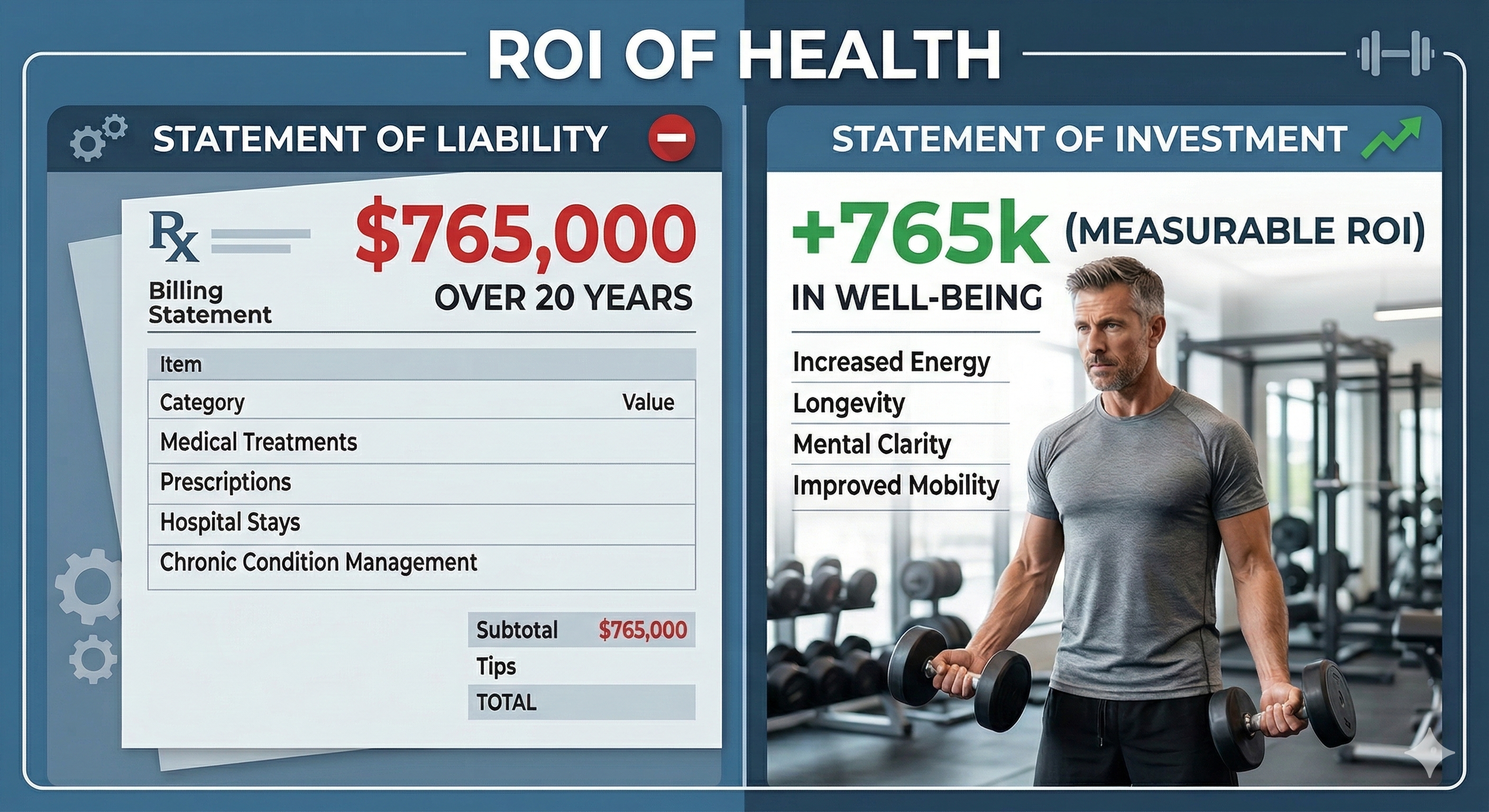
The ROI of Health: Why Fitness is the Best Investment a Leader Can Make
Many "spend" their health to gain wealth, only to spend their wealth later trying to buy back their health.
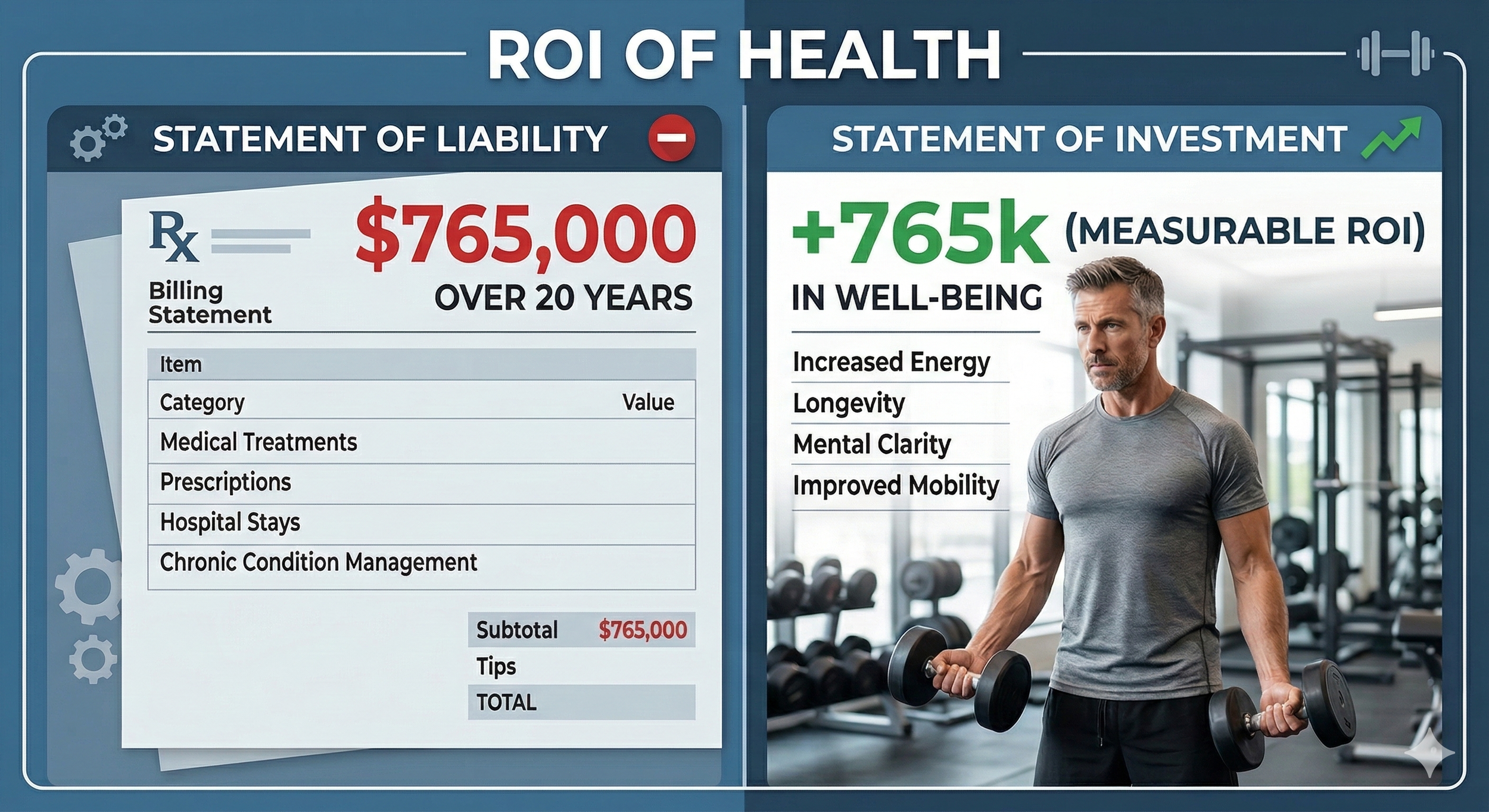
This image was created using AI to avoid copyright issues while conveying the context of this article.
In the corporate world, we are obsessed with Return on Investment (ROI). We scrutinize every software subscription, every new hire, and every marketing campaign to ensure it yields a positive result. We look for assets that appreciate and minimize liabilities that drain our resources.
Yet, many leaders overlook the most critical asset in their entire portfolio: their physical body.
At Legacy Fitness, we recently performed a 20-year cost-benefit analysis comparing a proactive healthy lifestyle against the reality of living with metabolic syndrome. The results were staggering. To be a truly effective leader, you must stop viewing fitness as a "time-cost" and start viewing it as a high-yield investment.
1. The Financial Data: Investing vs. Reacting
Most people hesitate at the cost of quality whole foods, gym memberships, and coaching. However, our "Health is Wealth" report shows that these are actually cost-saving measures.
The Liability: A male living with metabolic syndrome (high blood pressure, cholesterol, and diabetes) faces an estimated annual cost of $38,262 in healthcare, insurance surcharges, and medications. Over 20 years, that is a $765,000 liability.
The Asset: A male investing in a proactive healthy lifestyle, including a personal trainer and high-quality food, saves hundreds of thousands of dollars over that same period by avoiding escalating medical expenses.
In business terms: Would you rather spend $15,000 a year on "maintenance" (fitness and food) or $40,000 a year on "repairs" (healthcare)?
2. Increased Cognitive Performance
Your brain is a biological organ. Regular resistance training increases blood flow to the prefrontal cortex, the area responsible for executive function, decision-making, and emotional regulation.
A fit leader doesn't just have more energy; they have more clarity. When you are physically healthy, you can navigate a high-pressure boardroom with a level head, while your less-healthy competitors are struggling with "brain fog" and mid-afternoon fatigue.
3. Stress Resilience and Emotional Intelligence
Leadership is essentially the management of stress. Exercise is "controlled stress." When you push through a difficult set of squats, you are training your nervous system to stay calm under pressure.
This translates directly to your professional life. A leader who has mastered their physical discipline is far less likely to make an impulsive, stress-based decision. You are building a "buffer" of resilience that allows you to lead with a steady hand when the stakes are high.
4. Protecting Your Life Expectancy
Data shows that metabolic syndrome and obesity-related conditions can reduce life expectancy by 3 to 10 years. What is the value of your career if you are forced to retire early due to a preventable health crisis? We spend decades building a professional "legacy," yet many "spend" their health to gain wealth, only to spend their wealth later trying to buy back their health. Investing in your strength now is like contributing to a biological 401(k).
The Executive Summary
Stop waiting for a "fitness spark." You don't need a spark; you need a strategy.
Treat your coach like a consultant. Treat your nutrition like a high-budget project that requires precision. As the "Health is Wealth" report concludes, individual health status is a critical component of economic stability. When you bring the same level of professionalism to the gym that you bring to the office, the ROI isn't just better, it’s life-changing.

The Power of Accountability: Why a Coach is a Long-Term Investment, Not a Short-Term Fix
A coach is not a short-term fix; a coach is a long-term investment in your human potential and the resilience of your health legacy.

This image was created using AI to avoid copyright issues while conveying the context of this article.
As people plan their New Year's resolutions, many will decide they need to hire a trainer or a coach. They often view this relationship as a short-term fix: "I need a coach for six weeks to lose 10 pounds," or "I'll hire one until I know all the exercises."
At Legacy Fitness & Nutrition, we encourage a different, more powerful perspective: A coach is not a short-term fix; a coach is a long-term investment in your human potential and the resilience of your health legacy.
The true power of a coaching relationship lies not in the exercise plan they write, but in the Accountability and Strategy they provide. This is the difference between achieving a temporary weight loss goal and establishing a health legacy that endures decades of change and challenge.
Why Willpower Fails, But Accountability Works
We have discussed why willpower is a finite resource (ref article, The "Failure Filter"). When life gets stressful, that willpower disappears, and you default back to old, comfortable habits. This is where accountability steps in as your most powerful tool.
A Coach Creates a System: A coach removes the burden of constant decision-making. You do not wake up wondering what to eat or how to train; you simply follow the system that has been proven to work for you.
A Coach Provides the "External Spine": When your internal motivation sags (and it will), your coach is the external spine that reminds you of your deeper "Why" (see our article, Your "Why" is Not a Number). Knowing that someone is checking in and expecting your results prevents that 5-minute skip from becoming a 5-week breakdown.
A Coach Filters Failure: A coach applies the Failure Filter to your setbacks objectively. When you see a plateau as personal failure, a coach sees it as data and immediately adjusts the roadmap (see our article, Setting Your GPS: Creating a Fitness Roadmap). This eliminates emotional quitting.
The 3 Ways Coaching Secures Your Legacy
The value of a coach extends far beyond the gym floor and impacts your overall healthspan:
1. The Expert Guide to Longevity
Longevity is built on precision: specific movement patterns, targeted metabolic conditioning, and tailored nutrition. A coach is an expert guide who can quickly identify the subtle errors in form, the hormonal imbalances (ref article, Why You Can't "Out-Train" a Bad Sleep Schedule) you are facing, or the nutritional gaps (see article, "Protein Power" for the New Year) that are stalling progress. You do not pay for their time; you pay for the tens of thousands of hours of expertise that prevents costly mistakes and accelerates results.
2. The Investor in Your Identity
The most profound shift in fitness is changing your identity from "someone who tries to work out" to "someone who is an athlete." A coach treats you like an athlete, and their consistent belief in your potential slowly forces you to internalize that identity. This identity shift is the ultimate guarantee of long-term consistency.
3. The Planner for Life Changes
Life is unpredictable. You will deal with injuries, job changes, family needs, and travel. A relationship with a coach means you never have to scrap your fitness plan. Instead, the coach is there to adapt the plan to your current circumstances, ensuring that your health legacy continues to be built during busy, stressful, or low-energy periods.
View hiring a coach not as a cost center, but as an investment in your long-term independence, resilience, and vitality. It is the most direct path to securing a lifelong legacy of health.