
How to Build a 3-Day Personalized Fitness Plan in 2026
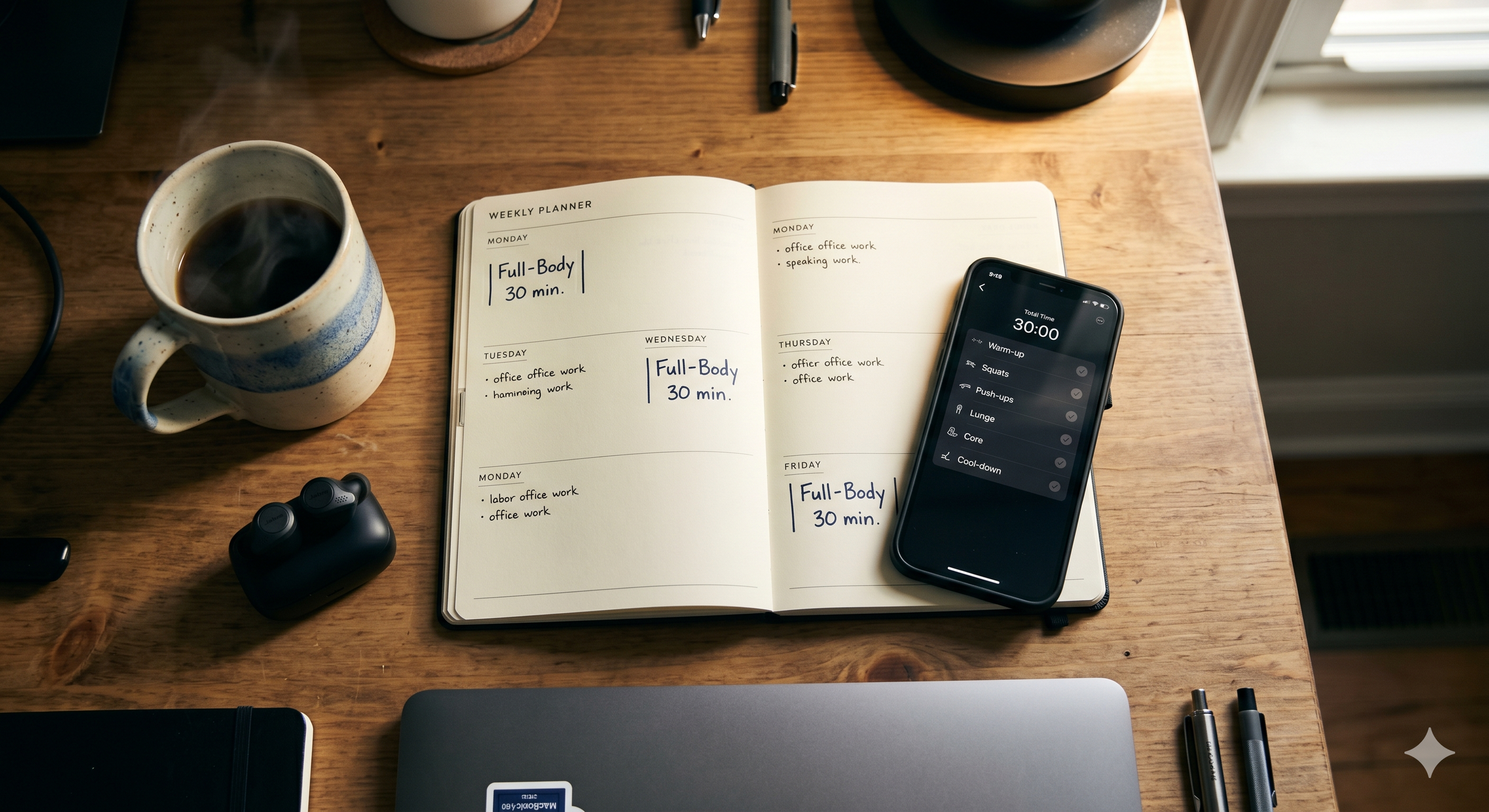
This image was created using AI to avoid copyright issues while conveying the context of this article.
Most busy professionals don't have a fitness problem. They have a scheduling problem.
When the calendar fills up with back-to-back meetings, last-minute travel, and the general unpredictability of running a business or leading a team, a five or six-day training schedule becomes the first casualty. You miss one session, then two, and before long the whole routine gets quietly shelved until "things calm down," which, as you know, they never really do.
Here's the reality: you don't need five days in the gym to build a lean, strong, capable body. You need three. A well-designed three-day training plan, built around your schedule and your movement patterns, will consistently outperform a five-day plan you can only follow half the time. Consistency wins every time — not the most ambitious schedule on paper.
Here is how to build one that actually works.
Start With Full-Body Sessions, Every Time
The old "body part split," chest on Monday, back on Tuesday, legs on Wednesday, was designed for people training five or six days a week. At three days, that model breaks down fast. Miss your Monday session and your chest doesn't get trained again for two weeks.
The fix is straightforward: every session should train your entire body. By hitting all your major muscle groups on Monday, Wednesday, and Friday, you create a consistent training signal across the whole week. If life pushes Friday's workout to Saturday, your progress stays intact. Nothing falls through the cracks because no single session carries the weight of the whole week.
Build Around the Five Foundational Movements
A common mistake when shortening a training plan is filling the time with isolated machine exercises, a bicep curl here, a leg extension there. These have their place, but they are not the foundation of an efficient plan. Your three-day structure should be built around the five movement patterns that develop real-world strength and protect your body over time:
Squatting: Builds lower body strength and protects your knees and hips. Goblet squats, split squats, and barbell squats all qualify.
Hinging: Deadlifts, Romanian deadlifts, and hip extensions that strengthen your glutes and lower back, critical for anyone spending long hours at a desk.
Pushing: Chest presses, shoulder presses, or push-up variations.
Pulling: Rows, pull-downs, and pull-ups that counteract the forward-rolled posture that comes with desk work and long flights.
Carrying or Core Stability: Farmer carries, planks, or any movement that forces your midsection to stabilize under load while you move.
One exercise from each category per session gives you a complete, athletic workout in under 30 minutes. There is no fluff, and nothing important gets left out.
Use the Superset Structure to Maximize Your Time
30 minutes sounds short until you realize how much time the average person wastes between sets, checking a phone, refilling a water bottle, watching someone else's set. The superset structure eliminates that dead time entirely.
Instead of resting between a set of chest presses and your next set of chest presses, you immediately move to a set of rows. Your chest recovers while your back works. Then you return to the press. You are doing the same volume of work in roughly half the time, and your heart rate stays elevated throughout, which adds a conditioning benefit on top of the strength work.
Pair your push and pull movements together. Pair your squat and hinge together. Finish with your core work. That structure alone can take a 60-minute workout and compress it cleanly into 25 to 30 minutes without sacrificing results.
Give Every Session an Alternate Version
This is the step most plans skip, and it is the reason most plans eventually fail.
Your Monday session calls for a barbell squat at your home gym or local facility. But you are flying out Sunday night and won't be back until Tuesday. If your plan doesn't have a backup, that session becomes a coin flip, you either improvise something, or you skip it.
Before your plan goes live, every workout should have a pre-built alternate version designed for a hotel room or a minimal gym. The goal for each movement stays identical. The execution adapts to what is available. A barbell squat becomes a heavy dumbbell goblet squat or a slow, controlled split squat using the hotel bed. A cable row becomes a resistance band row or a suitcase row. The substitution list should be built in advance, not invented under pressure at 6am in a Marriott.
The Real ROI of Three Days
There is a temptation to feel like three days isn't enough, that you should be doing more. That feeling is worth examining. More sessions create more opportunities to miss sessions, and every missed session erodes the psychological momentum that keeps a routine alive long-term.
A three-day plan that you execute consistently for 12 months will produce far better results than a five-day plan you follow for three weeks, abandon, restart, and abandon again. The compounding value of showing up, week after week, is the most underrated variable in fitness.
Three focused days. Five foundational movements. A backup plan already loaded. That is a system built to hold up under the real demands of a professional schedule, not just the idealized version of one.
At Legacy Fitness, we build three-day personalized training tracks around your specific movement history, schedule, and goals with alternate travel versions built in from day one. If you want a plan designed around your life, not against it, reach out here.
