
The Sleep-Fat Loss Connection: Why You Can’t Out-Train a Bad Night’s Sleep
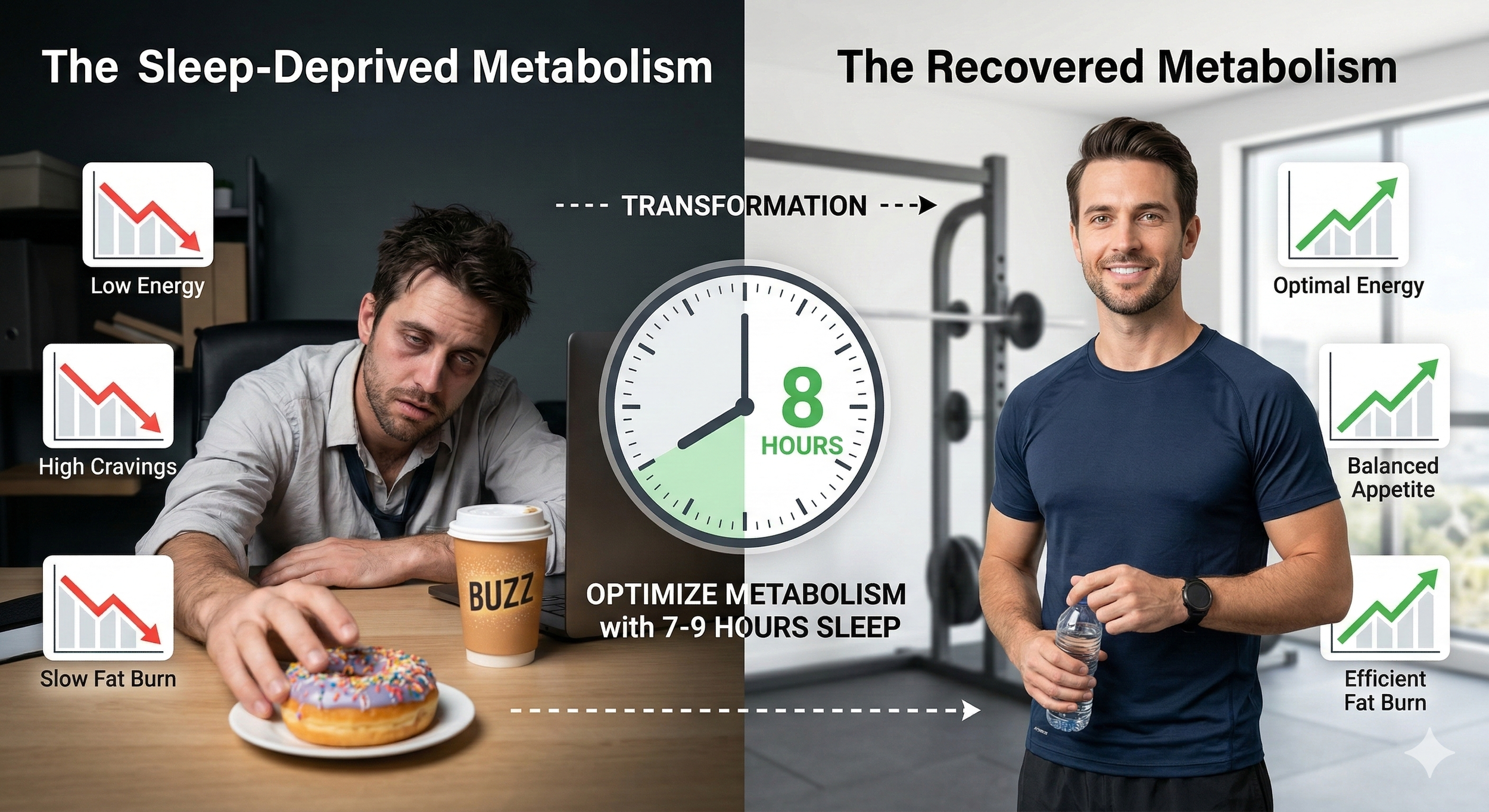
This image was created using AI to avoid copyright issues while conveying the context of this article.
In the pursuit of a leaner, stronger body, we often focus all our energy on what we do while we are awake; the grueling workouts, the precise macro counting, and the relentless activity. But what if the most important part of your fat-loss journey happens while you’re unconscious?
The data is clear: Sleep is not a luxury; it is a metabolic necessity. If you are consistently sleeping less than seven hours a night, you are fighting a biological uphill battle. You can have the perfect training program and a flawless diet, but without adequate recovery, your body will refuse to let go of fat.
The Hormonal Sabotage
When you are sleep-deprived, your body undergoes a massive hormonal shift that directly opposes your fat-loss goals.
Ghrelin (The Hunger Hormone): Lack of sleep causes ghrelin levels to spike. This is the hormone that tells your brain, "I'm starving." This is why you feel ravenous the day after a late night.
Leptin (The Fullness Hormone): Simultaneously, your leptin levels drop. Leptin is responsible for signaling that you are full. When it’s low, your brain never gets the "stop eating" memo.
Cortisol (The Stress Hormone): Sleep deprivation is a physical stressor. Elevated cortisol levels signal to your body that it is in "survival mode," encouraging it to store fat (especially around the midsection) and break down muscle for energy.
The Insulin Resistance Trap
Research shows that just one week of inadequate sleep can significantly impair your insulin sensitivity. When your cells become "resistant" to insulin, your body has to pump out even more of it to manage your blood sugar.
Insulin is a storage hormone. When it is chronically high, your body stays in "storage mode" and shuts down "burning mode." Essentially, poor sleep makes your body behave as if it has a metabolic disorder, making it nearly impossible to access stored body fat for fuel.
Decision Fatigue and Willpower
Beyond the biology, there is the psychology of exhaustion. Your prefrontal cortex, the part of the brain responsible for impulse control and complex decision-making, is the first thing to "go dark" when you’re tired.
This is why "tired you" makes choices that "rested you" would never make. You are more likely to skip the gym, grab the office donuts, and order takeout for dinner. You aren't lazy; your brain is simply too tired to exercise its "willpower muscle."
The Legacy Sleep Protocol
To finish March strong, we need to treat sleep with the same respect we treat our deadlifts. Here is how to optimize your recovery:
The 3-2-1 Rule: No food 3 hours before bed, no work 2 hours before bed, and no screens 1 hour before bed.
Cool and Dark: Your body needs a drop in core temperature to initiate deep sleep. Keep your room cool (around 65-68°F) and as dark as possible.
Consistency Over Duration: Going to bed and waking up at the same time every day (even on weekends) regulates your circadian rhythm, making it easier for your body to enter restorative REM cycles.
Recovery is the Work
In the Legacy Fitness philosophy, we don't just train hard; we recover hard. If you have to choose between a 5am workout on four hours of sleep or an extra two hours of rest, choose the rest. Your hormones, your metabolism, and your long-term results will thank you.
