

Scaling Your Health Like a Business: Systems, Metrics, and Consistency
By applying the principles of systems, metrics, and consistency, you ensure that your body remains your greatest asset, not your biggest liability.

This image was created using AI to avoid copyright issues while conveying the context of this article.
As an executive, you know that a business cannot grow on "vibes" or "good intentions." To scale a company, you need robust systems, reliable metrics, and absolute consistency. You wouldn't manage your P&L by "guessing" how much revenue came in, yet this is exactly how most people manage their health. They guess their calorie intake, they guess their effort in the gym, and they wonder why they aren't seeing an ROI.
At Legacy Fitness, we believe that your health is the ultimate business venture. It is the infrastructure that allows every other part of your life to function. If you want to achieve elite-level fitness without sacrificing your professional output, you have to stop treating your health like a hobby and start treating it like a high-growth organization.
Here is how to scale your physical performance using the same logic you use in the boardroom.
1. Build Systems, Not Just Goals
In business, a goal without a system is just a dream. If you want to increase revenue by 20%, you build a sales funnel, a marketing strategy, and a CRM. You don't just "hope" it happens.
The same applies to your body. "Losing 20 pounds" is a goal; having a pre-planned meal delivery service, a blocked-out 7:00 AM training slot, and a "sleep hygiene" checklist is a system. Systems remove the need for willpower. When your healthy choices are automated, just like your payroll, you stop making emotional decisions based on how "tired" or "busy" you feel.
A scaled health system ensures that even on your most stressful days, your baseline habits remain intact.
2. Identify Your Key Performance Indicators (KPIs)
You cannot manage what you do not measure. In the weight room and the kitchen, we need to identify the lead measures that actually drive results.
Most people focus only on the "lag measure," the number on the scale. But by the time the scale moves, the work has already been done. To scale your health, you need to track your Lead Measures:
Protein Intake: Are you hitting your daily target to protect your metabolic insurance?
Step Count (NEAT): Are you maintaining a baseline level of movement?
Training Volume: Are you progressively getting stronger over time?
Sleep Quality: Is your recovery keeping pace with your output?
When these KPIs are in the green, the lag measure (fat loss/muscle gain) takes care of itself.
3. The Power of "Marginal Gains"
In the 1990s, the British Cycling team was mediocre at best. They changed their trajectory by focusing on "the aggregation of marginal gains," the idea that if they improved every tiny detail by just 1%, the cumulative effect would be massive.
When scaling your health, don't look for a "magic pill." Look for the 1% improvements.
Can you improve your hydration by adding minerals?
Can you improve your sleep by 15 minutes?
Can you improve your "Mind-Muscle Connection" by slowing down your reps?
In business and in biology, small, consistent improvements compound into a legacy of success.
4. Delegate to Experts
The most successful CEOs know when to hire a specialist. They don't try to be their own CFO, CTO, and Head of HR. They delegate those roles to experts so they can focus on their "Zone of Genius."
The "DIY" approach to fitness is often the most expensive choice an executive can make. It costs you time spent in "analysis paralysis" and energy spent on ineffective strategies. Scaling your health means hiring a "Chief Health Officer," a coach who manages the strategy, analyzes the data, and provides the accountability. This allows you to stay focused on your professional legacy while your physical legacy is built in the background.
The Annual Report: Looking Back to Move Forward
As we wrap up April, it is time for your "Monthly Health Review."
What systems worked this month?
Which KPIs moved in the right direction?
Where did the "operational friction" occur?
Your health is not a project with a finish line; it is a company that requires constant optimization. By applying the principles of systems, metrics, and consistency, you ensure that your body remains your greatest asset, not your biggest liability.
Wondering how many calories you actually burn?
You can't manage what you don't measure. Mastering your health starts with knowing your baseline. Use my BMR Calculator to find your personalized daily calorie and macro targets so you can scale your health with the precision of a business plan. Use the BMR Calculator Here
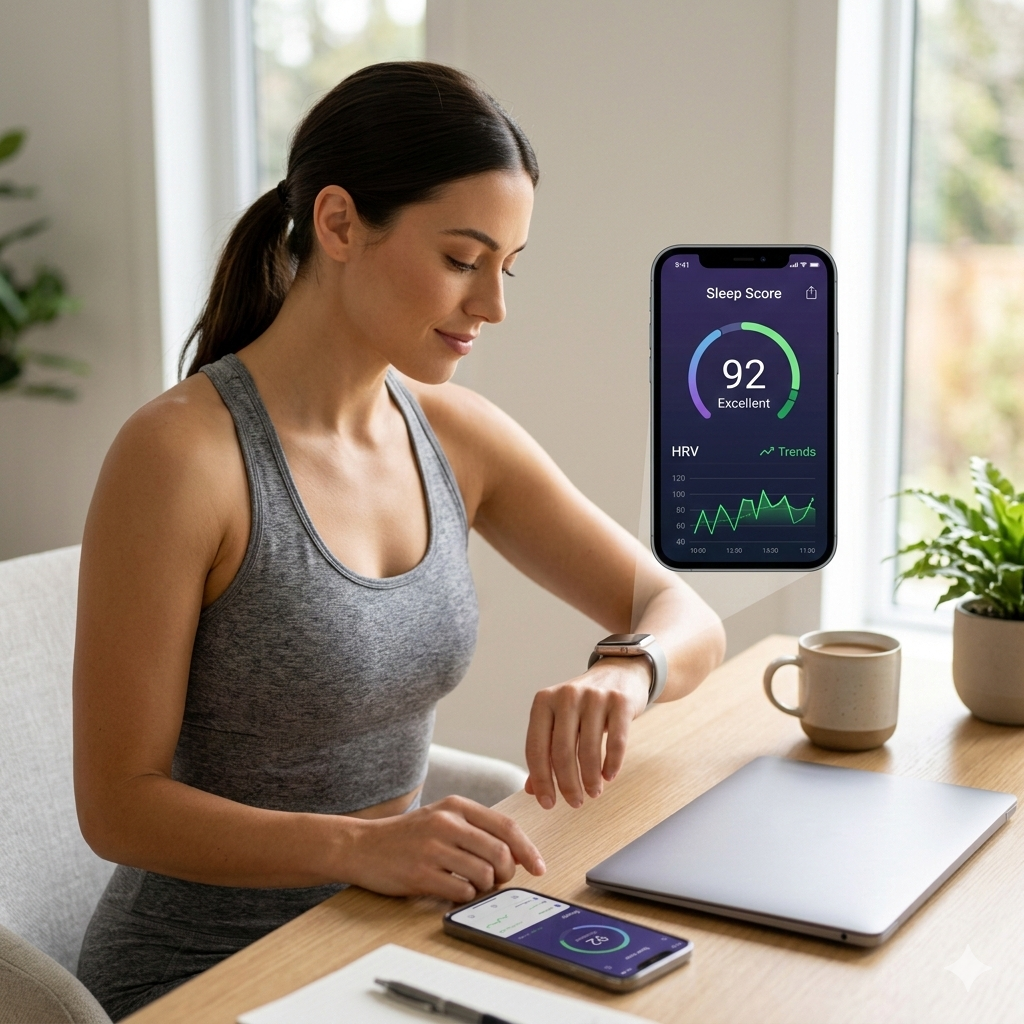
Beyond the Scale: What We Learn from Tracking Your Sleep, Energy and Stress
The scale is a single data point. Your biofeedback is the whole story.
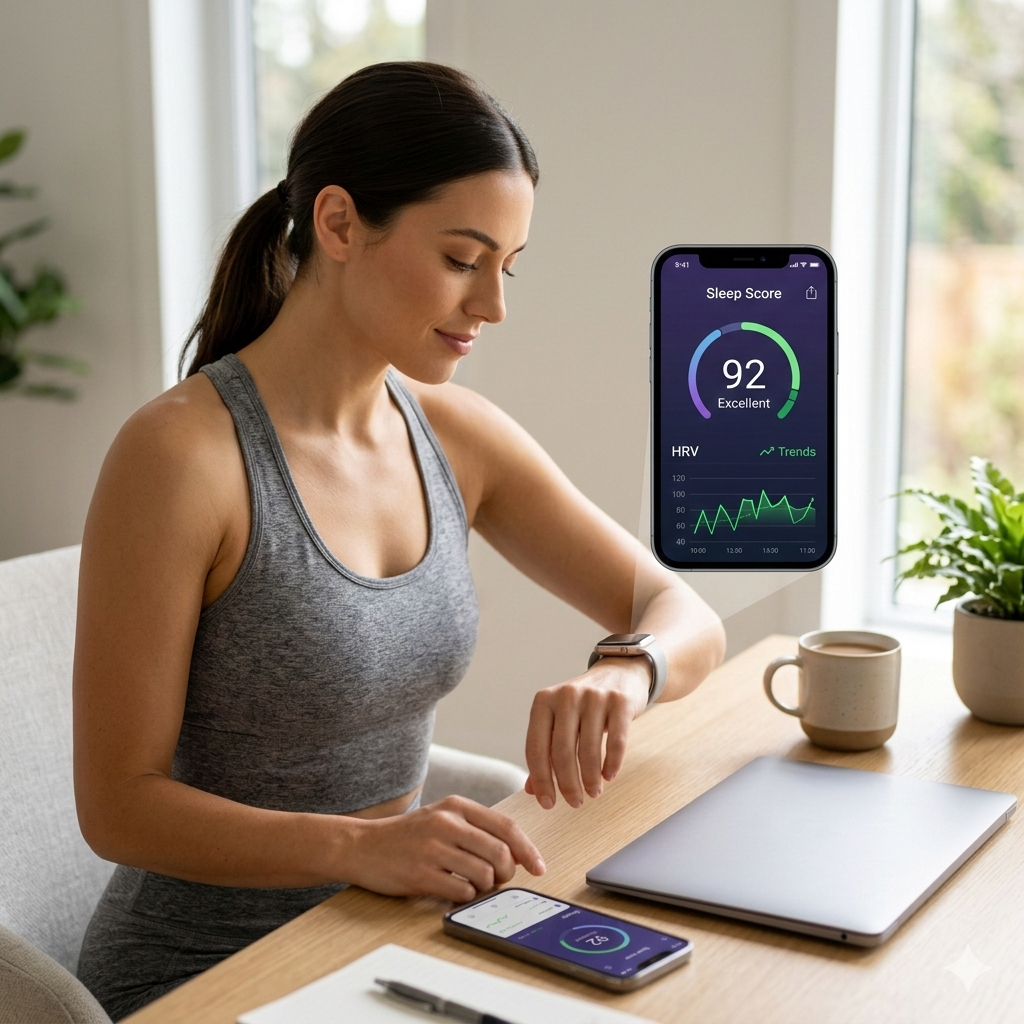
This image was created using AI to avoid copyright issues while conveying the context of this article.
If you have ever had a week where you followed your meal plan perfectly and hit every workout, only to see the scale go up by a pound, you know how frustrating fitness can be. Your first instinct is usually to eat less or run more. But often, the problem isn't your food or your exercise. The problem is everything else.
In the Legacy Fitness coaching model, we look at more than just calories and deadlifts. We track your "Biofeedback." These are the internal signals your body sends you every day, specifically your sleep, your energy levels, and your stress.
When you track these three things, you give us a "weather report" for your metabolism. It allows us to see why the scale might be stuck and, more importantly, how to fix it without burning you out.
Sleep: The Fat-Burning Foundation
Think of sleep as the "cleanup crew" for your body. While you sleep, your body repairs muscle tissue and regulates the hormones that control hunger.
If you consistently get less than seven hours of sleep, two things happen:
►Hunger Spikes: Your level of ghrelin (the hunger hormone) goes up, and leptin (the fullness hormone) goes down. You will feel hungrier all day, especially for sugar.
►Cortisol Rises: Lack of sleep is a physical stressor. High cortisol tells your body to hold onto water and protect its energy stores (fat).
If I see your sleep dropping in your logs, I know exactly why your weight isn't moving. We don't need a harder diet; we need a better bedtime.
Energy: The "Fuel Gauge" of Your Metabolism
Do you have a "3pm crash" every day? Or do you wake up feeling like you were hit by a truck even after eight hours of sleep?
Your energy levels tell me how well you are recovering and how your body is handling its fuel. If your energy is consistently low, it’s a sign that:
►You might be in too large of a calorie deficit.
►You might not be eating enough carbohydrates to fuel your brain and muscles.
►You might be overtraining.By tracking your energy on a scale of 1 to 10, we can find your "sweet spot." We want you to feel focused at work and powerful in the gym. If the data shows your energy is tanking, we make an adjustment before you hit a wall.
Stress: The Silent Progress Killer
Stress isn't just "in your head." It is a physical event in your body. Whether the stress comes from a deadline at work, an argument with a spouse, or a heavy set of squats, your body reacts the same way by releasing hormones.
If your stress levels are at a 9/10 all week, your body is in "survival mode." In survival mode, fat loss is not a priority for your biology; staying alive is.
By tracking your stress, we can decide when to "push" and when to "pivot." On a high-stress week, the best thing for your fat loss might actually be a lighter "deload" week in the gym or a few extra calories to help your body feel safe again.
The Big Picture
The scale is a single data point. Your biofeedback is the whole story. When you log your sleep, energy, and stress, you are helping me build a plan that works with your life, not against it.
In March, pay attention to these signals. They are the keys to a body that doesn't just look good, but feels incredible. When we master the "hidden" metrics, the visible ones, like your reflection in the mirror, take care of themselves.