

Mid-Year Check-In: How to Reset Your 2026 Goals
The goal isn't to lower your standards. It's to align your goals with your actual priorities, not an idealized version of yourself.

This image was created using AI to avoid copyright issues while conveying the context of this article.
You set intentions in January. Maybe you wrote them down, maybe you just held them in your head. Either way, it's now the midpoint of the year, and if things have drifted, you're not alone. Life doesn't pause to accommodate your goal sheet.
The good news is that June is one of the most underrated reset windows in the calendar year. You still have six months. That's enough time to build real momentum, but only if you stop treating a stalled plan like a failure and start treating it like useful data.
Here's how to do a mid-year check-in that actually means something.
Start with an honest audit, not a guilt trip
The first step isn't motivational. It's diagnostic. Pull up whatever you wrote in January, or reconstruct it from memory, and ask three questions: What did I actually do? What got in the way? What changed?
Notice the framing. You're not asking what you failed at. You're asking what happened and why. A goal that didn't survive contact with a demanding Q1 at work wasn't a bad goal; it was probably just under-resourced. You didn't account for the travel schedule, the late nights, the mental load of a big project. Now you know.
This matters because most people skip the audit and jump straight to setting new goals, which means they repeat the same mismatch between ambition and bandwidth.
Separate what you want from what you thought you should want
January goals are often aspirational, in the best and worst sense. The best version is that you were genuinely reaching for something. The worst version is that you were writing down what you thought a motivated person should want, rather than what actually fits your life.
By June, you have evidence. If you set a goal to train five days a week and it never happened, there are two possibilities: either life genuinely wouldn't allow it, or you didn't actually want it enough to protect the time. Both are valid. Both require a different response.
The goal isn't to lower your standards. It's to align your goals with your actual priorities, not an idealized version of yourself that doesn't have meetings until 8 PM or a toddler who wakes up at 5 AM.
Rebuild around what worked
This is where the audit pays off. Hidden inside every inconsistent first half is something that did work, even occasionally. Maybe you didn't follow the diet perfectly, but you consistently chose protein-heavy lunches on weekdays. Maybe you didn't hit the gym four times a week, but you never missed Monday. Maybe your sleep improved even when training didn't.
Those patterns are your foundation. Build from them, not against them. A realistic second half isn't about grinding harder; it's about compounding what's already working.
Set process goals, not just outcome goals
Outcome goals tell you where you want to end up. Process goals tell you what you'll do between now and then. The problem with a goal like "lose 20 pounds by December" is that it gives you nothing to execute on Tuesday morning when life is in the way.
Process goals fix that. "Eat a protein-first breakfast five days a week" is something you can either do or not do. "Walk 20 minutes after dinner, four nights a week" is either happening or it isn't. These small, repeatable behaviors are what actually produce outcomes over six months.
Set one or two clear process goals per area of your life you want to improve. Don't build a 12-variable system. Simplicity is how busy schedules sustain change.
Adjust your timeline without abandoning your target
If you're significantly behind on a goal, the answer usually isn't to scrap the goal; it's to extend or recalibrate the timeline. You wanted to be down 25 pounds by June. You're down 8. That's not nothing. It's a pace you can learn from and build on.
Running the same plan harder for six more months probably won't work if the plan itself was mismatched to your life. Running a slightly modified plan, one that accounts for what actually happens in your schedule, probably will.
Ask yourself: If I keep the destination but recalibrate the route, what does that look like?
Commit publicly to one specific thing
Accountability accelerates follow-through. You don't need a coach, a group, or a formal program to create it, though those things help. You just need to tell one person one specific thing you're going to do, and then do it.
The more specific, the better. "I'm going to focus on my fitness" gives nobody, including you, anything to hold. "I'm committing to walking every morning before I open my laptop, starting Monday" does.
The second half is yours to shape
At Legacy Fitness, we work with people who've been here, who had a plan that didn't survive the year, who are looking at the calendar in June and wondering if there's still enough time. There is. Six months, approached with clarity and honesty, will surprise you.
The question isn't whether you've fallen behind. It's whether you're willing to take an honest look, adjust, and move.

Your "Why" is Not a Number: Redefining Success Beyond the Scale
This December, as you plan for the New Year, change your focus. Don't chase a number that fluctuates daily. Chase the feeling of confidence, the energy to live your life, and the strength to build your lasting legacy.

Image courtesy of Tamara Govedarovic via Unsplash
When you set a New Year's goal, where does your mind go first?
"I want to lose 20 pounds."
"I want to fit into my old jeans."
"I want to hit a certain number on the scale."
At Legacy Fitness & Nutrition, we understand the power of numbers. They are easy to track, and they give a clear, simple goal. But here is the major trap people fall into: If your goal is only a number, your motivation will disappear the second that number moves in the wrong direction.
A successful fitness legacy is built on something much stronger than pounds or minutes. It's built on your "Why." And your "Why" is not a number.
The Flaw in the Number-Only Goal
Imagine you’re trying to lose 10 pounds. You eat perfectly for five days, you work out hard, and you jump on the scale. You’re up a pound!
Immediately, your brain goes: "This doesn't work. I failed. Why bother?" You throw in the towel, thinking you've ruined your progress.
What you didn’t account for is that the scale is a terrible tracker of daily effort. That single pound could be:
Water weight from a higher-sodium meal.
Glycogen (stored carbs) from a tough workout.
Muscle gain (which is denser than fat).
Focusing only on the number blinds you to the real successes happening every day. You need to redefine what "winning" means.
Finding the Deeper "Why" (The Legacy)
Your true "Why" is the reason you want to be healthy in the first place. It is what keeps you going when the scale won't move. It is your Legacy.
To find your true "Why," ask yourself, "If I achieve that number goal, what will I actually do with that result?"
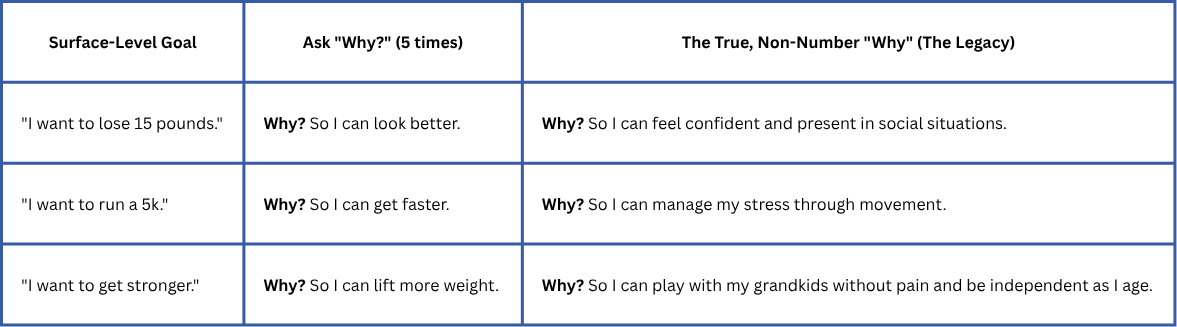
The true "Why" is always about feeling, functioning, and lasting.
The Three Non-Scale Victories (NSVs) to Track
To build a stronger "Why," start tracking these three Non-Scale Victories (NSVs) every week. These prove your habits are working, even if the scale is stuck:
1. Functional Strength and Energy
Win: You carried all the groceries in one trip instead of two.
Win: You walked up two flights of stairs and weren't out of breath.
Win: You got through the 3 PM slump without needing a coffee or sugar fix.
This tells you your cardio and strength are improving. Your body is functioning better in daily life.
2. Mood and Sleep Quality
Win: You felt calmer during a stressful work meeting.
Win: You fell asleep faster and woke up feeling truly rested (not just awake).
Win: You handled a difficult family conversation without relying on comfort food.
This shows your fitness is benefiting your mental health and hormones. You are building resilience.
3. Consistency and Recovery
Win: You nailed all three of your planned workouts this week.
Win: You felt good enough on Monday to work out again after a tough Sunday session.
Win: Your clothes fit more comfortably, even if the scale hasn't changed.
This is the ultimate win: you are building the identity of a healthy person. This consistency is the only way to guarantee the number goals follow later.
This December, as you plan for the New Year, change your focus. Don't chase a number that fluctuates daily. Chase the feeling of confidence, the energy to live your life, and the strength to build your lasting legacy. Your motivation will become unshakable.