

Mindful Muscle: Using Breathwork During Your Lift
"Mindful Muscle" is changing how we think about strength training. It is the practice of connecting your internal state, your nervous system, to your external movements.

This image was created using AI to avoid copyright issues while conveying the context of this article.
When you walk into a crowded gym, the atmosphere is usually loud and chaotic. You hear the clanging of metal, the thumping of music, and the sounds of people grunting through heavy repetitions. From the outside, it looks like a test of pure "will" and physical force. But if you look closely at the most elite athletes in the room, you will notice something different. They are calm. They are focused. And most importantly, they are in total control of their breath.
In 2026, a new trend called "Mindful Muscle" is changing how we think about strength training. It is the practice of connecting your internal state, your nervous system, to your external movements. If you have been holding your breath while you exercise or gasping for air between sets, you are missing out on a massive amount of strength and safety. Your breath is the "remote control" for your body, and it is time to learn how to use it.
The Physics of the "Human Soda Can"
To understand why breathing matters for lifting, think about an unopened can of soda. Because it is full of liquid and pressurized gas, you can stand on that can and it won't crush. It is incredibly strong. Now, imagine opening that can and pouring the soda out. If you step on it now, it collapses instantly.
Your torso is exactly like that soda can. Your spine is the structure, but your core muscles and your breath provide the "internal pressure" that keeps the structure safe. Many people make the mistake of "sucking in" their stomach when they lift. This is like emptying the soda can! Instead, you want to use a technique called "bracing." By breathing deep into your belly and holding that air against your abdominal wall, you create a "shield" for your lower back. This allows you to lift heavier weights with much less risk of injury.
The "360-Degree" Breath
Most of us are "chest breathers." When we take a deep breath, our shoulders shrug up toward our ears. This is a "stress breath." It tells your brain that you are in a "fight or flight" situation, which can make your muscles feel tight and guarded.
In the "Mindful Muscle" approach, we practice the "360-degree breath." Instead of the air going up into your chest, imagine it going down into your waistband. You should feel your belly move forward, but you should also feel your sides and your lower back expand outward. This creates total pressure all the way around your spine. Before you start a squat, a deadlift, or even a heavy overhead press, take this 360-degree breath. "Pack" the air down, perform the move, and then exhale as you finish the hardest part.
Breathing for Maximum Power
There is a specific rhythm to "Mindful Muscle" that helps you generate more power. As a general rule, you want to Inhale during the "eccentric" phase (the lowering of the weight) and Exhale during the "concentric" phase (the pushing or pulling of the weight).
For example, if you are doing a chest press:
Inhale slowly as you lower the bar to your chest, creating that "internal pressure" we talked about.
Pause for a split second at the bottom.
Exhale sharply as you push the bar back up.
This sharp exhale acts like a "release valve" that allows your muscles to contract with more force. It also keeps your blood pressure from spiking too high, which can happen if you hold your breath for too long during a heavy lift.
The Nasal Recovery Reset
What you do between your sets is just as important as what you do during them. After a hard set of exercises, most people stand around with their mouths open, gasping for air. This keeps your heart rate high and keeps your body in a "stressed" state.
To recover faster, try the "Nasal Reset." As soon as you finish your set, close your mouth and breathe only through your nose. It might feel difficult at first, but nasal breathing sends a signal to your "Vagus Nerve" (the body's internal brake pedal) to calm down. By lowering your heart rate faster, you ensure that you have more energy for your next set. This allows you to do more work in less time, which is the key to seeing results in January.
The Mind-Muscle Connection
The final benefit of "Mindful Muscle" is mental. When you focus on your breath, you cannot worry about your emails, your chores, or your stress. You are forced to be "present" in your body. This connection allows you to actually feel the muscles you are trying to work. Instead of just "moving the weight from point A to point B," you are intentionally contracting your chest, your glutes, or your back.
This January, don't just go through the motions. Stop being a passive observer of your workout and start being an active participant. Your breath is the bridge between your mind and your muscles. Master the bridge, and you will master your legacy.

Mindful Indulgence: A Guilt-Free Guide to Enjoying Holiday Treats
Mindful indulgence means accepting that treats are part of the holiday experience and deciding how you will enjoy them before you take the first bite.

Image courtesy of Nadiia Shuran via Unsplash
The weeks between Thanksgiving and New Year's Day often turn into an all-or-nothing eating pattern. We tell ourselves, "I can't eat that cookie!" or "I'll start over in January." This mindset leads to a cycle of restriction, followed by guilt-ridden bingeing, followed by more restriction.
This year, let's replace the guilt with a strategy of Mindful Indulgence. This approach is based on the idea that health isn't measured by one day or one meal, but by consistent habits over time. It gives you permission to fully enjoy the unique treats of the holiday season while keeping your long-term goals firmly in view.
Mindful indulgence means accepting that treats are part of the holiday experience and deciding how you will enjoy them before you take the first bite.
Rule 1: Pre-Decide the Treat, Not the Restriction
The moment you see a plate of your favorite holiday cookies, the emotional brain takes over. Don't wait until that moment to decide.
The Strategy: The 2-Treat Rule. Before you walk into a party or start a holiday dinner, look at the menu (or the dessert table) and decide, "I will enjoy two of my absolute favorite treats tonight."
Why it works: This removes the emotional fight ("Should I or shouldn't I?") and replaces it with a calm decision ("Which one should I choose?"). It shifts your focus from avoidance to selection, making the experience feel intentional and enjoyable, not accidental and guilty.
Rule 2: Engage All Five Senses
When you mindlessly eat a handful of treats while doing something else (like watching a movie or talking), you don't actually register the taste, but you still absorb the calories.
The Strategy: The Slow-Down Test. When you indulge, do so fully. Put your chosen treat on a small plate, sit down, and focus only on the food for a few minutes.
How to do it: Look at the treat, notice the color and texture. Smell the treat, notice the spices and warmth. Take a small bite and chew it slowly, focusing on the flavor profile (sweet, spicy, salty). The goal is to get 100% satisfaction from 25% of the food. When the satisfaction drops below 100%, put it down.
Rule 3: Build the Buffer Zone
Mindful indulgence doesn't mean ignoring your habits; it means strengthening them to support your indulgences. You build a "buffer zone" of healthy choices around the occasional treat.
Prioritize Protein First: Every day, ensure you hit your protein target (around 0.7g/lb of bodyweight). Protein keeps you full, supports your metabolism, and stabilizes blood sugar. If you fill up on protein and fiber first, you'll naturally have less room and less desire for simple sugars.
Don't Skip the Workout: The minute you decide to indulge, commit to your workout the next morning. Knowing you have a workout planned reinforces your identity as an active person and prevents the guilty feeling of "giving up." The workout is not punishment; it's a non-negotiable part of your routine.
Rule 4: Embrace the 80/20 Rule for the Whole Season
No one single meal or single treat will derail your goals. It is the continuous stream of "little cheats" that turns a week into a setback.
The Mindset Shift: Focus on controlling the 80% of your time that is not a holiday party. This means returning to your core habits (protein, veggies, water, sleep) immediately after the holiday event is over.
The Legacy Lesson: Think of the season as a marathon, not a sprint. The goal is to cross the finish line feeling good. By being intentional with your treats and consistent with your core habits, you eliminate the need for a frantic "January detox." You prove that healthy living is flexible enough to include joy, celebration, and tradition.
This holiday season, give yourself the gift of presence and peace. Replace the guilt with intentionality, and enjoy your holiday treats mindfully.
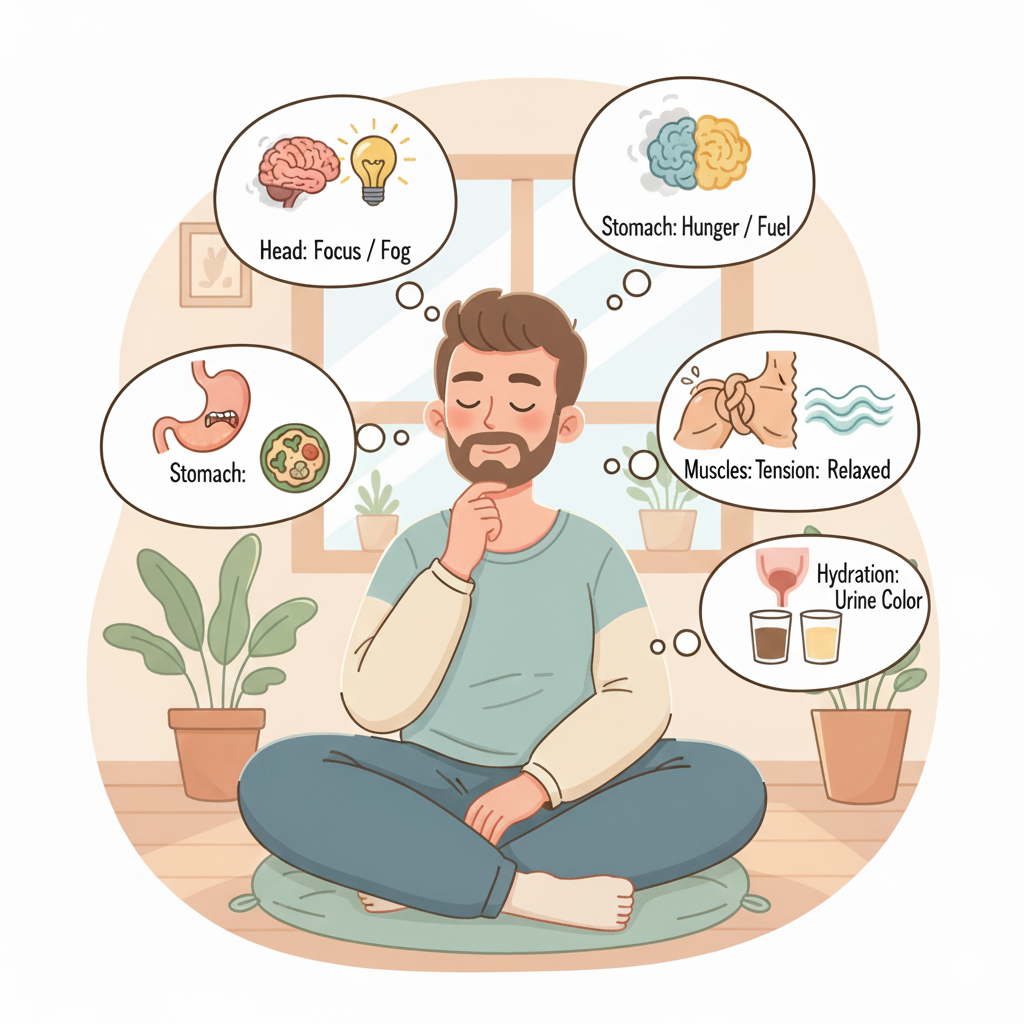
How to Read Your Own Body: Tuning in to Your Hunger, Energy, and Thirst Cues
The skill of tuning in, or listening to your own internal cues, is the foundation of intuitive eating, smarter training, and living a truly balanced, high-energy life.

In our fast-paced, screen-obsessed world, we often live "outside" our bodies. We rely on apps to tell us when to sleep, social media to tell us what to eat, and complicated formulas to tell us when to drink water.
But your body is actually a genius. It gives you constant, subtle feedback on exactly what it needs, when it needs it. The skill of tuning in, or listening to your own internal cues, is the foundation of intuitive eating, smarter training, and living a truly balanced, high-energy life.
Learning to interpret the signals your body is sending about hunger, energy, and thirst will empower you to stop following rigid external rules and start following your body’s true, deep wisdom.
1. Decoding Hunger: Beyond the Growl
We've already talked about the three types of hunger (physical, emotional, sensory). Mastering this skill means recognizing the subtler signals of true physical hunger before you reach the point of "hanger."
Early Signal: A slight drop in focus or mental sharpness. Your brain is the most energy-demanding organ, so mental fog is often the very first sign of needing fuel.
The Best Response: When you notice mental fog or a subtle, hollow feeling, eat a balanced snack or a meal (protein + fiber). Don't wait until you're ravenous and have lost all control over your food choices.
The Legacy Lesson: Eating when moderately hungry, and stopping when satisfied (not stuffed), keeps your energy stable and optimizes your digestion.
2. Decoding Energy: Understanding Fatigue
If you're constantly relying on coffee or sugary snacks to get through the day, you're masking a deeper message your body is sending you about energy management.
Signal 1: The Crash (Post-Lunch Slump): This is usually a sign that your last meal was unbalanced—too high in fast carbs and too low in protein/fiber.
The Best Response: Next time, build your plate around protein and vegetables first. If the crash hits, don't eat; instead, stand up and move for 5 minutes (a micro-workout!) to get blood flowing.
Signal 2: Morning Sluggishness: This is often a sign of poor sleep quality (not just duration).
The Legacy Lesson: Recognize that if you feel tired despite 8 hours of sleep, you need to focus on sleep quality (dark, cool room, less screen time before bed), not just duration.
3. Decoding Thirst: The Hidden Headache
Most people wait until they are genuinely thirsty before drinking, but thirst is often one of the last signals of dehydration. By the time you feel parched, your energy and performance are already suffering.
Early Signal: Headaches or irritability. Mild dehydration is one of the most common, overlooked causes of tension headaches and a sour mood.
The Next Signal: Dark or highly yellow urine. Pale straw color is the goal. If your urine is dark, you need water immediately.
The Legacy Lesson: Stop drinking just water. Drink water because you’ve created a visual cue (a water bottle on your desk) or linked it to a habit (after every bathroom break, drink a full glass). Staying properly hydrated boosts metabolism, flushes toxins, and keeps your mental clarity sharp.
The Body Check-In: Your Daily Practice
Learning to read your body takes practice. Use this quick check-in several times a day to tune in:

Your body is constantly telling you what it needs to perform optimally. By simply pausing, observing, and responding to these cues, you take back control from external noise and commit to a sustainable, self-aware path to lifelong wellness.

The 3 Types of Hunger: How to Tell if You're Truly Hungry or Just Bored
Have you ever finished a full meal and then, 30 minutes later, found yourself staring into the fridge? Understanding hunger is a core skill for mastering your nutrition and achieving lasting weight management.
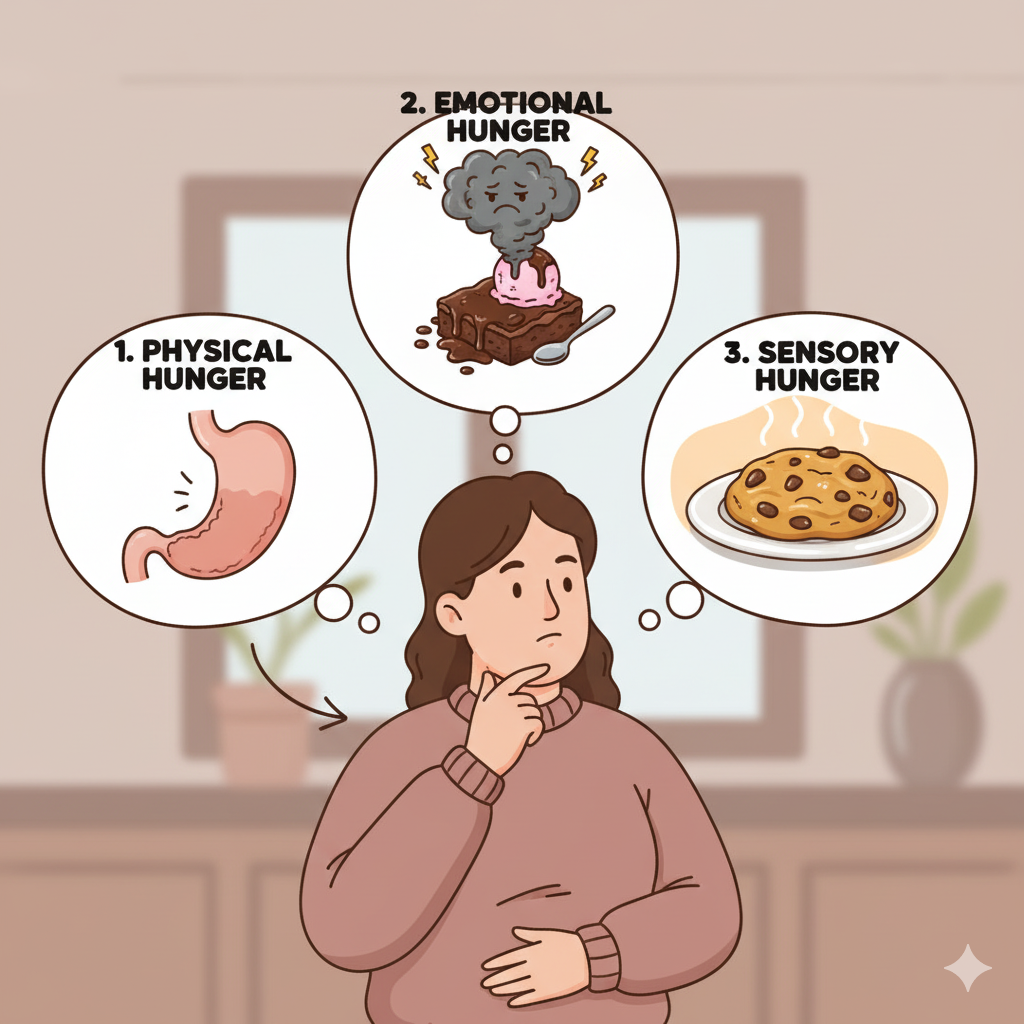
Have you ever finished a full meal and then, 30 minutes later, found yourself staring into the fridge? Or maybe you eat dinner, sit down to watch TV, and suddenly realize you want a snack, even though your stomach doesn't feel empty.
Understanding hunger is a core skill for mastering your nutrition and achieving lasting weight management. Most people only recognize one kind of hunger (stomach pangs), but there are actually three distinct types of hunger. Learning to identify them allows you to choose the right response—eating when you need fuel, or using a different tool when you need comfort or distraction.
Here is your guide to understanding the three types of hunger and how to manage each one.
1. Physical Hunger (The Real Fuel Light)
This is the kind of hunger your body uses to signal a genuine need for energy. It's slow and gradual, like a fuel light coming on in a car.
What it feels like:
Stomach signals: Mild gurgling, a hollow feeling, or a slight discomfort that grows over time.
Body signals: Slight lack of focus, low energy, mild headache, or a feeling of true weakness.
Satisfaction: It is satisfied by any type of food whether it’s a salad, a sandwich, or a piece of chicken.
The Right Response: EAT. When your body signals true physical hunger, it needs fuel. Honor this signal by eating a balanced meal or snack containing protein, fiber, and healthy fats. This is your chance to nourish your body and maintain stable energy.
2. Emotional Hunger (The Craving for Comfort)
Emotional hunger is the urge to eat that is triggered by feelings, not by an empty stomach. It's often related to stress, boredom, loneliness, or happiness.
What it feels like:
Speed: It hits suddenly and urgently, like flipping a switch. You feel like you need food right now.
Specific cravings: It often targets specific, highly palatable foods like chips, cookies, ice cream, or pizza—rarely does it make you crave broccoli.
Guilt: After eating, it often leaves you with feelings of guilt or shame because it didn't solve the underlying problem (the emotion).
The Right Response: PAUSE AND ADDRESS. Food cannot fix an emotional problem. When this hits, pause for 5 minutes and ask yourself: "What am I truly hungry for?"
If bored: Get up and move (walk, do a chore).
If stressed: Do a calming activity (deep breathing, calling a friend, listening to music).
If tired: Take a short nap or step away from your screen.
3. Sensory Hunger (The Smell/Sight Trigger)
Sensory hunger is triggered by your senses: seeing, smelling, or hearing food. This is the hunger you feel when you walk past a bakery or watch a commercial for your favorite food.
What it feels like:
External cues: The hunger is triggered entirely by something outside your body. Your stomach might be full, but the smell of coffee and a donut makes you feel like you must have one.
Short-lived: The feeling is often intense but fades quickly once the cue is removed.
The Right Response: DISTRACT AND WAIT. This type of hunger is usually the easiest to manage with a short distraction.
Try this: Brush your teeth, chew a piece of gum, grab a glass of water, or simply walk away from the sight or smell of the food. Since this hunger is based on external stimulation, removing that stimulation often makes the craving disappear in 10-15 minutes.
Mastering Your Hunger
Learning to listen to your body and correctly identify which "fuel light" is on is one of the most powerful steps you can take toward mindful eating.
When you feel the urge to eat, take a slow, deep breath and use this quick check:
Is it gradual? (Physical: EAT)
Is it urgent and specific? (Emotional: ADDRESS THE FEELING)
Is it triggered by a sight or smell? (Sensory: DISTRACT)
By giving your body what it truly needs, whether that's calories, comfort, or just a 15-minute distraction, you take control of your plate and move closer to your long-term health goals.

Vagal Tone: The Hidden Switch That Calms Your Nervous System (and How Exercise Helps)
In our fast-paced world, many of us spend too much time with our "fight or flight" system switched ON. By incorporating regular exercise and simple practices like deep breathing, you can actively strengthen your vagus nerve. This leads to a calmer mind, a more resilient body, and a better ability to thrive in the face of life’s challenges.

Ever feel stressed, anxious, or just constantly on edge? You’re not alone. In our fast-paced world, many of us spend too much time with our "fight or flight" system (the sympathetic nervous system) switched ON. But what if there was a way to naturally activate your body's "rest and digest" system (the parasympathetic nervous system) and find more calm?
Enter vagal tone. It might sound like a fancy science term, but it’s actually a powerful concept that can change how you feel every day.
What is Vagal Tone?
At the heart of your nervous system is a super important nerve called the vagus nerve. Think of it as a superhighway connecting your brain to almost all your major organs, including your heart, lungs, and gut. It’s a key player in how your body handles stress, digestion, heart rate, and even your mood.
Vagal tone isn't about how "strong" the nerve is. Instead, it refers to the activity of your vagus nerve—how well it can help your body switch from stressed to calm.
High vagal tone means your vagus nerve is working well. Your body can quickly calm down after a stressful event, your heart rate varies in a healthy way (more on this soon), and you feel more resilient and relaxed.
Low vagal tone means your vagus nerve isn't as active. Your body might stay in "fight or flight" mode longer, leading to chronic stress, anxiety, poor digestion, and even inflammation.
Why Does Vagal Tone Matter for Your Health and Fitness?
A healthy vagal tone is linked to all sorts of good things:
Stress Resilience: You can bounce back from stress more easily.
Better Digestion: The vagus nerve helps regulate gut function, which is key for nutrient absorption and avoiding digestive issues.
Reduced Inflammation: It helps control the body’s inflammatory response, which is crucial for overall health and recovery from workouts.
Improved Mood: A strong vagus nerve can help regulate mood and reduce feelings of anxiety and depression.
Heart Health: A key indicator of good vagal tone is Heart Rate Variability (HRV). A higher HRV (meaning more variation between heartbeats) suggests your body is adaptable and has a strong vagus nerve, which is a marker of good health and fitness. (Remember our article on wearable tech? This is part of what it measures!)
How to Boost Your Vagal Tone: Exercise and Beyond
The exciting news is that you can actually improve your vagal tone! While genetics play a role, lifestyle habits have a huge impact. And guess what? Your fitness routine is a powerful tool.
1. Exercise (Especially Zone 2 Cardio)
Regular exercise, particularly moderate activity, is one of the best ways to boost vagal tone.
Zone 2 Cardio: This is where you can still hold a conversation but are breathing a bit heavier. Think brisk walking, light jogging, cycling, or swimming. This type of consistent, moderate-intensity exercise has been shown to improve HRV, a direct measure of vagal tone. It gently challenges your body without overstressing it, helping your nervous system become more flexible.
Strength Training: While intense workouts can temporarily increase stress, consistent strength training builds a resilient body that handles all stressors (physical and mental) better over time, indirectly supporting vagal tone.
2. Deep, Slow Breathing (Diaphragmatic Breathing)
This is perhaps the simplest and most direct way to stimulate your vagus nerve.
How it works: Your vagus nerve passes through your diaphragm. When you take slow, deep breaths that expand your belly (diaphragmatic breathing), it gently massages and stimulates the nerve.
Try this: Breathe in slowly through your nose for 4-6 seconds, letting your belly expand. Hold for a count of 1-2, then exhale slowly through your mouth for 6-8 seconds, feeling your belly pull in. Repeat for 5-10 minutes.
3. Cold Exposure
Short bursts of cold exposure can shock your vagus nerve into action.
Try this: Finish your shower with 30 seconds to 1 minute of cold water. Or splash cold water on your face. The sudden change stimulates the vagus nerve.
4. Humming, Chanting, or Singing
The vagus nerve passes near your vocal cords and connects to muscles in your throat. Vibrations in this area can stimulate the nerve.
Try this: Hum your favorite tune in the shower, or simply hum deeply for a few minutes.
5. Social Connection & Laughter
Connecting with loved ones, hugging, and laughing all activate the parasympathetic nervous system and stimulate the vagus nerve. This is your body's natural way of telling you you're safe and supported.
6. Gut Health
Remember the gut-brain connection? The vagus nerve is the main pathway. Eating a diverse diet rich in fiber, fermented foods, and probiotics can support a healthy gut microbiome, which in turn can positively influence vagal tone.
Finding Your Calm
Understanding vagal tone gives us a powerful new perspective on managing stress and improving our overall well-being. It’s not about avoiding stress entirely—that's impossible. It's about building your body's ability to recover from stress more quickly and efficiently.
By incorporating regular exercise, especially moderate cardio, along with simple practices like deep breathing and even a cold splash, you can actively strengthen your vagus nerve. This leads to a calmer mind, a more resilient body, and a better ability to thrive in the face of life’s challenges. Your nervous system will thank you!

The 'Mindful Munch': How Paying Attention to Your Food Can Change Your Relationship with Eating
Mindful eating isn't about being perfect; it's about building awareness.

How many times have you eaten a meal without really tasting it? Maybe you ate lunch at your desk while staring at a computer, or snacked in front of the TV without truly noticing what you were putting in your mouth. In our busy world, eating often becomes just another task to get through. We eat quickly, distracted, and then wonder why we still feel unsatisfied or why we sometimes overeat.
This is where "mindful eating" comes in. It’s not a diet plan; it’s a way of approaching food with all your senses. It’s about slowing down, paying attention to your body’s signals, and truly experiencing your food. This simple shift can totally change your relationship with eating, making it more enjoyable and helping you make healthier choices naturally.
What is Mindful Eating?
Mindful eating is rooted in the practice of mindfulness, which is about paying attention to the present moment without judgment. When it comes to food, it means:
Noticing your hunger and fullness cues: Are you truly hungry, or are you eating out of boredom, stress, or habit? When do you start to feel comfortably full?
Engaging all your senses: What does your food look like? What does it smell like? How does it feel in your mouth? What are the different flavors you can taste?
Eating slowly and without distraction: Putting away your phone, turning off the TV, and focusing solely on your meal.
Understanding your body's response: How does certain food make you feel physically and emotionally?
Why Does it Matter?
In our fast-paced society, many of us have lost touch with these basic body signals. We eat when the clock tells us to, or when we see food, rather than when our bodies actually need fuel. Mindful eating helps you reconnect.
Here are some big benefits:
Better Digestion: When you eat slowly and chew your food thoroughly, you help your digestive system do its job better. This can reduce bloating and discomfort.
Increased Enjoyment: When you truly taste and appreciate your food, the experience becomes much more satisfying. You might find that you enjoy your meals more and feel less deprived.
Natural Portion Control: By paying attention to when you’re comfortably full, you’re less likely to overeat. Your body has a natural "off switch," and mindful eating helps you hear it.
Reduced Emotional Eating: Often, we eat to cope with stress, sadness, or boredom. Mindful eating helps you identify these triggers and find healthier ways to deal with your emotions.
Improved Food Choices: When you pay attention to how certain foods make you feel, you naturally start gravitating towards foods that nourish your body and leave you feeling good.
How to Practice the 'Mindful Munch'
You don't need to change your entire diet overnight to start mindful eating. It's a practice, and you can begin with small steps:
Eliminate Distractions: For at least one meal a day, turn off the TV, put away your phone, and step away from your computer. Just focus on your food.
Observe Your Food: Before you take your first bite, pause. Look at the colors and textures. Smell the aromas.
Take a Small Bite: Don't just shovel it in. Take a small, manageable bite.
Chew Slowly and Thoroughly: Notice the texture changes as you chew. How many times do you chew before swallowing? Aim for at least 20-30 chews for solid foods.
Savor the Flavors: Let the food sit on your tongue for a moment. What spices do you taste? Is it sweet, salty, sour, or bitter?
Put Your Fork Down Between Bites: This is a simple but powerful trick to slow down. It forces you to pause and gives your body time to register fullness.
Listen to Your Body: Periodically check in with yourself. How hungry are you on a scale of 1 to 10? When you feel comfortably full (not stuffed), stop eating.
Appreciate Your Meal: Take a moment to think about where your food came from and all the effort it took to get it to your plate.
Mindful eating isn't about being perfect; it's about building awareness. Some meals you'll be more mindful than others, and that's completely okay. The goal is progress, not perfection. By bringing more attention and intention to your meals, you'll not only enjoy your food more, but you'll also build a healthier, more sustainable relationship with eating that serves your body and mind well. It's a journey of self-discovery, one mindful bite at a time.