

Sweet Rewards: Healthier Valentine’s Treats for Your Legacy
Valentine’s Day is often seen as the ultimate "diet buster." Between the heart-shaped boxes of chocolate and the decadent multi-course dinners, it is easy to feel like you have to choose between celebrating with your loved ones and staying on track with your fitness goals.

This image was created using AI to avoid copyright issues while conveying the context of this article.
Valentine’s Day is often seen as the ultimate "diet buster." Between the heart-shaped boxes of chocolate and the decadent multi-course dinners, it is easy to feel like you have to choose between celebrating with your loved ones and staying on track with your fitness goals.
But at Legacy Fitness, we believe that health is not about deprivation; it is about making better choices that actually make you feel good. You can absolutely enjoy a "sweet reward" without the sugar crash, the brain fog, or the regret the next morning.
The secret lies in shifting your focus from processed sugars to high-quality ingredients that honor our 4:1 protein-to-fiber goal, even when we are indulging.
The Sugar Crash Cycle
Most Valentine’s treats are a combination of refined sugar and unhealthy fats. When you eat these, your blood sugar spikes (remember the "Glucose Curve" we discussed earlier?), causing a massive release of insulin. This is usually followed by a "crash" that leaves you tired, irritable, and craving even more sugar.
By choosing "smarter" sweets, we can keep those pleasure centers in the brain happy while keeping our energy levels stable.
Three Strategies for Healthy Indulgence
1. The Darker, The Better
If you are a chocolate lover, the simplest upgrade is to move toward dark chocolate (at least 70% cocoa or higher). Dark chocolate is actually a fermented food that contains significant amounts of fiber and antioxidants called polyphenols.
The Bonus: High-quality dark chocolate has much less sugar than milk chocolate, meaning you can satisfy your craving with just one or two squares rather than the whole bar.
2. Protein-Powered Puddings
One of the most popular healthy treats right now is "Pro-Yo" (Protein Yogurt) or blended cottage cheese bark. By mixing a high-quality protein source with a natural sweetener like stevia or a handful of berries, you are hitting that satiety double-whammy. You get the "sweet" fix your brain wants, while the protein and fiber keep your hunger hormones quiet.
3. Nature’s Candy with a Twist
Fruits like raspberries and strawberries are low in sugar and high in fiber. To make them feel like a Valentine’s treat, try dipping them in melted dark chocolate and topping them with crushed walnuts or hemp hearts. This adds healthy fats and a bit of protein, creating a "clothed carb" that won't wreck your energy.
Valentine’s Recipes for Two
The "Legacy" Lava Cake: Instead of flour and sugar, use a base of mashed black beans (trust us!), cocoa powder, and eggs. The beans provide the fiber and structure, while the cocoa provides the rich flavor. It’s a high-fiber, high-protein dessert that tastes like a decadent brownie.
Chia Seed Parfait: Mix chia seeds with almond milk and a touch of vanilla. Let it set overnight to create a pudding-like texture. Top it with raspberries and a few cacao nibs. With 10g of fiber per serving, this is a "Fibermaxxing" dream that feels like a reward.
The Mindful Indulgence
The most important part of Valentine’s Day isn't the food; it's the connection. If you do decide to have a traditional treat, practice mindful eating. Don't eat while watching a movie or scrolling on your phone. Sit down, look at your partner (or enjoy your own company), and savor every single bite. When you eat mindfully, you’ll find that a small portion is often more than enough to satisfy you.
The Legacy View
We want you to build a life you don't need a "vacation" or a "cheat day" from. True health is being able to navigate a holiday like Valentine’s Day with confidence. You don't need to be perfect; you just need to be intentional.
Choose a treat that loves you back, one that tastes great in the moment and makes you feel energetic the next day. That is the ultimate act of self-love.

Cleaning the Slate: A Gentle 3-Day Nutrition Reset
After the holidays, many people feel like they need to "punish" themselves for eating too much sugar or heavy food. You don't need a magic potion to reset your nutrition. You just need to give your body the right fuel and a little bit of a break.

This image was created using AI to avoid copyright issues while still conveying the meaning of this article.
After the holidays, many people feel like they need to "punish" themselves for eating too much sugar or heavy food. You might see ads for juice cleanses or detox teas that promise to wash away your mistakes. Here is the truth: your body already has a detox system. It is called your liver and your kidneys. You don't need a magic potion to reset your nutrition. You just need to give your body the right fuel and a little bit of a break.
This 3-day reset is not about starving yourself. It is about "cleaning the slate" by removing the foods that make you feel sluggish and replacing them with high-quality, whole foods.
Why Three Days?
Three days is the perfect amount of time to break a sugar craving cycle and reduce bloating. It is long enough to see a difference in your energy, but short enough that it doesn't feel impossible. The goal here is to stabilize your blood sugar. When your blood sugar is steady, you don't get those "hangry" crashes that lead to overeating.
The Ground Rules
For the next 72 hours, we are going to focus on three simple rules:
Whole Foods Only: If it comes in a box with a long list of ingredients, skip it. Stick to things that grew in the ground or walked on it.
The Hydration Goal: Aim for half your body weight in ounces of water. If you weigh 200 pounds, drink 100 ounces of water. This helps flush out excess sodium that causes bloating.
The 12-Hour Gap: Try to give your digestive system a 12-hour break overnight. If you finish dinner at 7:00 PM, don't eat breakfast until 7:00 AM.
A Simple 3-Day Framework
You don't need a complicated recipe book. Just follow this "Legacy Plate" model for every meal:
Protein: A palm-sized portion of chicken, fish, eggs, or lentils.
Healthy Fat: A thumb-sized portion of avocado, olive oil, or raw nuts.
Fiber: Fill the rest of your plate with colorful vegetables like spinach, peppers, or broccoli.
What to Expect
On Day One, you might feel a little tired, especially if you usually drink a lot of soda or eat a lot of bread. This is your body adjusting. By Day Two, the "brain fog" usually begins to lift. By Day Three, most people report feeling "lighter" and having more steady energy throughout the afternoon.
This reset isn't a permanent diet. It’s a tool you can use whenever you feel like you’ve lost your way. It reminds your body how good it feels to be fueled by real food. Once the three days are over, don't go right back to the junk. Use this new sense of clarity to make better choices for the rest of the month.

Happy New Year! Start with a Single, Perfect Push-Up (The Power of 1)
Happy New Year! Today, you do not need to do two hours of exercise. You do not need to cut every single thing you love. You simply need to execute The Power of 1.

Image courtesy of Soumitra Sengupta via Unsplash
Happy New Year! The calendar flips to to January 1st tomorrow. The pressure is on, the gyms will be packed, and the enthusiasm for change is high.
Many people feel they must launch their new routine with a massive, punishing two-hour workout, an immediate, drastic diet overhaul, or an aggressive five-mile run. They believe the sheer size of the effort must match the size of the goal.
At Legacy Fitness & Nutrition, we encourage the opposite approach for the single most important day of the year: Start with a single, perfect action.
Today, you do not need to do two hours of exercise. You do not need to cut every single thing you love. You simply need to execute The Power of 1. That first small, perfect action is the signal that you are committed, in control, and ready for a consistent year.
The Power of 1: Momentum Beats Effort
The goal of January 1st is not to prove how strong you are; it is to prove how consistent you can be. Consistency is the true currency of a lasting health legacy.
The first action of the year should be so easy that you cannot logically skip it.
1. The Single, Perfect Push-Up
The push-up is a great, foundational functional movement. It is a full-body exercise that requires core stability, arm strength, and chest engagement.
The Action: Perform one perfect push-up. If you cannot do a floor push-up yet, do one perfect push-up against a wall or an elevated surface (like a kitchen counter).
The Goal: The goal is not exhaustion; the goal is perfection and completion. You are not trying to build muscle in that one rep; you are sending a powerful signal to your brain: "The year has started, and the workout is done." This creates immediate momentum.
2. The Single, Perfect Meal
Do not use January 1st for extreme fasting or cutting. Use it to establish a strong nutritional anchor for the day.
The Action: Eat one meal that is perfectly structured: high in protein, packed with fiber-rich vegetables, and clean. (See article, Protein Power for the New Year).
The Goal: You are demonstrating control and intention. That one clean meal proves that your system is back online and that the indulgence of the holidays is over. You are establishing the baseline for the rest of the week.
3. The Single, Perfect Habit Stack
As we discussed in The Micro-Habit Playbook, habits need an anchor. The first day of the year is when you set that anchor firmly in the ground.
The Action: Commit to starting one single micro-habit that you will attach to an existing routine.
Example: "Right after I finish my first cup of coffee, I will drink a full glass of water."
The Goal: This creates immediate structure. You are automating a positive action so it is not reliant on willpower. This small action will carry you through the rest of the year.
Forget the Overhaul, Focus on the Launch
The trap of the New Year is feeling overwhelmed by the size of the challenge ahead. A single, perfect action breaks that feeling of overwhelm into manageable chunks.
When you finish that one perfect push-up, you have already won the day. You have proven that you are in control. You have built immediate momentum that makes the second action easier, and the third even easier.
Today, forget the resolutions that require massive effort. Focus on The Power of 1. Start small, start perfect, and build your legacy of health one powerful, consistent action at a time. Happy New Year from Legacy Fitness & Nutrition!

Don't Let New Year's Eve Derail You: Tips for a Balanced Celebration
Celebrate the year, cherish the memories, and ring in the New Year feeling balanced and in control.

This image was created using AI to avoid copyright issues while conveying the context of this article.
New Year's Eve is often the final hurdle before the grand launch of your January goals. It is a night of high energy, celebration, and often, high-calorie food and abundant alcohol.
The atmosphere is designed for maximum indulgence, which makes it incredibly easy to step off the track and wake up on January 1st feeling sluggish, dehydrated, and regretful. That feeling of regret is the worst way to start a new resolution.
At Legacy Fitness & Nutrition, we believe you can celebrate the end of a successful year without sacrificing your momentum for the next one. The key is applying the same strategic planning you used for your holiday parties (as discussed in the article, The "Pre-Game" Strategy) with a focus on intentional balance and hydration.
Here are four crucial tips to ensure your New Year's Eve celebration sets you up for success, not shame.
1. Prioritize a Protein-Rich Day
The common mistake is starving all day to "save" calories for the evening feast. This is a behavioral disaster waiting to happen. By the time you get to the party, your hunger hormones (Ghrelin) are spiking, and your willpower is nonexistent.
The Strategy: Eat two well-balanced, protein-rich meals during the day (reinforcing the principles in Protein Power for the New Year).
Example: A large, protein-packed breakfast and a lean lunch of chicken or fish.
Why it Works: This keeps your blood sugar stable and your satiety hormones (Leptin) high. You walk into the party feeling in control, allowing you to choose your indulgences thoughtfully rather than reacting to desperate hunger.
2. Implement the "Hydration Ladder"
New Year's Eve involves champagne, cocktails, and late hours, a perfect storm for dehydration and a massive hangover, which will kill your ability to start your new fitness plan on January 1st.
The Strategy: Use the Hydration Ladder:
Level 1 (Pre-Game): Drink 16 ounces of water before you leave the house.
Level 2 (In-Game): Commit to the "One-to-One" rule (one glass of water for every alcoholic drink).
Level 3 (Post-Game): Drink 16 ounces of water before you go to sleep, along with an electrolyte packet if you have one.
Why it Works: This constant, strategic hydration minimizes the impact of alcohol and ensures you wake up on January 1st feeling refreshed and ready to go, not recovering from a massive headache.
3. Be Selective: Choose Your Favorite Indulgence
The key to balance is realizing you do not have to eat or drink everything that is offered. You are celebrating a successful year; be intentional about what you choose to commemorate it.
The Strategy: Pick your One True Indulgence. Is it the special champagne toast? Is it the chocolate dessert? Is it the late-night pizza? Commit to truly enjoying that one thing and politely passing on the rest.
Why it Works: This removes the guilt of overconsumption. You savor your chosen treat fully, which enhances the emotional satisfaction, making it easier to refuse the endless stream of mindlessly consumed snacks.
4. Set the January 1st Anchor
The easiest way to prevent New Year's Eve from derailing you is to set a non-negotiable anchor for the next morning.
The Strategy: Pre-plan one small, simple action for January 1st that must happen, regardless of how you feel.
Examples: Go for a 15-minute gentle walk; Do 10 push-ups; Make a protein smoothie.
Why it Works: This small action (your resolution head start) proves that you are back on track. It prevents the psychological spiral where a night of indulgence turns into a week of quitting. Your legacy begins again the moment you perform that first planned action on January 1st.
Celebrate the year, cherish the memories, and ring in the New Year feeling balanced and in control.

🎅 Santa's Secret Workout: How the Big Guy Stays Strong for the Global Sprint
How does the Big Guy do it? He does not rely on holiday magic alone.

Christmas Day has arrived, and the spirit of joy and giving is everywhere. But pause for a moment to consider the sheer physical demands of the job of being Santa Claus.
He has to cover every continent, navigate all kinds of weather, lift and carry millions of pounds of presents, and maneuver up and down countless chimneys. This is not a leisurely sleigh ride; it is the ultimate, global, high-intensity functional fitness challenge.
How does the Big Guy do it? He does not rely on holiday magic alone. At Legacy Fitness & Nutrition, we have uncovered Santa's secret routine. He maintains a consistent, strategic workout plan focused on the 3 Pillars of Functional Strength required for his annual Global Sprint.
1. The Core of the Carry: The Chimney Maneuver
The most critical functional move for Santa is the chimney maneuver. This requires extreme core stability, hip mobility, and the ability to control heavy loads while descending and ascending awkward spaces.
Santa's Workout: Farmer’s Carries and Planks.
Farmer’s Carries: Santa uses heavy dumbbells (or bags of toys) and walks for long distances. This is the single best exercise for building grip strength, core stability, and the endurance needed to carry heavy, uneven loads all night long.
Planks: He holds a strict plank for minutes at a time. This keeps his abdominal and lower back muscles rigid, allowing him to brace his core when pulling himself out of a narrow fireplace.
The Lesson for Your Legacy: Your core is built for stability, not just crunching. Train it to brace, hold, and carry heavy things to prevent injury in real life (see our article, Training for Life).
2. The Power of the Presents: The Sleigh Load
Moving millions of toys from the workshop floor, up to the sleigh, and back down again requires explosive, repetitive strength.
Santa's Workout: Goblet Squats and Sled Pushes/Pulls.
Goblet Squats: He holds a single, heavy package to his chest and squats deeply. This builds the foundational leg and hip strength needed to safely lift heavy loads from the floor without bending or stressing his lower back.
Sled Push/Pull: At the North Pole workshop, Santa uses a sled (loaded with naughty/nice lists) and performs intense, repetitive pushes and pulls. This builds the endurance and raw pushing power needed to launch the sleigh and haul it back in.
The Lesson for Your Legacy: Focus on functional, compound movements (see our article, Strength Training for Longevity). Use squats and hinges to build the hip and leg strength needed for safe lifting in your daily life, whether it is presents or a suitcase.
3. The Endurance Fuel: Anti-Cookie Strategy
You might think Santa survives on cookies, but his true secret is the Anti-Cookie Strategy. The sheer volume of energy needed for a global sprint cannot be sustained by sugar.
Santa's Diet: Protein-First Fueling.
The Secret: Before leaving the North Pole, Mrs. Claus ensures Santa loads up on lean protein (reindeer flank steak) and fiber (arctic berry oats). This stabilizes his blood sugar and provides sustained energy, preventing the massive crash that would happen if he ate every cookie on the first few continents.
The Cookie Strategy: Santa takes one small, mindful bite of the best cookie from each country and washes it down with water. He enjoys the connection and flavor, but he avoids the metabolic disaster of a full sugar binge (ref article, Christmas Day: The Permission to Enjoy).
The Lesson for Your Legacy: Use protein power for sustained energy and craving control. Enjoy the holidays mindfully, but never rely on simple sugars for the energy you need for a busy day.
This Christmas Day, as you enjoy the magic, remember that a strong legacy requires consistent, functional training, even if your job only requires one global sprint per year. Have a safe, happy, and functionally fit Christmas!

The Power of the 15-Minute Home Workout: No Gym, No Problem
We want to destroy the myth that a workout needs to be long and complicated to be effective. The truth is, a high-quality, focused, 15-minute home workout can be a powerful engine for consistency, fat loss, and strength maintenance.

Image courtesy of Sunday II Sunday via Unsplash
The number one reason people struggle to stay consistent with fitness is simple: time.
The thought process goes like this: "I need 15 minutes to drive to the gym, 60 minutes for the workout, 15 minutes to drive home, plus shower time. That's two hours I don't have today." When you don't have two hours, the workout gets skipped entirely.
At Legacy Fitness & Nutrition, we want to destroy the myth that a workout needs to be long and complicated to be effective. The truth is, a high-quality, focused, 15-minute home workout can be a powerful engine for consistency, fat loss, and strength maintenance. It ensures you never have a "skipped day."
The goal is to eliminate every single excuse. When you realize that 15 minutes is all you need, your fitness legacy becomes unbreakable.
The Science of the "Too Short to Skip" Workout
Why is a 15-minute workout so effective, especially when consistency is the goal?
Consistency Over Intensity: As we discussed in the Micro-Habit Playbook, a short workout is "too small to fail." It builds the habit of showing up. Four consistent 15-minute workouts are always better than one exhausting 60-minute session followed by a week of rest.
The Afterburn Effect: When you use those 15 minutes for high-intensity, total-body movements, you trigger what is called EPOC (Excess Post-Exercise Oxygen Consumption), or the "afterburn." Your body continues to burn calories at an elevated rate long after the workout is finished; sometimes for hours.
Hormonal Response: Short, intense work is fantastic for spiking growth hormone and boosting your metabolism without the elevated, chronic cortisol that long, draining sessions can sometimes cause (especially when you are stressed).
The best workout is the one you actually do. If you have 15 minutes, you have time for a game-changing session.
Your 15-Minute, No-Equipment Playbook
You don't need a fancy gym or heavy weights to get a complete, full-body workout. Use your bodyweight and the space around you.
Phase 1: The 2-Minute Warm-Up (Total Body Activation)
The goal is to get the blood flowing and prepare your joints for movement.
Action: 30 seconds of High Knees (jogging in place), 30 seconds of Arm Circles, 30 seconds of hip rotations (opening and closing your hips), and 30 seconds of jumping jacks.
Phase 2: The 10-Minute Metabolic Circuit (Total Body Strength)
This is the work phase. We will use a circuit format, moving quickly from one exercise to the next with minimal rest. The goal is to maximize muscle engagement and keep your heart rate high.
Perform each exercise for 40 seconds of work, followed by 20 seconds of rest.
Once you complete the four exercises below, you have finished one round. Rest for 60 seconds, and then repeat the circuit again for a total of two full rounds.
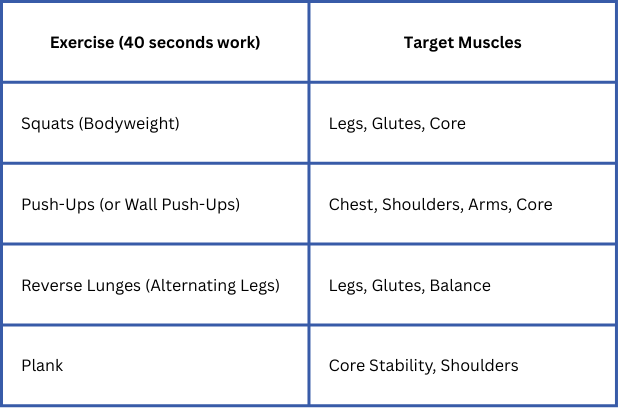
Total work time: 4 minutes per round x 2 rounds + 1 minute rest = 9 minutes.
Phase 3: The 3-Minute Cool-Down (Essential Recovery)
Never skip the cool-down. This brings your heart rate down and helps stretch the muscles you just worked, which aids in recovery and prevents stiffness.
Action: 30 seconds stretching your hamstrings (touching toes), 30 seconds for your quadriceps (pulling heel toward buttock), 30 seconds holding a low lunge (for hip flexors), and 30 seconds shoulder/arm stretches.
The Power of Consistency
The difference between successful fitness goals and resolutions that fail isn't found in a massive one-time effort. It is found in consistent effort, day after day.
This December, when the weather is cold and the schedule is chaotic, stop thinking you need to find an hour for the gym. Look at your calendar and ask yourself, "Can I find 15 minutes today?" The answer is always yes. Start today and build a legacy of health that always shows up.

The Pre-Feast Power Workout: 30 Minutes to Boost Your Metabolism Before the Turkey
This Thanksgiving, wake up, get moving for 30 minutes, and enjoy the metabolic and mental boost it gives you.
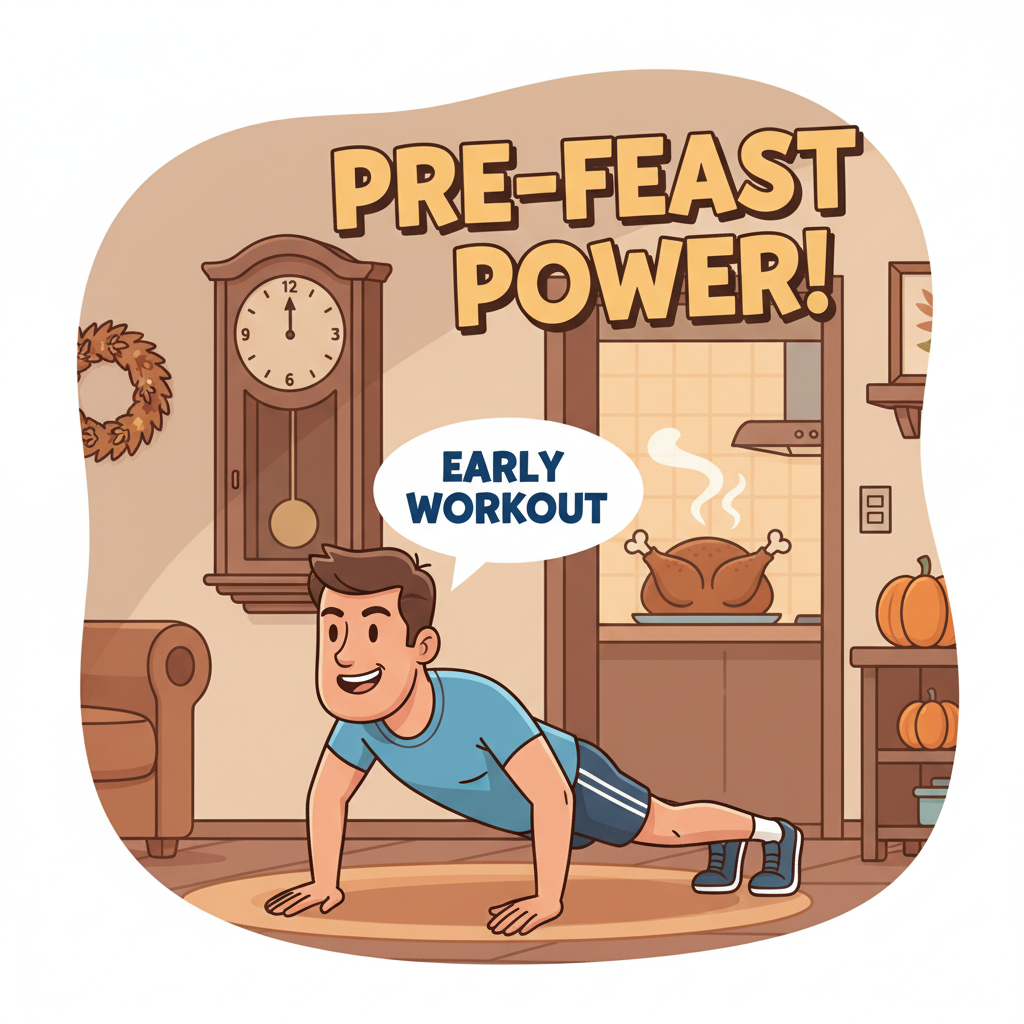
Thanksgiving morning is often a blur of preparing food, traveling, or just relaxing before the main event. But dedicating a quick 30-minute power workout before the feast is one of the smartest things you can do for your body, your mind, and your metabolism.
This isn't about "earning" your calories; it's about optimizing your body's resources. A morning workout improves your body's ability to handle the large influx of food, boosts your mood, and sets a positive, energized tone for the entire holiday.
Here is why a pre-feast workout is non-negotiable and a simple, highly effective routine you can do in 30 minutes, right at home.
The Metabolic Advantage (The Scientific Reason)
When you do a quick, challenging strength and conditioning circuit, you set up a metabolic advantage for the rest of the day:
Increases Insulin Sensitivity: Exercise immediately makes your muscles more receptive to glucose. This means that when the holiday starches hit your bloodstream later, your muscles are primed to absorb that glucose for energy and storage, rather than letting it linger in your blood or immediately storing it as fat. This is a huge win for managing the holiday meal.
The EPOC Effect (The Afterburn): A challenging workout creates an "afterburn" effect known as Excess Post-exercise Oxygen Consumption (EPOC). This keeps your metabolism elevated for hours after the workout is over, meaning you burn more calories at rest while you are sitting down enjoying your meal.
Appetite Regulation: Believe it or not, a burst of intense exercise can actually help regulate your appetite and prevent overeating, ensuring you stop when you are satisfied, not stuffed.
The 30-Minute Total Body Circuit (No Equipment Needed)
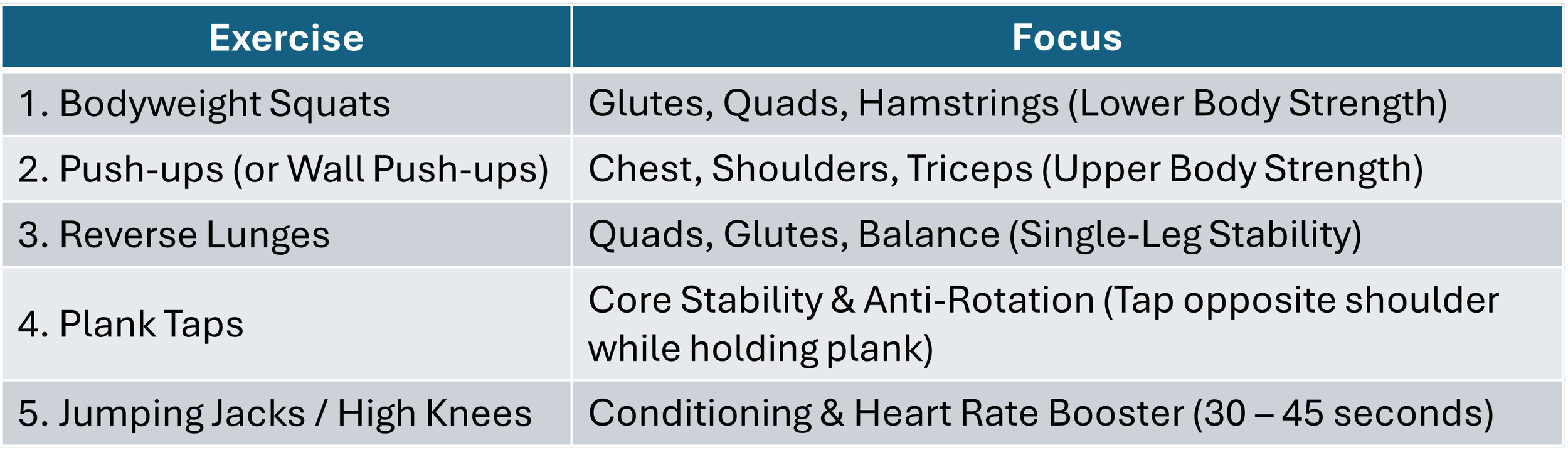
This circuit focuses on compound movements—exercises that use multiple large muscle groups—to maximize your metabolic engine in minimal time.
Instructions: Perform 10-12 repetitions of each exercise, moving directly from one to the next with minimal rest. Rest for 60 seconds after completing all five exercises. Complete the entire circuit 4 times for a killer 30-minute workout.
The Mental Advantage (The Mindset Reason)
Beyond the science, the greatest benefit is how a morning workout makes you feel.
Positive Momentum: Completing a tough workout before noon sets a powerful, proactive tone for the day. You start the holiday feeling accomplished and energetic.
Guilt-Free Enjoyment: Having maintained your commitment to fitness allows you to sit at the table with genuine, guilt-free pleasure. Your workout was a gift to yourself; the feast is a gift to enjoy with family.
This Thanksgiving, wake up, get moving for 30 minutes, and enjoy the metabolic and mental boost it gives you. You'll not only feel stronger when you sit down for the feast, but you'll feel better when you stand up afterward.