

Personalized Fitness Plans for Long-Term Weight Loss in 2026
Long-term weight loss, the kind that doesn't reverse the moment you stop paying close attention, comes from building a system that fits your life rather than a plan you temporarily tolerate.

This image was created using AI to avoid copyright issues while conveying the context of this article.
You've probably tried the plan that worked for your coworker. Or the one your college roommate swore by. Maybe you downloaded a popular app, followed the macros to the letter for three weeks, and got nowhere. You weren't doing it wrong. You were doing someone else's plan.
That's the central problem with weight loss in 2026: there's more information available than ever, and most of it isn't designed for you. Generic programs are built for averages. You are not average. You have a specific schedule, a specific stress load, a specific hormonal profile, and a specific history with food and training. When those factors go unaddressed, no plan survives contact with your actual life.
Why Generic Programs Keep Failing Busy Professionals
Most commercial fitness plans are built for someone with unlimited time, low stress, and a body that hasn't been through 20 years of desk work, travel, poor sleep, and the inevitable metabolic shifts that come with being in your 40s or early 50s. That's not a criticism of those programs. It's just math.
When you're a busy professional or entrepreneur, your training window might be 35 minutes on a good day. Your cortisol levels run high because deadlines are real. Your sleep is inconsistent because life is inconsistent. A plan that calls for six days a week of structured training and aggressive caloric restriction doesn't account for any of that. It sets you up to fail within two weeks, then blames your willpower.
The shift that changes everything is moving from compliance-based thinking to systems-based thinking. Instead of asking "can I stick to this plan," start asking "is this plan built for the conditions I actually live in."
What Personalization Actually Means
Personalization isn't picking your favorite exercises or swapping chicken for salmon. It means building a program around the variables that actually drive your results.
Start with your schedule. Not your ideal schedule; your real one. If you can reliably train three times per week for 40 minutes, that's your foundation. A good plan works within that window, not despite it. Consistency at 80 percent effort beats perfection at 20 percent adherence every single time.
Next, account for your recovery capacity. Stress from your job is physiological stress. Your body doesn't distinguish between a brutal board meeting and a hard conditioning session. Both draw from the same recovery pool. If your workload spikes for two weeks, your training load needs to flex. Rigid programs don't do that. Personalized ones do.
Your nutrition plan needs to reflect how you actually eat, not how a fitness influencer eats. If you travel four days a month, your calorie targets and food strategies need a travel protocol. If you skip breakfast because you're genuinely not hungry until noon, forcing an early meal because "breakfast is important" may work against your natural appetite cues. The goal is a structure you can maintain across seasons, not just a six-week sprint.
The Role of Tracking in 2026
Wearables have gotten remarkably accurate. Heart rate variability, sleep staging, resting heart rate trends, and even body temperature data now give coaches and clients a real-time window into recovery and readiness. In 2026, ignoring this data is like navigating without GPS when you have it in your pocket.
That said, tracking is a tool, not a verdict. Your HRV being low on a Monday doesn't mean you're broken. It means you adjust. You do the lighter session. You prioritize sleep. You hold the harder training day for Wednesday. Personalized programming uses this data to make smart pivots, not to create anxiety.
For weight loss specifically, tracking your actual food intake, even loosely, remains one of the highest-leverage habits you can build. You don't need obsessive precision. But knowing your rough calorie range and protein intake gives you data to work with when progress stalls, which it will at some point. When that happens, adjusting becomes a math problem, not a mystery.
Building a Plan That Lasts
Long-term weight loss, the kind that doesn't reverse the moment you stop paying close attention, comes from building a system that fits your life rather than a plan you temporarily tolerate.
That means your training format matches your energy patterns. Your nutrition strategy accounts for social meals, travel, and high-stress weeks. Your recovery protocols, whether that's sleep hygiene, active rest, or stress management, are built in, not treated as extras.
Progress checkpoints matter too. A personalized plan isn't static. It evolves as you do. What works in month one will need to shift in month four as your fitness improves, your body adapts, and your schedule changes. Building in regular reassessments, every four to six weeks is a solid rhythm, keeps the plan aligned with where you actually are.
The Coaching Advantage
You can build a decent personalized plan on your own if you're willing to learn the principles and honest about your data. Most people, though, benefit enormously from having an experienced set of eyes on their situation. A coach doesn't just write workouts. They help you see what you're too close to see yourself: the inconsistency pattern, the nutrition blind spot, the training load that's subtly too high for your current recovery capacity.
At Legacy Fitness, we build plans around your actual life, not a fictional version of it. Our clients are busy people who need a system that works when things get hard, not just when conditions are ideal. If that's the kind of structure you're looking for, we'd like to show you what that looks like for you specifically.

Habit Design vs. Willpower: How We Build Consistency
Use your data trends to identify where your daily consistency tends to fracture. Partner with a coach to build clear, repeatable guardrails around your nutrition, your sleep, and your movement.

This image was created using AI to avoid copyright issues while conveying the context of this article.
If you rely on willpower to stay fit, you are playing a losing game.
It is a common cycle for high performers. You start a new fitness push on Monday morning with massive motivation. You vow to hit the gym at 6pm every day and completely cut out processed foods. For the first two days, your mental focus is high, and you power through the sessions on pure discipline.
Then, Wednesday happens. A high-stakes corporate project hits a major roadblock. You spend eight hours making intense structural decisions, managing client panic, and sitting through grueling board updates. By the time you close your laptop at 5:30pm, you are mentally exhausted. Your brain feels completely drained.
When you look at your calendar and see a heavy lifting session scheduled, a voice in your head instantly starts making excuses. Within minutes, you are on your couch ordering takeout, feeling like a failure because your "discipline" cracked.
This breakdown has nothing to do with your character or your desire to be healthy. The truth is that willpower is a finite emotional resource. It operates exactly like a phone battery. Every decision you make, every email you draft, and every stressful situation you navigate drains that battery. By the time evening arrives, your mental energy is in the red.
If your health system requires you to make excellent choices when your decision-making battery is completely empty, it is fundamentally engineered to fail. True consistency isn't built on willpower; it is built on deliberate habit architecture.
The Power of Behavioral Systems
In your professional career, you do not run operations by crossing your fingers and hoping your team feels motivated every morning. You build systems. You create standard operating procedures that remove guesswork and automate repetitive workflows.
Your personal health requires the exact same structural approach. Habit design is the art of building behavioral systems that make success the path of least resistance. Instead of forcing yourself to make a difficult choice every single day, you design your daily workflow so that the optimal choice is already made for you.
When you shift from a willpower-based mindset to a design-based system, staying healthy stops feeling like an exhausting second job. It simply becomes an automated routine that happens in the background of your life.
The Mechanics of Environmental Architecture
Human behavior is heavily dictated by convenience. If a task requires a massive amount of mental friction or logistical coordination, you will eventually skip it when you are tired. To fix this, you must change your environment to remove friction from your target habits, while adding friction to your distractions.
At Legacy Fitness, we help you build this architecture directly into your daily routine using your mobile dashboard. We don't just give you a list of guidelines; we help you stack micro-habits right alongside behaviors you already perform automatically.
For example, instead of relying on willpower to remember your hydration targets during a back-to-back meeting day, we tie your water intake to your calendar. Every time you open a new corporate meeting link, you take three sips from an insulated bottle sitting directly next to your keyboard. You are stacking a new, healthy habit onto an old, established prompt. By removing the need to think about the behavior, the friction completely disappears.
Automating the Travel Contingency
Nowhere does the willpower trap manifest more clearly than during business travel. When you step off a long flight into a chaotic new environment, your routine is immediately compromised. If you have to design a new workout on the spot using a subpar hotel fitness center, the mental effort required is too high. You will choose the hotel bar every single time.
A design-based approach removes the cognitive strain. Before you ever board the plane, your coach proactively uploads an alternate, minimal-equipment travel track directly into your profile. When you wake up, you do not have to deliberate, think, or plan. You simply open your dashboard, see the short, time-boxed sequence built for your specific hotel room or park space, and execute. You are running a pre-loaded script, completely bypassing the need for willpower.
Designing Your Success
Stop beating yourself up for a lack of discipline. The highest-performing executives who maintain lean, strong, and capable bodies into their 50s and 60s do not possess a magical reserve of willpower. They have simply spent time building better systems.
Use your data trends to identify where your daily consistency tends to fracture. Partner with a coach to build clear, repeatable guardrails around your nutrition, your sleep, and your movement. When you stop fighting your biology and start designing your environment, physical transformation becomes an inevitable byproduct of your daily life.

Professionalism in Fitness: Treating Your Health Like Your Career
Treat your coach like a consultant. Treat your workouts like a standing meeting with a VIP client. Treat your nutrition like a high-budget project that requires precision.

This image was created with AI to avoid copyright issues while conveying the context of this article.
If you missed a high-stakes board meeting because you "didn't feel motivated," your career would suffer. If you consistently failed to track your department's budget because it was "too much work," you would be replaced. In the professional world, we understand that results are driven by systems, standards, and a commitment to showing up—regardless of how we feel.
Yet, many of the same high-performers who are elite in the office treat their health like an optional hobby. They rely on "inspiration" to get to the gym. They "wing it" with their nutrition. They treat their physical body, the very vehicle that allows them to lead, as a secondary priority.
To reach the next level of your transformation, you have to bridge the gap. It is time to apply the same level of professionalism to your fitness that you apply to your career.
The Standard of "Non-Negotiables"
In your professional life, you have a set of standards. You answer certain emails within 24 hours. You show up for meetings five minutes early. You hit your deadlines. These are your non-negotiables.
In fitness, most people have "negotiable" goals. They hope to work out. They try to eat protein. The moment a work project gets difficult, these goals are the first thing to be sacrificed.
A professional approach means setting a floor, not just a ceiling. Your "floor" is the minimum amount of work you do even on your busiest day. Whether it’s a 15-minute mobility session or hitting a specific protein target, these are the appointments with yourself that you simply do not cancel.
Data and Reporting: Your Personal KPI
Imagine trying to run a company without looking at a profit and loss statement. You would be flying blind.
Your workout and nutrition logs are the "Key Performance Indicators" (KPIs) of your health. When you skip logging, you are failing to report on the most important asset you own. Professionalism in fitness means:
Accurate Tracking: Not "guessing" your intake, but measuring it.
Regular Audits: Using your weekly check-in to review what worked and what didn't.
Objective Analysis: Looking at a "bad" day as a data point to be corrected, not a moral failure.
Managing the "Physical Business"
Every CEO knows that you have to invest in your infrastructure to prevent a collapse. Your heart, your lungs, your muscles, and your brain are your infrastructure.
When you prioritize sleep, hydration, and resistance training, you aren't "taking time away" from work. You are performing essential maintenance. A leader who is well-rested and physically strong makes better decisions, has higher emotional intelligence, and possesses the stamina to outlast the competition.
The Executive Summary
Stop waiting for a "fitness spark." You don't need a spark; you need a schedule.
Treat your coach like a consultant. Treat your workouts like a standing meeting with a VIP client. Treat your nutrition like a high-budget project that requires precision. When you bring the same level of professionalism to the gym that you bring to the office, the results aren't just better, they are inevitable.

The 10-Minute Rule: What to Do When You Have Zero Motivation
When motivation fails, most people simply stay on the couch. If you want to build a legacy of health, you need a strategy that works even when your mood doesn't.

This image was created using AI to avoid copyright issues while conveying the context of this article.
We have all had those days. The alarm goes off, but your body feels like lead. Or you finish a long day at the office, and the very thought of driving to the gym feels like a physical burden. You search for that spark of motivation you had on March 1st, but it is nowhere to be found.
When motivation fails, most people simply stay on the couch. They tell themselves they will "wait until they feel like it" to train. But as we’ve discussed this month, feelings are unreliable. If you want to build a legacy of health, you need a strategy that works even when your mood doesn't.
This is where the 10-Minute Rule comes in. It is the ultimate "emergency brake" for your fitness goals.
The Psychology of the Starting Line
The hardest part of any workout isn't the heavy lifting or the final mile of a run. The hardest part is the first ten minutes.
Our brains are wired for comfort. When you think about a 60-minute workout, your brain sees a huge, painful task. It tries to protect you by making you feel tired or distracted. But your brain has a weakness: it is much easier to negotiate with a small task than a large one.
How the 10-Minute Rule Works
The rule is simple: Tell yourself you only have to do ten minutes.
Put on your gym clothes, drive to the gym, and start your warm-up. Tell yourself that if, after ten minutes of movement, you still feel exhausted and want to quit, you have 100% permission to stop and go home. No guilt. No shame. You showed up and did ten minutes.
Here is what almost always happens:
The Blood Flow Effect: Once you start moving, your heart rate increases and oxygen begins to reach your brain and muscles. This naturally wakes you up.
The Momentum Shift: By the time the ten minutes are up, the "mountain" of the workout feels like a "hill." You’ve already done the hardest part (starting), so you might as well finish.
The Identity Win: Even if you do decide to go home after ten minutes, you still win. You proved to yourself that you are the kind of person who honors their commitments, even when it’s hard.
A Strategy for "Low-Power" Days
Some days, you really are physically drained. Maybe you didn't sleep well or your stress is at a 10/10. On those days, the 10-Minute Rule allows you to "check the box" without burning out.
Instead of a heavy lifting session, use your ten minutes for:
Mobility and stretching.
A brisk walk on the treadmill.
A bodyweight circuit in your living room.
As your coach, I would much rather see a "low-power" ten-minute session in your log than a blank space. It keeps the habit alive and ensures that the next day, when your energy is back, you don't have to fight the "Snowball Effect" to get started again.
Finish March Strong
We are entering the final stretch of the month. The "New Year" energy is a distant memory. This is where the 10-Minute Rule becomes your best friend.
Next time you feel like skipping, don't argue with your brain. Just give me ten minutes. You’ll be surprised at how often that small start leads to your best finish.

The Snowball Effect: How One Missed Workout Leads to a "Lost" Week
A legacy isn't built on a series of perfect weeks. It is built on the ability to get back on the horse after a fall.

This image was created using AI to avoid copyright issues while conveying the context of this article.
It starts with a simple excuse. You have a late meeting, you’re feeling a bit tired, or the weather is gloomy. You tell yourself, "I’ll just skip today and make it up tomorrow." But tomorrow comes, and you feel a strange sense of "heavy" momentum. Because you missed yesterday, the "streak" is broken. Suddenly, it feels easier to skip Tuesday, too. By Wednesday, you feel like the whole week is a wash, so you decide to "just start fresh on Monday."
This is the Snowball Effect. In the world of fitness, momentum is your most valuable asset. When you have it, everything feels easy. When you lose it, even the smallest task feels like climbing a mountain. In March, we want to learn how to stop the snowball before it turns into an avalanche.
The Psychology of the "Broken Streak"
There is a psychological phenomenon called the "What the Heck" effect. It happens when we perceive that we have failed a goal, so we decide to fail "all the way."
If you miss one workout, your brain tells you that your "perfect" week is ruined. Since it’s no longer perfect, your brain decides there is no point in trying at all. You stop logging your food, you stay up late, and you stop drinking your water. You aren't just missing a gym session; you are abandoning your identity as a fit person for seven days.
How to Stop the Snowball
If you want to reach your long-term goals, you have to get comfortable with being "imperfect." Here are three strategies to stop a single miss from ruining your entire week.
The "Never Miss Twice" Rule
This is the golden rule of consistency. Life happens. You will miss a workout eventually. But the goal is to never let one miss turn into two. One miss is an accident; two misses is the start of a new habit. If you miss Monday, your only job on Tuesday is to show up, even if it’s just for twenty minutes.
The "Short-Session" Pivot
Most people skip their workout because they think, "If I can't do the full hour, it isn't worth it." This is a lie. If you are short on time or energy, don't skip, pivot. Do ten minutes of bodyweight movements in your living room. Go for a 15-minute brisk walk. By doing something, you keep the "neural pathway" of exercise alive. You are telling your brain: "I am still the kind of person who moves every day."
Separate Your Habits
Just because you missed a workout doesn't mean you have to miss your nutrition goals. Your gym sessions and your kitchen habits are two separate departments in the business of your health. If the "Gym Department" is closed for the day, make sure the "Nutrition Department" is working overtime.
Log your food, hit your protein, and drink your water. When you stay on track with your food, you feel better, which makes it much easier to get back to the gym the following day.
Building a "Resilient" Legacy
A legacy isn't built on a series of perfect weeks. It is built on the ability to get back on the horse after a fall.
In March, expect that things won't always go according to plan. But instead of letting a missed workout snowball into a lost week, draw a line in the sand. Every "next decision" is a chance to restart. Don't wait for Monday. The best time to stop the snowball is right now.

The Mid-Month Slump: How to Refresh Your Motivation When the "New Year" Feeling Is Gone
Don't panic about the slump. Expect it. Acknowledge it. And then, use your systems to walk right through it.

This image was created using AI to avoid copyright issues while conveying the context of this article.
It is officially the middle of March. If you made it this far with your new fitness routine, congratulations. You are ahead of about 80% of the population.
But let's be honest: the "New Year, New Me" energy from January is gone. The excitement of starting a new program in February has faded. Now, you are just in the "grind." The workouts feel a little heavier. The meal prep feels like a little more work. The initial "quick wins" on the scale might be slowing down.
This is the Mid-Month Slump. It is the danger zone where many people start to skip a workout here, or "forget" to log a meal there, until the whole program quietly fades away.
In March, we built a "Bridge of Consistency." Now, we need to make sure you have the mental power to cross it. Here is how to refresh your motivation when the hype is gone and the real work begins.
1. Shift from "Motivation" to "Identity"
Motivation is a feeling. It comes and goes like the weather. If you only exercise when you feel like it, you will never be consistent.
To beat the slump, you have to stop relying on motivation and start relying on identity. You have to stop asking, "Do I want to go to the gym?" and start stating, "I am a person who goes to the gym." When your fitness is part of who you are, just like brushing your teeth or showing up for your job, you don't need a blast of motivation to do it. You just do it because it is on your "Must-List" for the day.
2. Reconnect with Your "Deep Why"
Take a look back at your goals from January. Many people write things like, "I want to lose 20 pounds."
That is a "shallow why." It isn't strong enough to pull you out of bed on a Tuesday when you are tired. To refresh your dedication, you need to find your "deep why."
Why do you want to lose 20 pounds? So I can fit into my clothes again.
Why do you want to fit into your clothes again? So I can feel confident when I make presentations at work.
Why do you want to feel confident at work? So I can get that promotion and build a better future for my kids.
Now that is a why that can beat the slump. When you connect your daily workout to the future you are trying to build, it stops feeling like a chore and starts feeling like an investment.
3. Set a "Micro-Challenge" for this Week
Sometimes, you are in a slump because the long-term goal feels too far away. Your body transformation is a marathon. To keep your head in the game, you need to set up a few "sprints."
Set a micro-challenge just for this week. Pick something you have total control over:
The Logging Sprint: I will log 100% of my meals, including snacks, for seven days straight.
The Protein Peak: I will hit my exact protein target, every day.
The Step Sprint: I will hit 12,000 steps every day this week, no matter what.
By setting a small, seven-day goal, you can get a quick win that reminds you of what you are capable of. It gives you a blast of accomplishment that can carry you through the rest of the month.
Discipline Starts When Motivation Ends
In March, the hype is gone, and that is a good thing. The hype was a temporary engine. Now, you are fueled by something stronger: your discipline, your identity, and your "deep why."
Don't panic about the slump. Expect it. Acknowledge it. And then, use your systems to walk right through it. You are building something that lasts, and the work you do now is what matters the most.

Weekend Warrior or Weekend Worrier? How to Stay Consistent on Saturdays and Sundays
Don't let the weekend be the "weak" end of your journey.

This image was created using AI to avoid copyright issues while conveying the context of this article.
We have all seen the pattern. From Monday to Friday, you are a machine. You prep your meals, you hit your workouts, and you log every single gram of protein. But then, Friday at 5:00 PM hits. Suddenly, the "rules" disappear. By the time Monday morning rolls around, you feel bloated, tired, and discouraged because you spent 48 hours undoing five days of hard work.
This is the "Weekend Warrior" trap. Many people view the weekend as a total escape from their health goals. But your body doesn't know it’s Saturday. Your metabolism doesn't take a vacation, and your muscles still need fuel.
Staying consistent on the weekend doesn't mean you can’t have fun. It just means you need a plan so you don't become a "Weekend Worrier," someone who spends their Sunday night stressed out about the damage they did.
The "All-or-Nothing" Mistake
The biggest reason weekends fail is the "All-or-Nothing" mindset. People think that if they can’t eat a perfect salad and spend 90 minutes in the gym, the whole day is a wash. They eat one slice of pizza, decide the day is "ruined," and proceed to eat everything else in the pantry.
In March, we are working on building a "Bridge of Consistency." That bridge has to stretch across Saturday and Sunday, too. Instead of trying to be perfect, we aim to be purposeful.
Three Strategies for Weekend Success
The "One-Daily-Win" Rule
On the weekends, your schedule is usually different. Instead of a full routine, pick one non-negotiable win. Maybe it is hitting your protein goal, even if you go out to dinner. Maybe it is getting a 30-minute walk in before the family activities start. By securing one win early, you keep your "fitness identity" alive. You remind yourself: "I am still a person who cares about my health, even on a Saturday."
The "Social Buffer" Plan
If you know you are going out for a big dinner or drinks on Saturday night, plan for it. Eat a high-protein, low-calorie breakfast and lunch. This creates a "buffer." You are "saving" your calories for the social event so you can enjoy yourself without going over your daily limit.
Also, follow the One-to-One Rule: For every alcoholic drink or soda you have, drink one full glass of water. This keeps you hydrated and slows down your pace, helping you make better decisions.
Move Your "Check-In" Energy to Sunday
Most people treat Sunday as a "lazy day." Instead, use Sunday afternoon as your "Launchpad." This is the perfect time to do your weekly check-in for coaching (depending on when you and your coach agree for check-ins). By reviewing your data on Sunday, you refocus your brain on your goals. You can see where you succeeded during the week and prepare your grocery list for the coming days.
The 80/20 Reality
You don't have to be 100% perfect to see results. If you are 90% consistent from Monday to Friday, but only 20% consistent on the weekend, you are actually only about 70% consistent overall. For many people, that isn't enough to see the fat loss they want.
However, if you can stay 80% consistent on the weekend, meaning you still move a bit, you still prioritize protein, and you still log your food, your overall average stays high. That is how you win.
March Momentum
Don't let the weekend be the "weak" end of your journey. Use these two days to prove to yourself that your new habits are part of who you are, not just something you do when you're at work. When you wake up on Monday morning feeling energized instead of guilty, you’ll know you’ve built a bridge that can hold its weight.

The Bridge from February: How to Turn Last Month’s "Tries" into This Month’s "Musts"
We made it to March. For many people, this is the month where the "New Year" excitement finally starts to fade.

We made it to March. For many people, this is the month where the "New Year" excitement finally starts to fade. In January, everyone is motivated. In February, most people try their best to keep up. But March is often where the wheels fall off. The weather might still be cold, the initial "spark" is gone, and life starts to get in the way.
However, at Legacy Fitness, we look at March differently. March is not the end of a resolution; it is the "bridge" month. It is the time when we move from "trying" to "doing." It is the month where we take the habits we practiced in February and turn them into non-negotiable parts of who we are.
If you want to make sure your progress doesn’t stall, you need to change your mindset. You have to stop treating your fitness like a temporary project and start treating it like a professional commitment.
The Problem with "Trying"
Think about the language we use. When we say, "I’m trying to get to the gym," we are giving ourselves an out. We are saying that if something else comes up, it is okay to skip. "Trying" is based on how we feel in the moment.
"Musts," on the other hand, are based on your identity. You don’t "try" to brush your teeth in the morning; you just do it because that is who you are. You don't "try" to show up for your job; you go because it is a requirement. To see real, lasting change in your body and your energy levels, your fitness habits need to move into that "must" category.
Building the Bridge: Three Steps to Consistency
How do we actually make that jump? It comes down to three specific strategies to bridge the gap between February and the rest of your year.
Review Your February Wins (And Your Misses)
You cannot improve what you do not measure. Take a look back at your logs from last month. Which workouts did you enjoy the most? Which days were the hardest to stay on track?
Don't judge yourself for the days you missed. Instead, look at them like a scientist. If you missed every Tuesday workout, maybe Tuesday isn't the right day for the gym. If you ate great until 3:00 PM and then crashed, maybe your lunch wasn't big enough. Use that data to build a better plan for March.The "Non-Negotiable" List
In March, I want you to pick three things that are "musts." These should be simple enough that you can do them even on your worst day. For example:
► I will hit my protein goal every single day.
► I will walk for 20 minutes, no matter what.
► I will log every meal in my tracker.
When these become "musts," you stop debating with yourself. You don't ask, "Should I log this?" You just do it because it’s on the list.Focus on the "Next Best Decision"
A lot of people quit in March because they have one "bad" day and feel like they ruined everything. They think the bridge is broken.
The bridge isn't broken; you just took a step back. Your only job is to make the "next best decision." If you ate a doughnut at the office, the next best decision is a high-protein lunch, not giving up on the whole day. Discipline is simply the act of stacking good decisions on top of each other, one at a time.
Why March Matters for Your Future Self
The habits you solidify this month are the ones that will carry you into the summer and beyond. If you can stay disciplined when the "newness" has worn off, you are building a version of yourself that is resilient and strong.
You aren't just working for the body you want in April; you are building the health you need for the next twenty years. Let’s stop "trying" to be fit and start being the person who never misses a "must."

Consistency Over Intensity: Why the "B Grade" Workout Wins
At Legacy Fitness, we aren't looking for a six-week transformation. We are looking for a sixty-year legacy.

This image was created using AI to avoid copyright issues while conveying the context of this article.
In the world of fitness, we are often sold the image of the "perfect" workout. We see videos of people drenched in sweat, pushing their absolute limits, and collapsing on the floor after an hour of high-intensity training. While that kind of intensity has its place, it is actually the biggest reason people quit in February.
When you believe that a workout only "counts" if it is a 10 out of 10 in intensity, you set yourself up for failure. Life is messy. Some days you are tired, some days the kids are sick, and some days work runs late. If your only option is "perfect intensity" or "nothing," you will eventually choose nothing.
At Legacy Fitness, we advocate for a different path: The "B Grade" Workout.
The Math of the Long Game
Let’s look at the math. If you do a "perfect" 10/10 workout once a week because that is all the energy you have, but you skip the other six days, your total volume is low.
However, if you do a "B Grade" workout—maybe a 6/10 or 7/10 effort—four or five times a week, you win. Consistency creates a compounding effect. Just like saving money, it isn't the one big deposit that builds wealth; it is the small, frequent deposits made over decades. In fitness, a 20-minute walk on a day you "don't feel like it" is worth more than a 90-minute gym session once a month.
The "All-or-Nothing" Trap
The "All-or-Nothing" mindset is a psychological trap. In January, your motivation is high enough to climb over that wall. But by February 6th, that motivation starts to dip. If you feel like you can't give 100%, you might feel like there is no point in trying at all.
This is where the "Consistency" mindset saves you. Your goal shouldn't be to have the best workout ever; your goal should be to not break the chain. If you planned to lift weights for an hour but only have twenty minutes, do ten minutes of squats and push-ups. You kept the habit alive. You proved to your brain that you are the kind of person who shows up, regardless of the circumstances.
Intensity is the Topping, Consistency is the Cake
Think of your fitness journey like a cake. Consistency is the actual cake: the foundation, the substance, and the part that actually feeds you. Intensity is the frosting. Frosting is great, and it makes the cake better, but you cannot have a meal made of only frosting. You will get sick and burn out.
If you focus on showing up consistently, your "base level" of fitness rises. Eventually, your "easy" days will be more productive than your "hard" days used to be. But this only happens if you stay in the game long enough to see the results.
How to Practice Consistency This Week
Lower the Bar: If you are feeling overwhelmed, give yourself permission to do a "half-workout." Just get to the gym or put on your shoes. Usually, once you start, you’ll do more than you planned.
Focus on the "Show Up" Goal: Make your goal for the week "I will move for 20 minutes every day," rather than "I will burn 500 calories."
Celebrate the "B Grade": Be proud of the days you worked out even when you were tired. Those are the workouts that actually build your character and your legacy.
Maintaining the Momentum
We’ve spent the last few days talking about NEAT and the P:F Ratio. These are tools designed to help you stay consistent. NEAT keeps you moving without the stress of a "workout," and the 4:1 P:F ratio keeps your energy stable so you don't feel too exhausted to train.
When you combine smart nutrition with the habit of simply showing up, you become unstoppable. You stop being a "seasonal" athlete and start becoming a "lifetime" athlete.
The Legacy View
At Legacy Fitness, we aren't looking for a six-week transformation. We are looking for a sixty-year legacy. That legacy is built on the days when you did a "mediocre" workout instead of sitting on the couch. It is built on the walks you took when it was cold outside.
This February, stop chasing perfection. Chase the streak. Stay consistent, stay moving, and let the intensity take care of itself when the time is right.

Micro-Workouts: How 10 Minutes Saves Your Day
If your plan requires 60 perfect minutes to be successful, your plan is fragile. The secret to January success isn't intensity; it's consistency.

This image was created using AI to avoid copyright issues while still conveying the context of this article.
One of the biggest lies we tell ourselves is: "If I don't have an hour to work out, it isn't worth doing." This "all or nothing" mindset is the reason most people quit their fitness journey by February. Life happens. Meetings run late, kids get sick, and traffic jams occur.
If your plan requires 60 perfect minutes to be successful, your plan is fragile. To build a lasting legacy, your fitness needs to be "anti-fragile." It needs to work even when your day is falling apart. Enter the Micro-Workout.
What is a Micro-Workout?
A micro-workout is a short burst of physical activity, usually lasting between 5 and 10 minutes. It is not meant to replace your long gym sessions entirely, but it is meant to "save the day" when a full session isn't possible.
Think of it like a "fitness snack." While a full meal is better, a snack keeps you going until you can sit down for that meal. Recent studies show that these small "snacks" of exercise can improve your metabolism, lower your blood pressure, and—most importantly—keep your habit streak alive.
The Power of "Greasing the Groove"
In the fitness world, there is a concept called "Greasing the Groove." This means that doing a movement frequently makes your body more efficient at that movement.
If you do 10 push-ups every time you go to the kitchen to get water, you will have done 50-60 push-ups by the end of the day. You never got sweaty, and you never had to change your clothes, but you did more work than the person who planned to go to the gym for an hour but never made it out the door.
Three Ways to Use Micro-Workouts
The "Meeting Reset": After a long Zoom call, set a timer for 5 minutes. Do 2 minutes of bodyweight squats and 3 minutes of stretching. This clears the "stale" feeling in your legs and resets your brain.
The "Commercial Break": If you are watching TV in the evening, use the breaks to do a plank or some lunges.
The "Commuter Walk": Park at the very back of the parking lot or get off the bus one stop early. That 7-minute brisk walk counts as a micro-workout.
Why "Small" is Actually "Big"
The secret to January success isn't intensity; it's consistency. When you use micro-workouts, you stop being a person who "misses" workouts. Even on your busiest day, you can find 5 minutes.
By the end of the month, those 5-minute sessions add up to hours of extra movement. More importantly, they reinforce your identity as an active person. You are proving to yourself that your health is a priority, no matter what. Don't let the "perfect" hour get in the way of a "good" ten minutes.

The Power of Consistency: Turning Motivation into a Lifelong Habit
Motivation is like a lightning strike, powerful and exciting, but it rarely lasts. If you rely on motivation to stay fit, you're setting yourself up for a failure cycle.
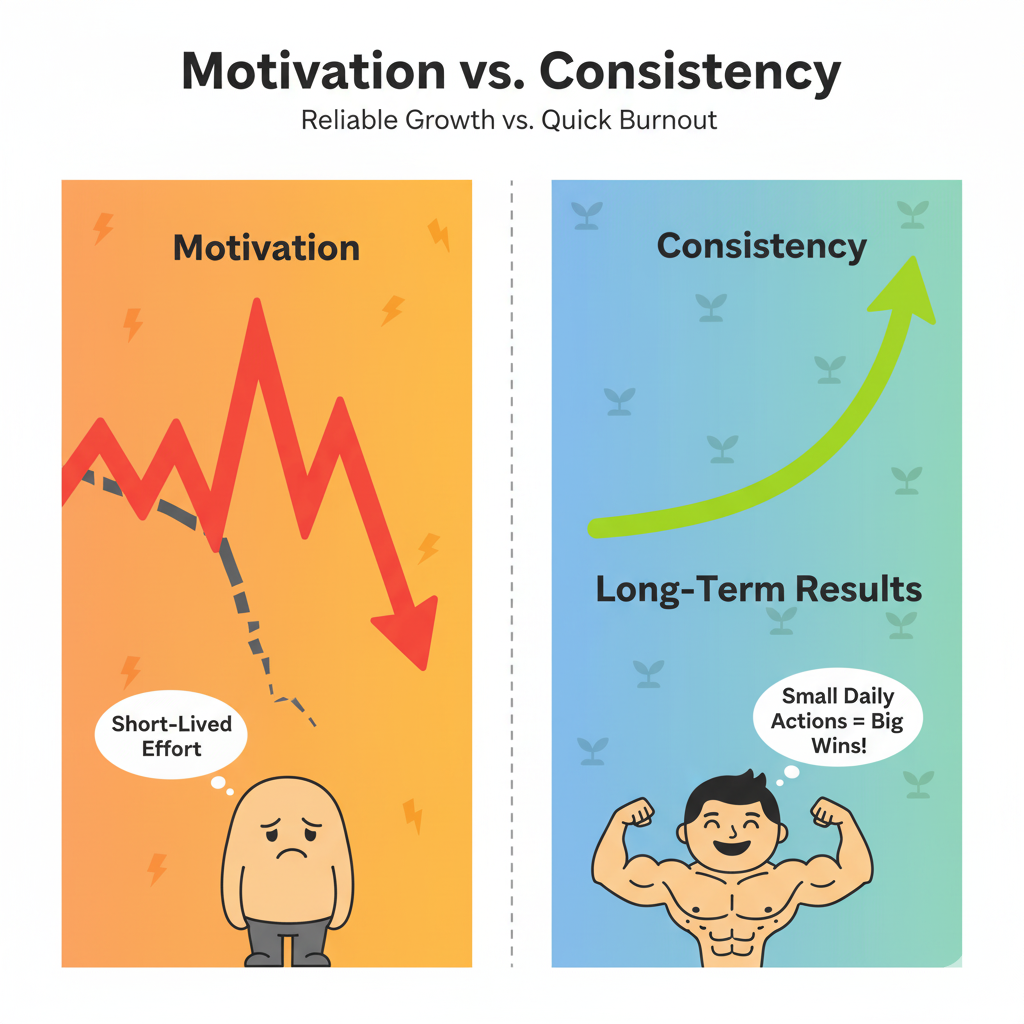
We've all been there: January 1st hits, you're bursting with motivation, you buy new gear, and you hit the gym hard for two weeks. Then, life gets in the way. Work piles up, you miss one day, and suddenly two months have gone by.
Motivation is like a lightning strike, powerful and exciting, but it rarely lasts. If you rely on motivation to stay fit, you're setting yourself up for a failure cycle. The secret to fitness that lasts, the kind that builds your legacy of health, isn't motivation. It's consistency.
Consistency is the quiet, reliable foundation that allows your effort to compound over time. Here is how to stop chasing motivation and start building the powerful habit of consistency.
1. Lower the Bar (The Five-Minute Rule)
The number one reason people break consistency is that their minimum expectation is too high. If you set a goal of "I must do an hour at the gym," and you only have 30 minutes, you often skip the workout entirely because you feel like you "failed."
The Habit Hack: Lower your minimum requirement until it's almost impossible to fail. Tell yourself, "I just need to put on my workout shoes," or "I just need to do 5 minutes of stretching."
Why it works: Showing up is the hardest part. Once you start that 5-minute task, you'll often find the motivation to continue for 20 or 30 minutes. If you still stop after 5 minutes, you still win because you maintained your habit streak. Consistency trumps intensity every time.
2. Use the 'Habit Stack' Principle
Consistency thrives on routine. You shouldn't try to cram a new workout habit into an already busy day; instead, you should attach it to an existing habit you already do automatically.
The Formula: [After I do X, I will do Y.]
Instead of: "I need to work out tonight."
Try: "After I finish brushing my teeth in the morning, I will do 10 bodyweight squats."
Why it works: Your brain uses less energy when a habit is linked to a strong cue. The automatic action (X) cues the desired action (Y), making it feel less like a choice and more like the next logical step.
3. Stop Seeking Perfection
Perfection is the enemy of consistency. If you believe your diet needs to be 100% clean every day, one cookie can make you feel like the whole day is ruined, leading to a downward spiral. The same goes for the gym: if you miss one day, don't let that one miss turn into a week of misses.
The Strategy: The 80/20 Rule: Aim for consistency 80% of the time, and give yourself grace for the other 20%. If you miss a workout, don't punish yourself. Just make sure you do the 5-minute minimum tomorrow.
Focus on the Streak: Track your consistency on a calendar. Your goal is to maintain the streak. If you have to break it, keep the break short. Never miss twice in a row.
4. Connect to Your 'Why' (The Legacy)
Motivation focuses on the immediate reward ("I want to look good for vacation"). Consistency focuses on the long-term identity ("I am the type of person who stays healthy and strong").
The Shift: When you feel unmotivated, don't ask yourself, "Do I feel like working out?" Ask yourself, "What kind of person do I want to be in 10 years?"
The Legacy: Your actions today are building your health legacy. Every time you show up (even for 5 minutes), you are reinforcing your identity as a dedicated, strong, and healthy individual. That powerful, future-focused reason is far stronger than any fleeting burst of motivation.
Consistency is the ultimate compounding factor in fitness. Small, repeatable actions, performed reliably over a long period, generate massive results that motivation alone can never achieve. Commit to showing up every day, and your lifelong results will take care of themselves.