
The Myth of "Busy": How the World’s Most Successful People Find Time for Fitness
"I don't have time" is just code for "It isn't a priority."
This image was created using AI to avoid copyright issues while conveying the context of this article.
In my years practicing and teaching martial arts, and now as a fitness coach, I have heard every excuse in the book. But there is one that stands above the rest: 'I’m just too busy right now.
It’s a phrase used by CEOs, founders, and executives alike. And while it feels like a valid reason, it is almost always a myth. We all have the same 168 hours in a week. The difference between those who stay fit and those who "stall out" isn't the number of meetings on their calendar; it’s how they view their time.
If you have time to check your email 50 times a day, scroll through social media, or watch a Netflix series, you aren't "too busy." You are simply prioritizing other things over your health. Here is how the world’s highest performers find the time to train, and why you can, too.
1. They Stop "Finding" Time and Start "Scheduling" It
You don't "find" time for a board meeting or a doctor's appointment; you schedule it. Successful people treat their health with the same level of respect. They don't wait for a gap in their day to see if they can fit in a workout. They put it on the calendar as a non-negotiable event.
If it’s on the calendar, it’s real. If it’s just a "hope," it’s a hobby.
2. The "Minimum Effective Dose" Strategy
The "too busy" myth is often fueled by the belief that a workout has to be 90 minutes of grueling effort to count. High-performers understand the principle of the Minimum Effective Dose.
If you have an hour, take the hour. But if you only have 20 minutes between calls, a focused, high-intensity circuit is infinitely better than doing nothing. They don't let the "perfect" workout get in the way of the "possible" one.
3. Decision Stacking
The most efficient leaders look for ways to stack their habits. Need to have a one-on-one with a direct report? Make it a walking meeting. Have to catch up on an industry podcast? Do it while you’re on the treadmill. By integrating movement into their existing workday, they eliminate the need to "carve out" extra time.
4. They View Fitness as a Productivity Tool
This is the most critical shift. Most people see exercise as something that takes energy. Successful people know that exercise generates energy.
Research shows that employees who exercise during the workday report better time management, increased mental sharpness, and higher resilience to stress. When you spend 45 minutes in the gym, you aren't "losing" 45 minutes of work; you are upgrading the quality of the other 10 hours you spend in the office.
The Executive Summary
"I don't have time" is just code for "It isn't a priority."
In March, as we focus on our "Must-Lists," I challenge you to look at your calendar with total honesty. Your body is the engine that drives your career, your family, and your legacy. You don't "owe" it to yourself to find time; you owe it to the people who depend on your leadership to make the time.
Stop being "busy" and start being effective.

Time-Saving Strength: Maximizing Muscle in 30 Minutes with Bilateral, Multi-Joint Movements
If you are a busy professional, you know that time is your most valuable resource. We often hear people say, "I wish I had an hour and a half to lift weights." But here’s the truth: you don't need it.

That’s me! 😁
If you are a busy professional, you know that time is your most valuable resource. We often hear people say, "I wish I had an hour and a half to lift weights." But here’s the truth: you don't need it. You can build significant muscle, boost your metabolism, and get stronger in just 30 minutes, as long as you use the right strategy.
The secret to powerful, time-saving strength training is focusing on bilateral, multi-joint movements (aka Compound Movements). If those terms sound complicated, don't worry—they simply mean choosing the most efficient exercises that work the largest amount of muscle mass at the same time. This strategy gives you the best return on your 30-minute investment.
What is a Bilateral, Multi-Joint Movement?
Let’s break down the jargon with two simple rules:
Multi-Joint: An exercise that causes movement at more than one joint. For example, a Squat involves your hip, knee, and ankle joints. A Bicep Curl only involves your elbow joint. Multi-joint movements engage more muscles and burn more calories.
Bilateral: An exercise that uses both sides of your body at the same time (both legs or both arms). This allows you to lift the most weight safely, creating a powerful signal to your body to build muscle.
By using these exercises, you stop wasting time isolating small muscles and start challenging your entire body efficiently.
The 30-Minute Power Plan: Your Core Exercises
You can build a full-body, high-impact strength workout using just four core movements. If you can perform these four exercises, you've hit every major muscle group in your body and laid a rock-solid foundation for ageless strength.
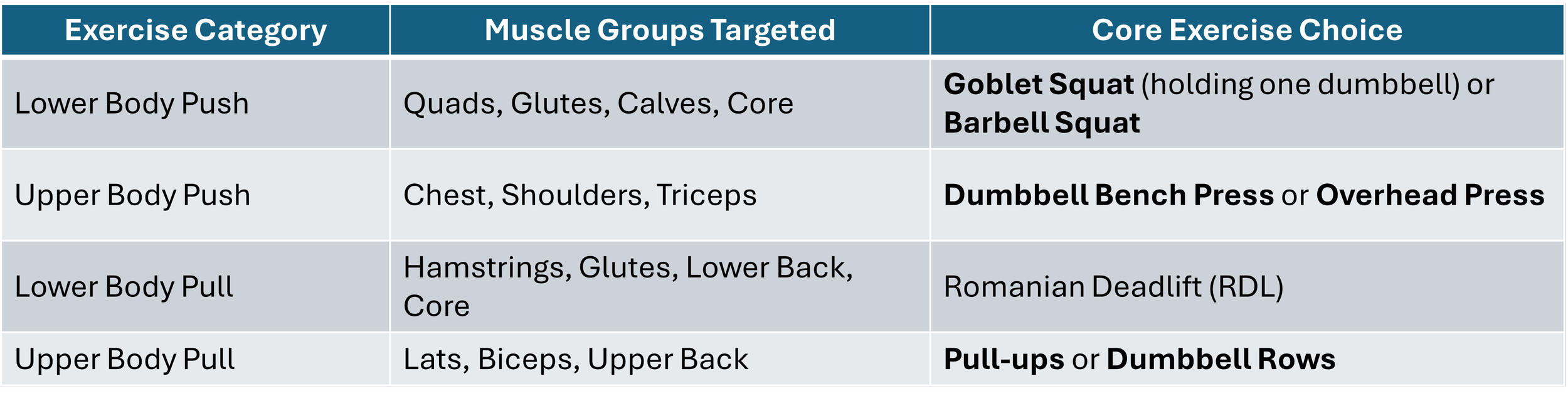
The 30-Minute Efficiency Method
To fit this into 30 minutes, you need to use a technique that keeps your rest periods short while still allowing you to lift heavy enough to be effective. We recommend Supersets and limiting your rest.
Warm-up (5 minutes): Light cardio (jogging, rowing) and dynamic stretching (arm circles, leg swings).
Workout (20 minutes): Complete all three supersets below. Perform the two exercises in a pair back-to-back (A1 and A2) with only 60 seconds of rest after A2.

Cool-down (5 minutes): Static stretching and foam rolling.
By using this 30-minute approach, you perform 12 powerful sets, a scientifically proven amount for muscle growth, using efficient movements that create total-body strength. This is not just a quick workout; it’s a smart, sustainable way to maintain a thriving fitness routine, no matter how busy your October schedule gets. Stop measuring your workout by the clock, and start measuring it by the intensity and the quality of your movements.

Back to the Grind: Easy Fitness Routines for Busy Parents
The school year is starting up again, and it's time to get back into a routine! If you're a parent, you know this is a busy time.

The school year is starting up again, and it's time to get back into a routine! If you're a parent, you know this is a busy time. Between packing lunches, school drop-offs, homework, and after-school activities, it can feel like there's no time left for you. But staying active is important for your health and for setting a good example for your kids.
Don't worry, you don't need a lot of time to get a good workout. The trick is to find short, easy routines that fit into your busy life and add up throughout the week.
Morning Power-Up (15-20 Minutes) Before the kids wake up, get in a quick workout that combines heart-pumping cardio and muscle-building strength training. This mix is great for your overall health. For this workout, you might want to use some dumbbells or a resistance band, which are inexpensive and don't take up much space.
Warm-up (2 minutes): Start with jumping jacks or a light jog in place to get your blood flowing.
Bodyweight Moves:
30 seconds of squats, then rest for 10 seconds.
30 seconds of push-ups (you can do these on your knees!), then rest for 10 seconds.
30 seconds of lunges, then rest for 10 seconds.
Resistance Moves: Now, grab your dumbbells or resistance band. Resistance training isn't just about big muscles—it's super important for making your bones stronger, too.
Bicep Curls: Stand with a dumbbell in each hand. Keep your elbows at your sides and lift the weights up to your shoulders. Do this for 30 seconds.
Overhead Press: Hold a dumbbell in each hand at your shoulders. Push the weights straight up overhead and then slowly lower them back down. Do this for 30 seconds.
Resistance Band Rows: Wrap a resistance band around a pole or door handle. Hold an end in each hand and pull the band back toward your chest, squeezing your shoulder blades together. Do this for 30 seconds.
Repeat: Go through all of the bodyweight and resistance moves again to complete your workout.
Lunch Break Lunge (10 Minutes) If your mornings are too hectic, a midday workout is a great choice. Take 10 minutes during your lunch break to take a brisk walk around your neighborhood or office park. A quick walk can help clear your head, reduce stress, and give you an energy boost for the rest of the day. If you have stairs nearby, walking up and down a few times is a great way to get your heart rate up even more.
Family Fun Fitness (20 Minutes) Make fitness a family activity! In the evenings, turn on some music and have a dance party in the living room. Or, head to a nearby park to play tag, ride bikes, or kick a soccer ball around. This is a great way to be active and spend quality time with your children. Not only will you be exercising, but you’ll also be creating fun, active memories with your family.
Putting It All Together: The 30-Minute Goal
The key to a successful routine is to be consistent, not perfect. Even a few minutes of exercise each day can make a big difference in how you feel. The good news is that all these activities count toward a big fitness goal. Health experts recommend that adults get at least 150 minutes of moderate cardio exercise per week, which comes out to about 30 minutes a day, five days a week.
The workouts above—like your morning routine, your quick walk, and your family fun time—can easily add up to meet this goal. So, don't feel like you have to find a single 30-minute block of time. Squeeze in 15 minutes here and 10 minutes there, and you'll be on your way to a healthier you. Start small, and you'll see big results.